Climate Resilience
Urban Wind Profiles
Doppler LiDAR observations to investigate wind profile patterns and urban morphological impacts
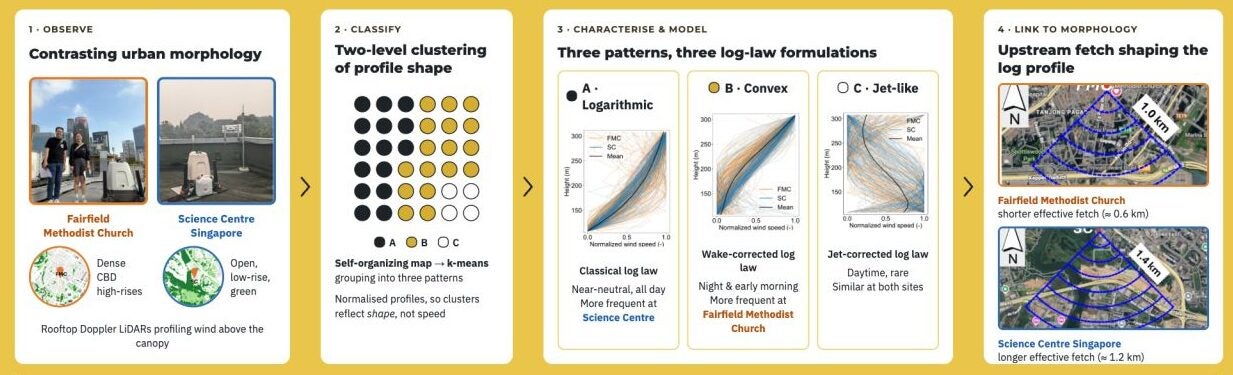
In this study, Doppler LiDAR measurements from two contrasting urban sites in Singapore are analysed to investigate wind profiles between approximately 108 and 308 m. The two sites have contrasting urban morphology: a high-density CBD site (Fairfield Methodist Church) and a low-density, green site in Jurong East (Science Centre Singapore). We applied a two-level self-organizing map + k-means framework to identify recurrent wind-profile patterns in the urban boundary layer. Using 4,412 synchronised 10-min profiles (0-300m) above ground, the framework separates profiles by shape and links each pattern to semi-empirical formulations, upstream morphology and momentum exchange.
The three patterns are represented using classical, wake-corrected, and jet-corrected logarithmic formulations. The logarithmic pattern occurs more frequently at the low-density site, whereas the convex pattern dominates at the high-density site and occurs preferentially at night and in the early morning. The less frequent S-shaped pattern exhibits a localized wind-speed maximum and occurs mainly during daytime. Fitted friction velocities suggest that the mechanical-shear contribution is strongest for the logarithmic pattern and weakest for the S-shaped pattern.
The influence of upstream urban morphology is examined using fan-shaped areas with different radii and opening angles. For the logarithmic pattern, representative upstream fetch radii are approximately 0.6 km at FMC and 1.2 km at SC, with a 90° opening angle at both sites. These findings provide observation-based guidance for specifying inflow profiles and selecting upstream areas in urban wind simulations, although their broader applicability requires validation beyond the month and wind-direction sector examined.
This work offers observation-based guidance for inflow specification and upstream domain selection in urban wind and CFD modelling.
This research is supported by the Urban Redevelopment Authority, Singapore (“the URA”), and Ministry of National Development (“the MND”), Singapore under the MND Research & Innovation Fund. Any opinions, findings and conclusions or recommendations expressed in this material are those of the author(s) and do not reflect the views of the URA and the MND.
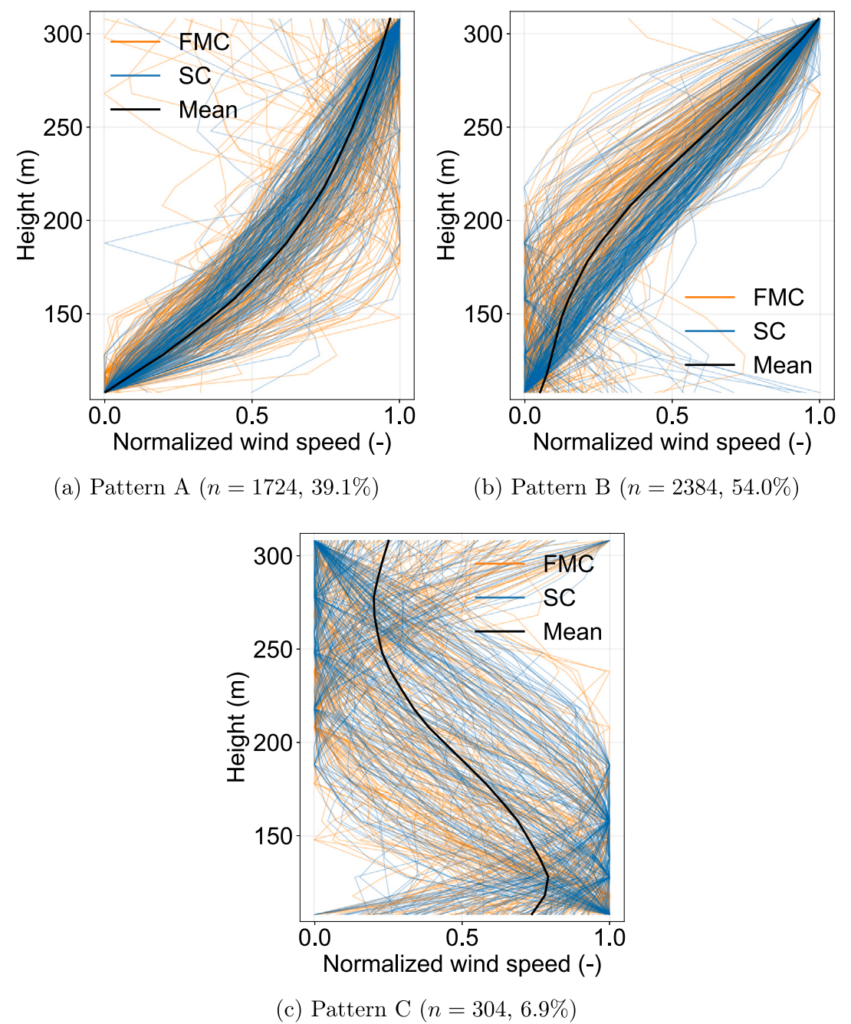
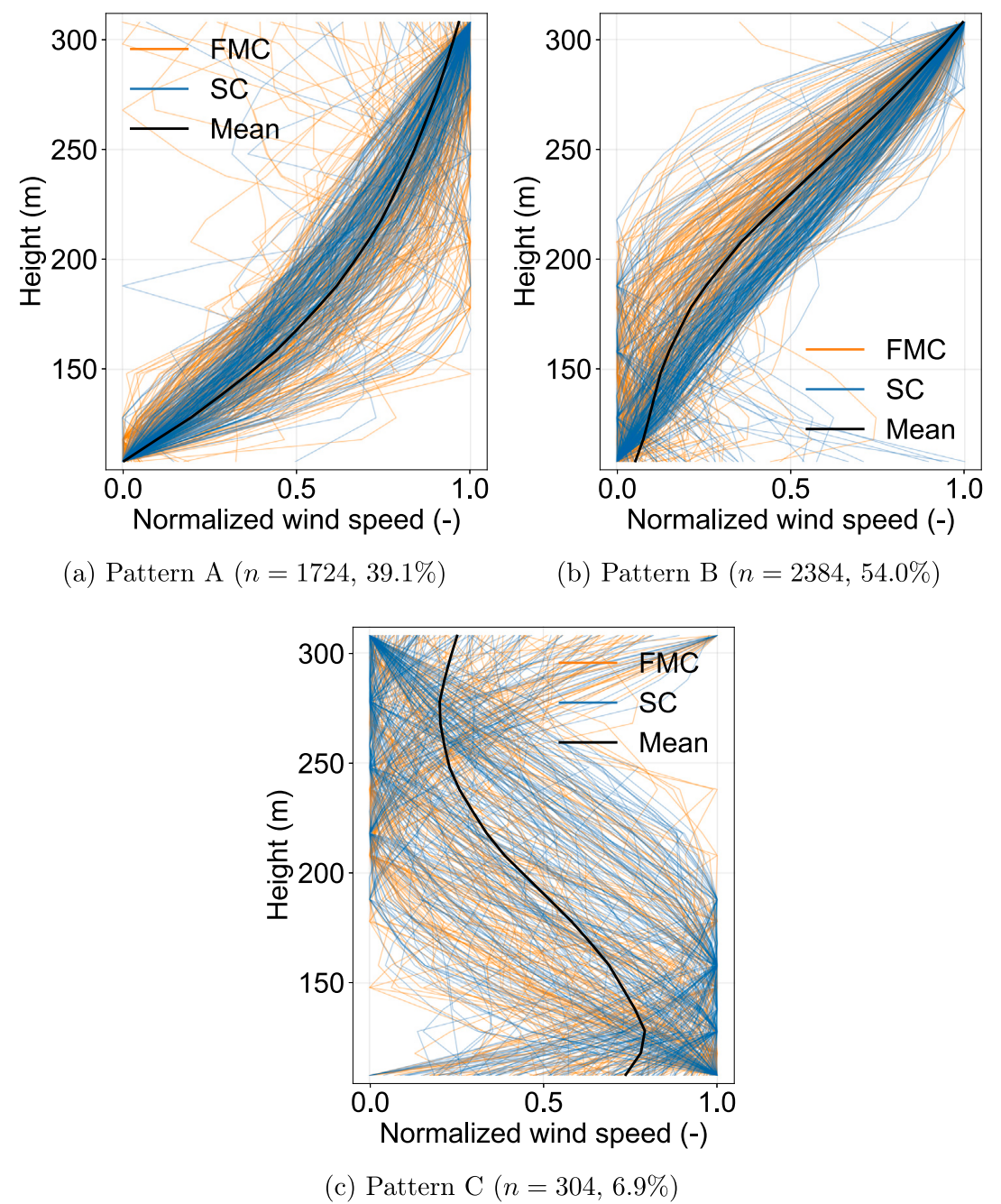
Figure. Normalized wind speed profiles for (a) logarithmic, (b) convex, and (c) S-shaped patterns at Fairfield Methodist Church and Science Centre Singapore. Coloured lines represent selected ten-minute profiles; black lines indicate the mean profile for each pattern. Reproduced from Fig. 7 of the article.
Key findings:
- Three recurrent regimes emerge: a classical logarithmic profile (39%), a convex profile that accelerates above ~150 m (54%), and a rarer jet-like S-shaped profile with a low-level wind maximum (7%);
- The log profile is more frequent at the low-density site and occurs throughout the day, whereas the convex profile dominates in the CBD at night and in the early morning; Each regime is captured by its own semi-empirical form: classical, wake-corrected and jet-corrected log laws;
- The effective upstream fetch shaping the log profile is ~0.6 km in the dense CBD versus ~1.2 km at the open site, and friction velocity decreases from the logarithmic to the jet-like regime.
Publications:
- Xing, J., Zhang, L., & Yuan, C. (2026). Doppler LiDAR observations of wind profiles in a tropical urban boundary layer: Pattern identification, semi-empirical formulations and morphological impacts. Urban Climate, 70, 103184. https://doi.org/10.1016/j.uclim.2026.103184