3D Lidar Collections
Research, Documentation, and Restoration of Singapore’s Built Heritage through 3D Modelling 2
By Abhimanyu Goel
Progress Report 2: Digital Restoration of NUS-Baba House with 3D Scanning and 3D Printing
Through the use of high resolution LIDAR scanning, a portion of an architectural facade ornamentation was processed in a 3D software and prepare it for 3D printing. However the first print was too faint, as seen in Progress Report 1.
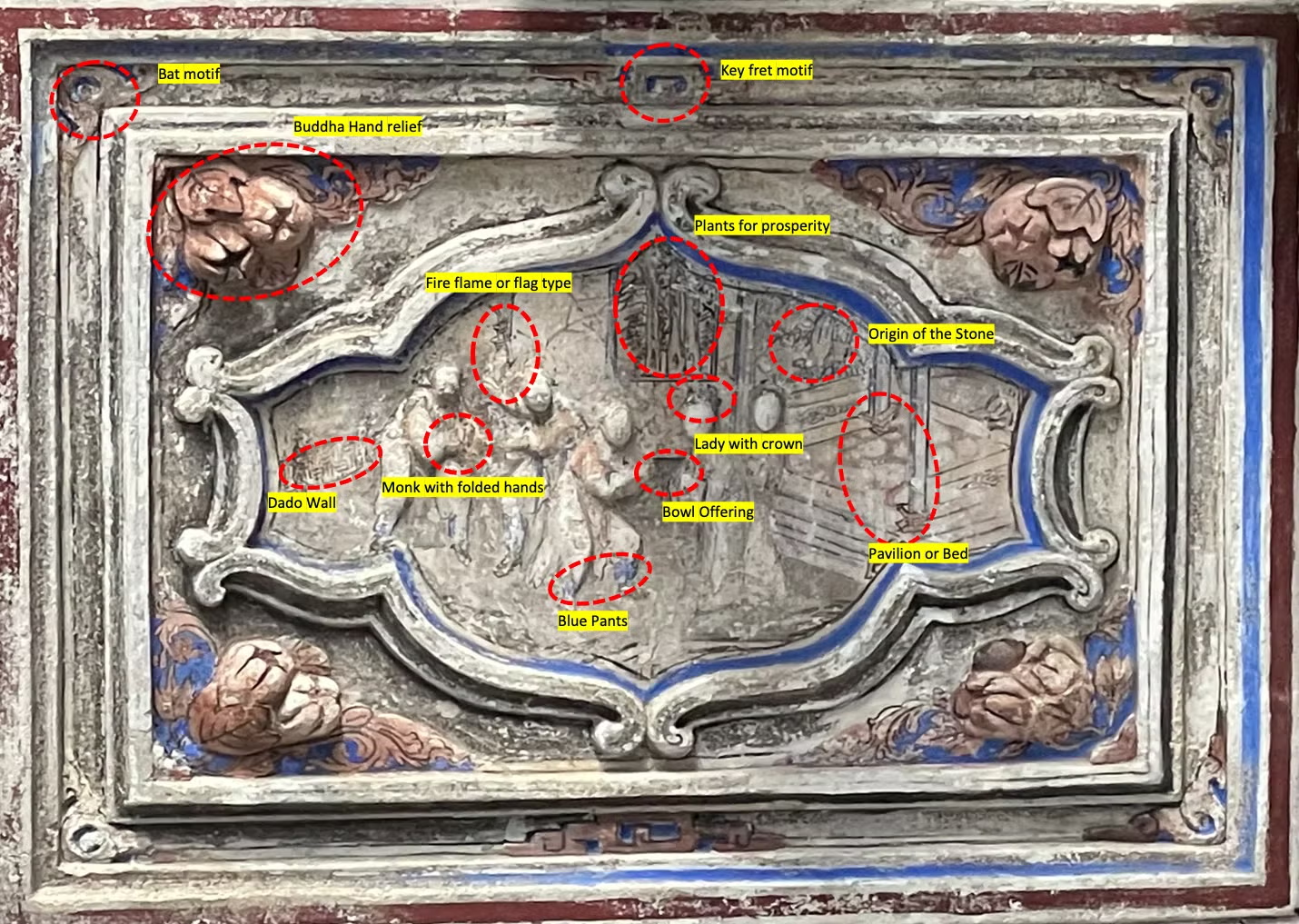
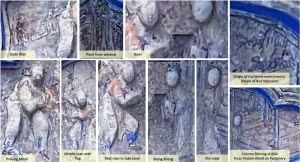
Coupled with historical research and analysis, the team worked on deciphering the various visual elements in the panel in its existing condition. This process allowed for several motifs to be reconstructed. The reconstruction was eventually printed in 1:1 scale and joined.
—
Subsequently, several Material Casting Tests were conducted with different materials for one motif – the Buddha Hand Motif to assess the feasibility of this method being applied to the entire panel.
These tests were done by developing a reusable mould and filling in castable mortar of different compositions (of lime and cement base mixtures). Certain mechanical properties were tested for outdoor environmental conditions, such as strength, degradation, and breakage points.
The team also conducted experiments to analyse the composition necessary for a weather-proof special paint mix. The paint samples were also subjected to ultraviolet (UV)-visible spectroscopy to observe the reflectance of UV light. It was evident that the tiles coated with special coating material performed better.
The final step involved fixing the 3D printed panel over the top of the actual panel at NUS-Baba House. Magnetic fixtures were used after discussions on how to best approach without damaging the original panel.
These tests were done by developing a reusable mould and filling in castable mortar of different compositions (of lime and cement base mixtures). Certain mechanical properties were tested for outdoor environmental conditions, such as strength, degradation, and breakage points.
—