

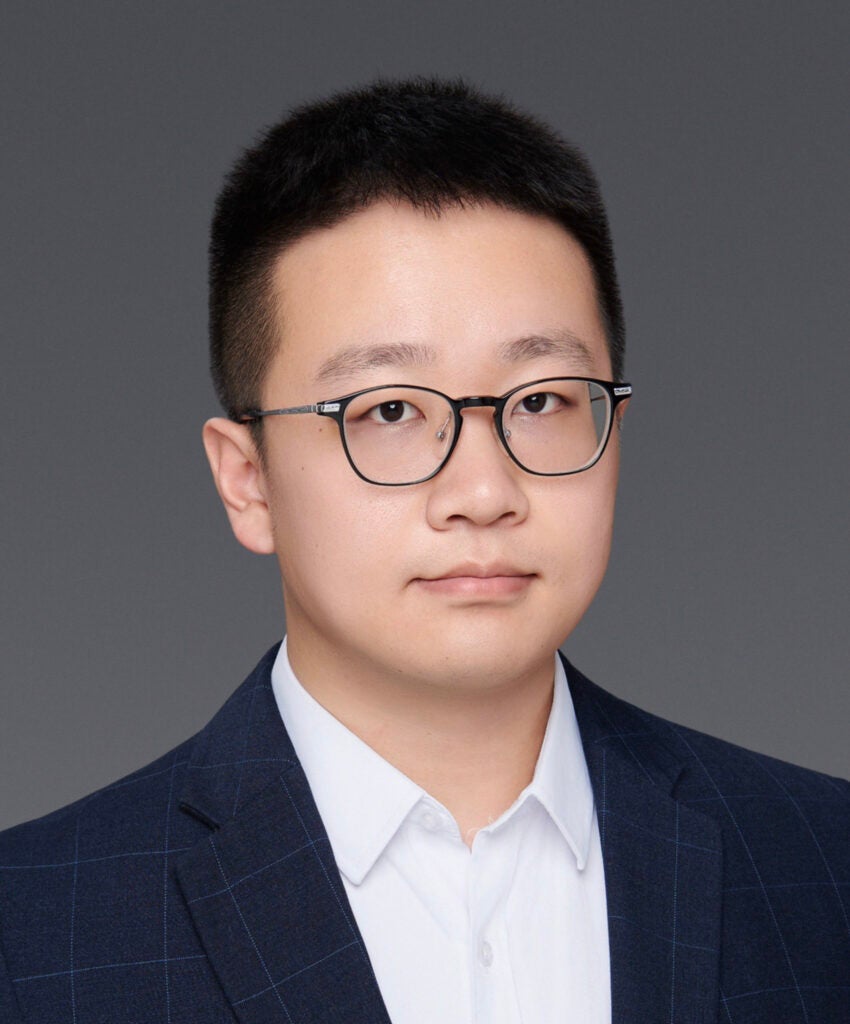
Dr. Peichen Zhong is an Assistant Professor at the Department of Materials Science and Engineering, National University of Singapore. He obtained a BS in Physics from the University of Science and Technology of China (USTC) in 2018, followed by a PhD in Materials Science from UC Berkeley in 2023. He then completed the postdoctoral work at Lawrence Berkeley National Laboratory (LBNL) and Bakar Institute of Digital Materials for the Planet (BIDMaP). He was awarded the 2023 Rising Stars in Materials Science and Engineering by CMU/MIT/Stanford, the BIDMaP Emerging Scholar Fellowship from the College of Data Science, Computing and Society (CDSS) at UC Berkeley, and the AI2050 Early Career Fellowship by Schmidt Sciences.
Research Interests
Dr. Zhong leads the Applied Machine Learning and Materials Modeling (AM3) Group at NUS MSE. The AM3 Group focuses on both methodology development and the application to pioneer clean energy & sustainability technologies.
- Computational modeling of complex materials for renewable energy applications
- Atomistic simulations with statistical mechanics & first-principles calculations in complex energy materials
- AI for Science: machine learning interatomic potentials and generative models in scientific applications
Selected Publications
- P. Zhong*, K. A. Persson*, “Machine‑Learning‑Guided Insights into Solid‑Electrolyte Interphase Conductivity: Are Amorphous Lithium Fluorophosphates the Key?”, ACS Energy Letters 11, 806–812 (2026).
- P. Zhong†, D. Kim†, D. King†, B. Cheng*, “Machine learning interatomic potential can infer electrical response”, npj Computational Materials 11, 384 (2025).
- P. Zhong*, B. Deng, S. Anand, T. Mishra, G. Ceder*, “Modeling phase transformations in Mn‑rich disordered rocksalt cathodes with machine learning interatomic potentials”, Physical Review Materials 9, 105404 (2025).
- P. Zhong*, X. Dai, B. Deng, G. Ceder, K. Persson*, “Crystal structure prediction with host‑guided inpainting generation and foundation potentials”, Materials Horizons 12, 9669–9678 (2025).
- P. Zhong, S. Gupta, B. Deng, K. Jun, and G. Ceder*, “Effect of Cation Disorder on Lithium Transport in Halide Superionic Conductors”, ACS Energy Letters 9, 2775 (2024).
- P. Zhong*, B. Deng, T. He, Z. Lun, and G. Ceder*, “Deep learning of experimental electrochemistry for battery cathodes across diverse compositions”, Joule 8, 1837–1854 (2024).
- P. Zhong†, F. Xie†, L. Barroso-Luque, L. Huang, and G. Ceder*, “Modeling intercalation chemistry with multi‑redox reactions by sparse lattice models in disordered rocksalt cathodes”, PRX Energy 2, 043005 (2023).
- P. Zhong, T. Chen, L. Barroso‑Luque, F. Xie, G. Ceder*, “An ℓ0ℓ2‑norm regularized regression model for construction of robust cluster expansion in multicomponent systems”, Phys. Rev. B 106, 024203 (2022).
- P. Zhong†, Z. Cai†, Y. Zhang, R. Giovine, B. Ouyang, G. Zeng, Y. Chen, R. Clément, Z. Lun, and G. Ceder, “Increasing Capacity in Disordered Rocksalt Cathodes by Mg Doping”, Chemistry of Materials 32, 10728 (2020).
- B. Deng, P. Zhong*, K. Jun, J. Riebesell, K. Han, C. J. Bartel, and G. Ceder*, “CHGNet as a pretrained universal neural network potential for charge‑informed atomistic modeling”, Nature Machine Intelligence 5, 1031–1041 (2023).