
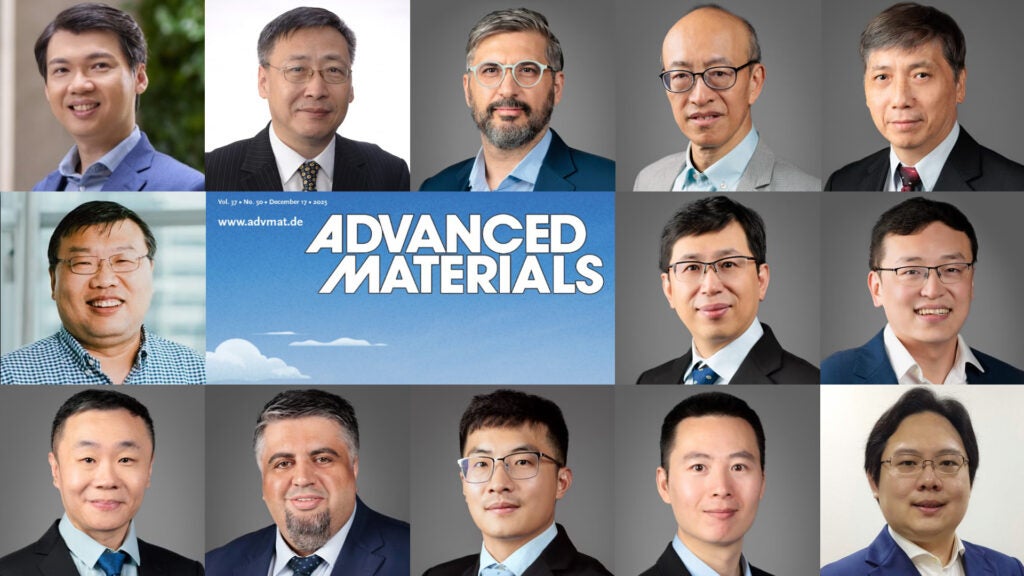
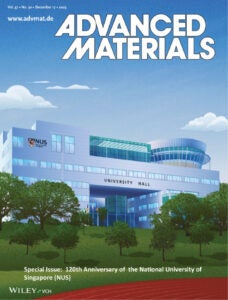
 In 2025, NUS celebrates 120 years of excellence, innovation, and service to society. To commemorate this milestone, Advanced Materials presents a special issue — “Materials Innovation in NUS” — featuring cutting-edge research from leading NUS scientists. This collection showcases recent breakthroughs and emerging directions across four pivotal domains: advanced catalytic materials for a sustainable future, next-generation materials for the energy transition, advanced materials for green computing, and functional materials for flexible electronics and biomedical applications. Prof. Liu Bin (Deputy President of NUS) and Assoc. Prof. Xue Junmin (HOD of MSE) also highlighted the latest advances across diverse areas of materials innovation at NUS in a Guest Editorial entitled “Materials Innovation at the National University of Singapore: A Special Issue Dedicated to the 120th Anniversary”. (doi.org/10.1002/adma.202522375) Excitingly, faculty members from the Department of Materials Science and Engineering (MSE) have contributed to this prestigious collection, showcasing the department’s strengths across energy, sustainability, electronics, sensing, and bioengineering, underscoring NUS MSE’s enduring commitment to advancing materials science and shaping a sustainable, technologically empowered future.
In the Perspective section, Prof. Wang Qing and Dr Jing Yan presents “Materials Design and Assessment of Redox-Mediated Flow Cell Systems for Enhanced Energy Storage and Conversion,” offering strategic insights into the design principles and performance metrics of next-generation flow battery systems for scalable energy storage. (doi.org/10.1002/adma.202509991)
In the Review Article category, Prof. Ding Jun contributes “Utilize Natural Forces in Water Treatment Through 3D-Printed Structures: From Purification to Clean Energy,” synthesizing recent advances in harnessing natural hydrodynamic and physicochemical forces via architected structures for sustainable water treatment and energy recovery. (doi.org/10.1002/adma.202509185)
The special issue also features a strong suite of Research Articles from MSE faculty, demonstrating the breadth of experimental and translational materials research in the department:
- John Wang: “Tailoring Graphite Interlayers with Electron-Acceptor Bridges Raises Ion Diffusion Kinetics for Ultrafast Charging Batteries,” advancing fundamental understanding of ion transport for high-rate energy storage. (doi.org/10.1002/adma.202509207)
- Benjamin C. K. Tee: “Self-Spiking Linear Neuromorphic Soft Pressure Sensor for Underwater Sensing Applications,” introducing a bio-inspired sensing platform with potential in marine robotics and soft electronics. (doi.org/10.1002/adma.202505486)
- Barbaros Özyilmaz and Dr Chee Tat Toh: “Dry Transfer of CVD Graphene Film Using Adhesion Switchable Ferroelectric Polymers,” developing a scalable approach for high-quality graphene integration. (doi.org/10.1002/adma.202510545)
- Chen Jingsheng: “HZO/HSO Superlattice ReFET Array Integrating Optical Sensing for Neuromorphic Vision Computing,” merging ferroelectric memory with optical perception for neuromorphic hardware. (doi.org/10.1002/adma.202508889)
- Prof. Ahmet Avsar: “Reconfigurable Magnetotransport in MnBi₂Te₄ via Gate and Magnetic Field Tuning,” elucidating tunable quantum transport phenomena in magnetic topological materials. (doi.org/10.1002/adma.202510734)
- Prof. Tan Swee Ching: “Rhus Chinensis-Inspired Vertical Hierarchical Structure for Solar-Driven All-Weather Co-Harvesting of Fresh Water, Clean Salts, and Authigenic Electricity,” demonstrating multifunctional materials for sustainable resource generation. (doi.org/10.1002/adma.202506762)
- He Chaobin: “Zinc-Coordinated Trienzyme Nanogel Cascade Therapy for Accelerated Post-Pancreatectomy Cutaneous Wound Healing,” presenting an innovative biomaterials-based therapeutic strategy. (doi.org/10.1002/adma.202508538)
- Profs. Zhao Ming & He Qian: “Ce Single Atom-Engineered Amorphous/Crystalline Nanosheets for Enhanced Alkaline Water Electrolysis,” advancing catalyst design for efficient green hydrogen production. (doi.org/10.1002/adma.202508893)
Collectively, these contributions highlight MSE’s interdisciplinary research culture and its impact on critical global challenges, from clean energy and water sustainability to advanced electronics and healthcare technologies. The department congratulates all contributing faculty for their recognition in this landmark special issue celebrating NUS’s 120-year legacy of innovation.