


RESEARCH IMPACT & COLLABORATIONS
CDE Research Newsletter Issue 07
The latest edition of the NUS CDE Research Newsletter, covers a topic of profound importance to our global community: Energy.
From new materials to breakthroughs in device engineering, being at the leading edge of energy innovation is among the highest priorities for our CDE community. In this issue, we are joined by guest editor, Professor Lee Poh Seng. We thank him for his stewardship of this important topic and our colleagues who are pioneering new advancements in the field!
This month's edition includes research features from:
- Professor Lee Poh Seng
- Professor Praveen Linga
- Professor Yan Ning and Assistant Professor He Qian
- Associate Professor Sanjib Kumar Panda
- Professor Dipti Srinivasan
- Dr Su Bin
- Associate Professor Palani Balaya
- Associate Professor Ernest Chua
- Assistant Professor Shin Sunmi
- Associate Professor Yang Wenming
- Associate Professor Zhang Huangwei
Microneedles deliver biofertilisers straight into plant tissue
How do you help plants grow faster while using less fertiliser? A dissolving microneedle patch that delivers living biofertilisers directly into plant tissue could be the key.
Developed by researchers led by Asst Prof Andy Tay, the microneedle system puts beneficial bacteria exactly where plants need them: into their leaves and stems. In greenhouse trials, plants grew faster using over 15 per cent less biofertiliser compared to standard soil application.
The innovative approach opens the way to more precise dosing in urban farms, vertical farms and high-value crops where efficiency matters. It could also support more sustainable agriculture with less waste and lower environmental impact.
Medical AI to see, reason and anticipate

Assistant Professor Jin Yueming is advancing the next generation of medical AI — systems that can see, reason and anticipate to support real clinical decision-making.
At the iMVR Jin Lab, her team bridges computer vision and biomedical science, adapting large vision–language models to the nuances of medical imaging, surgical workflows and diagnostic reasoning. Together with her students Wang Ziyue and Liu Haofeng, she has developed the SAM-based methods, especially Medical SAM Adapter, enabling rapid, clinician-friendly segmentation across CT, MRI and ultrasound scans, as well as agentic AI frameworks that enhance interpretability and decision support.
Most recently, her group is developing predictive models that forecast surgical steps and future clinical states — a promising capability for surgical navigation, automation and patient-centred care. Her PhD students Zeng Zhitao and Yang Shuojue work on this promising direction.
Read more here: https://cde.nus.edu.sg/news-detail/medical-ai-to-see-reason-and-anticipate
Durability breakthrough for tandem solar cells
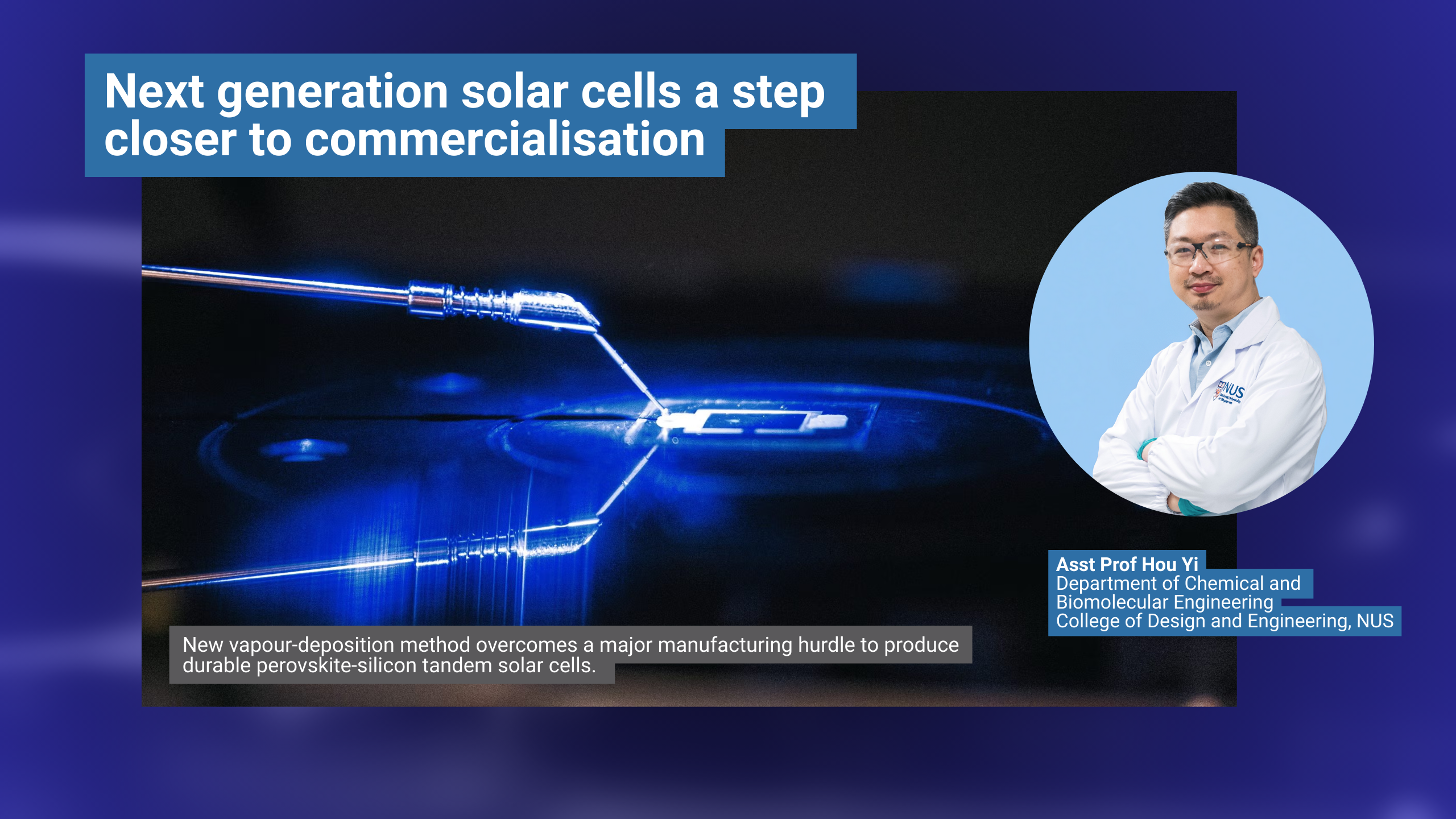
Taking high-efficiency tandem solar cells closer to commercial reality.
A team of researchers led by Asst Prof Hou Yi have demonstrated a new fabrication process that significantly improves the long-term stability of perovskite–silicon tandem solar cells on industrial silicon wafers.
Tandem solar cells can generate more electricity from the same surface area than conventional silicon solar cells, making them a promising route to higher-efficiency solar power. However, challenges related to durability and manufacturing compatibility have limited their real-world use. The breakthrough by Asst Prof Hou and team shows a viable pathway towards overcoming those barriers.
By achieving both high efficiency and sustained operation under demanding conditions using an industry-compatible process, the research brings tandem solar cells closer to practical deployment on rooftops, solar farms and large-scale energy systems.
The findings mark an important step in the transition from laboratory devices to real-world solar technologies.
Read more here: https://cde.nus.edu.sg/news-detail/durability-breakthrough-for-tandem-solar-cells/
CDE PYP Feature: Meet Asst Prof Beatrice Soh
Uncovering these physics is crucial for designing products - from shampoos to soft materials - that feel and function exactly as intended, without the waste and trial-and-error usually involved.
Looking ahead, she hopes to extend these tools beyond simple polymers to systems relevant to nanotechnology and biomedical science, including understanding interactions between biomolecules like RNA and proteins.
Hear from Asst Prof Beatrice Soh, Presidential Young Professor at CDE about her research into polymers. You can also learn more about her research lab here: https://bwysoh.wixsite.com/sohlab/research
What happens when electricity supply exceeds demand?
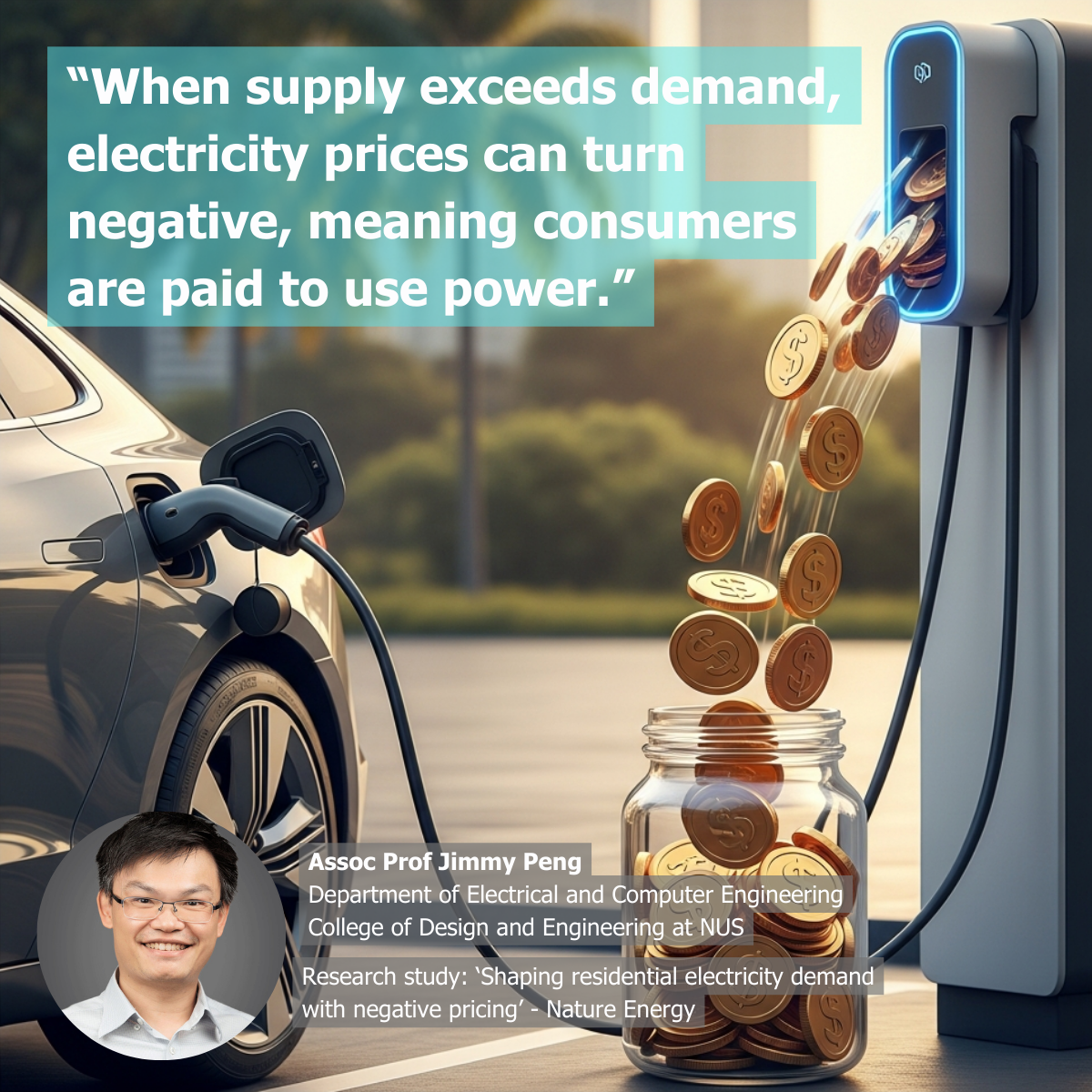
Getting paid to charge your EV?! It sounds improbable, but research suggests it could soon be a reality for Singapore.
A study by Assoc Prof Jimmy Peng explores what happens when electricity prices turn negative; a seemingly counterintuitive situation where the consumers are effectively incentivised to use power.
“Sometimes the power grid has too much electricity, especially when there’s a surge of renewable energy like solar, wind or hydropower,” says Assoc Prof Peng. “When supply exceeds demand, electricity prices can turn negative, meaning consumers are paid to use power.”
Negative pricing can also happen for another reason: some generation companies would rather sell electricity at a negative price than curtail their output, because shutting down and restarting generators can cost more than paying consumers to use the excess energy. In such cases, keeping the power flowing is simply the more economical option.
Assoc Prof Peng’s research, which surveyed around 2,000 people in the United States, found that more than 75 per cent said they would shift activities like EV charging to those negative-price periods. In other words, people respond very strongly when electricity becomes free – or even profitable – to use.
In the coming years, Singapore has plans to import large amounts of mostly renewable energy from its ASEAN neighbours. “When that happens, there will be times when we face the same challenge,” says Assoc Prof Peng. “Because of surplus renewable energy generation, or due to contractual agreements, we may have episodes where we have more electricity than we need. Negative pricing could become a practical way to absorb that surplus.”
With Singapore aiming to accelerate EV adoption, especially for heavy vehicles, this behaviour could become an important tool for balancing the grid and making full use of imported green energy. But the study also shows that sudden spikes in demand could strain electricity networks if not carefully managed, meaning thoughtful market design will be essential.
As Singapore increases its renewable energy imports, pricing innovations like this may become part of everyday energy planning — including deciding when we top up the charge on our EVs.
Read the full research paper published in Nature Energy here: https://www.nature.com/articles/s41560-025-01901-x
Soft robots get smarter with magnetic power and flexible batteries
With a design inspired by manta rays, an innovative soft robot that uses magnetic fields to both move and strengthen its own power supply.
By pairing magnetic actuation with specially developed flexible batteries, a research team led by Asst Prof Changsheng Wu created a robot that can swim freely without cables, sense its environment, and make simple decisions underwater.
The magnetic fields that control the robot’s movement also help the batteries last longer under constant bending, making it possible to integrate sensing, power, and control into a compact, flexible body.
The robot can navigate around obstacles, correct its path, and monitor temperature changes, offering potential applications in underwater inspection, environmental monitoring and biomedical use.
Major Grants Awarded
The major grants (start date in December 2025) with total project value > $1M.
| Hosting Unit | Project Title | Funding Programme (Source of Funding) |
Principal Investigator | Co-Investigator |
| NUS Cities | Town geodemographic modelling & forecasting methodology to inform land use planning | Housing and Development Board (HDB) | Chua Yung Hwa, Alvin | |
| MSE | Room temperature solid state sodium-sulfur batteries | A*STAR Manufacturing, trade and connectivity (MTC) programmatic fund – 2024 / A*STAR | Yang Hui Ying | |
| CEE | Bio-based FRP as a novel low-carbon corrosion protection technology for steel structures under severe marine environments | Coastal protection and flood management research programme (CFRP) – Applied research – 2024 / NRF | Pang Sze Dai | Daniel John Blackwood; Liew Jat Yuen, Richard; Yang Yi |
| CEE | Clustering ensemble realisations into weather scenarios with uncertainty estimates | Weather science research programme (WSRP) funding initiative – 2025 / NEA | He Xiaogang | Zhu Lailai; Yeow Chen Hua |