


Electrical and Computer Engineering
Balancing the charge towards clean mobility
Follow CDE
PDF Download
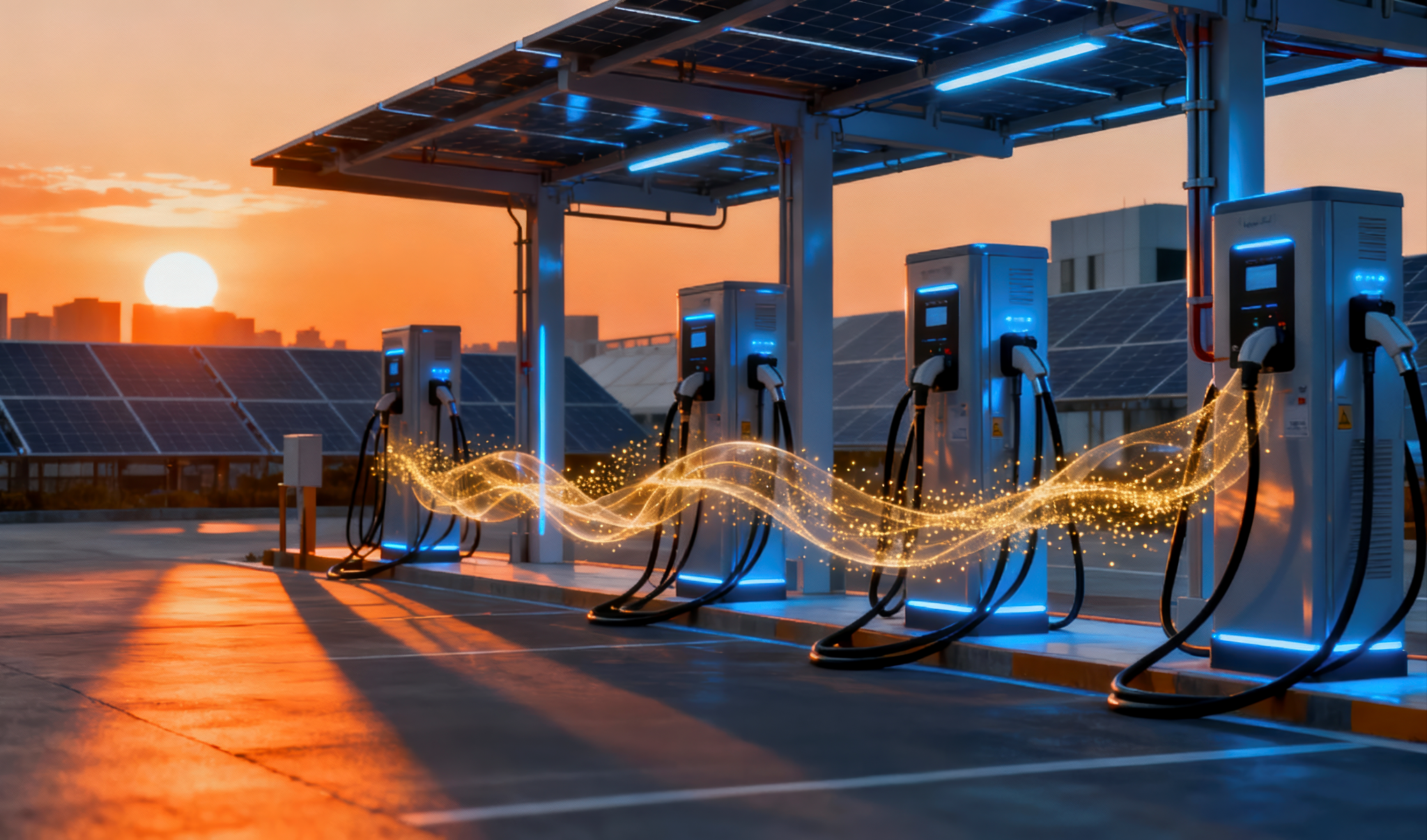
A coordinated control approach keeps electric vehicles, solar power and the grid in perfect harmony, enabling stable, battery-free ultra-fast charging that makes the most of the sun.
Ultra-fast electric-vehicle charging stations juggle between three fast-moving sources of variability: solar power that fluctuates with passing clouds, vehicles that change their charging demand abruptly as they move through different fast-charging phases, as well as grid connections that can only tolerate limited swings in power without causing disturbances.
In many stations, these fluctuations are buffered using large battery systems, but this comes with added cost and maintenance. Associate Professor Sanjib Kumar Panda from the Department of Electrical and Computer Engineering at the College of Design and Engineering, National University of Singapore, wanted to find out: can stability still be achieved without adding yet another energy storage device?

Associate Professor Sanjib Kumar Panda led a team to develop a coordinated-control algorithm that keeps electric vehicles, solar power and the grid in perfect harmony, without relying on additional energy storage devices.
A smarter way to share the load
Assoc Prof Panda’s team set out to develop a coordinated-control algorithm that manages all these interactions in real time, without relying on additional energy storage devices. Detailed in a paper published in the IEEE Transactions on Consumer Electronics, the algorithm monitors four key factors: how quickly the grid can safely ramp power up or down; how much energy the solar plant can supply at its most efficient operating point (a condition known as maximum power point tracking, or MPPT); each vehicle’s charging capacity; and the limits set by its battery management system.
When sunlight fluctuates or a car begins charging, the controller redistributes available power among all connected vehicles in proportion to what they can handle, while keeping total grid power within the permitted bounds. If both the grid and solar irradiance fluctuate concurrently, with solar power generation higher than the allowable limit, it temporarily reduces solar output to safeguard the system — a kind of real-time compromise that keeps everything running smoothly.
“We wanted to make the system ‘think’ as a whole, not as separate components,” says Assoc Prof Panda. “Each charger adapts to what the others are doing, and the grid stays steady even when conditions change suddenly.”
To evaluate the approach, the team built a laboratory-scale setup powered by solar emulators and a solid-state transformer (SST), with seven fast-charging ports for different vehicle types. Over hour-long trials, the system maintained solar power extraction at more than 99% efficiency and delivered nearly full charging energy to every port — all while keeping grid fluctuations within strict ramp-rate limits and staying within each vehicle’s battery constraints. The current distortions on the grid side also stayed well below the code limits, showing that stability and efficiency could coexist.
“Intelligently designed software algorithms can in fact take up the role of hardware storage devices — there is no need to supply ever more batteries if you can control the flow of power between different available resources precisely,” adds Assoc Prof Panda.
Making storage-free fast-charging possible
The implications of the researchers’ study go beyond laboratory results. As electric vehicles proliferate, ultra-fast charging stations will become focal points of power demand. Without meticulous control, they could strain local grids or squander renewable energy resources. The team’s coordinated-control method offers a way to integrate solar power into these systems, reducing stress on the grid and cutting out the cost and complexity of grid-scale batteries.
“Our aim is to make solar-assisted charging practical and reliable enough for use in the real world, which is often messy and unpredictable.”
“Our aim is to make solar-assisted charging practical and reliable enough for use in the real world, which is often messy and unpredictable.”
“Our aim is to make solar-assisted charging practical and reliable enough for use in the real world, which is often messy and unpredictable.”
In their comparison study, using a battery to achieve similar performance would have increased installation costs by up to 10%. The proposed method achieves the same stability using only algorithms and sensors — a leaner and more adaptable path for large-scale deployment.
“Fast EV charging shouldn’t come at the expense of grid health or adopting clean-energy goals,” Assoc Prof Panda notes. “Our aim is to make solar-assisted charging practical and reliable enough for use in the real world, which is often messy and unpredictable.”
The next question, he adds, is how such intelligent systems might connect with broader digital frameworks — for instance, linking to secure communication protocols, blockchain-based energy management or digital-twin-based pilot projects within real utility electrical power networks.
Looking ahead, the team will focus on bringing more renewable sources into the grid without compromising stability as supply and demand will continue to fluctuate in a dynamic environment. A particular challenge is that many modern renewables rely on power-electronics-based controllers rather than traditional inertia based on spinning synchronous machines — so they do not have the natural “buffering” effect that helps to stabilise the grid. The team aims to develop control methods that allow these inverter-based systems to play a stabilising role even as renewable energy penetration grows. Their work will feed into upcoming efforts under the Singapore Energy Market Authority’s Energy Grid 3.0 Grant Call.
Read More
View Our Publications ▏Back to Forging New Frontiers - December 2025 Issue
If you are interested to connect with us, email us at cdenews@nus.edu.sg