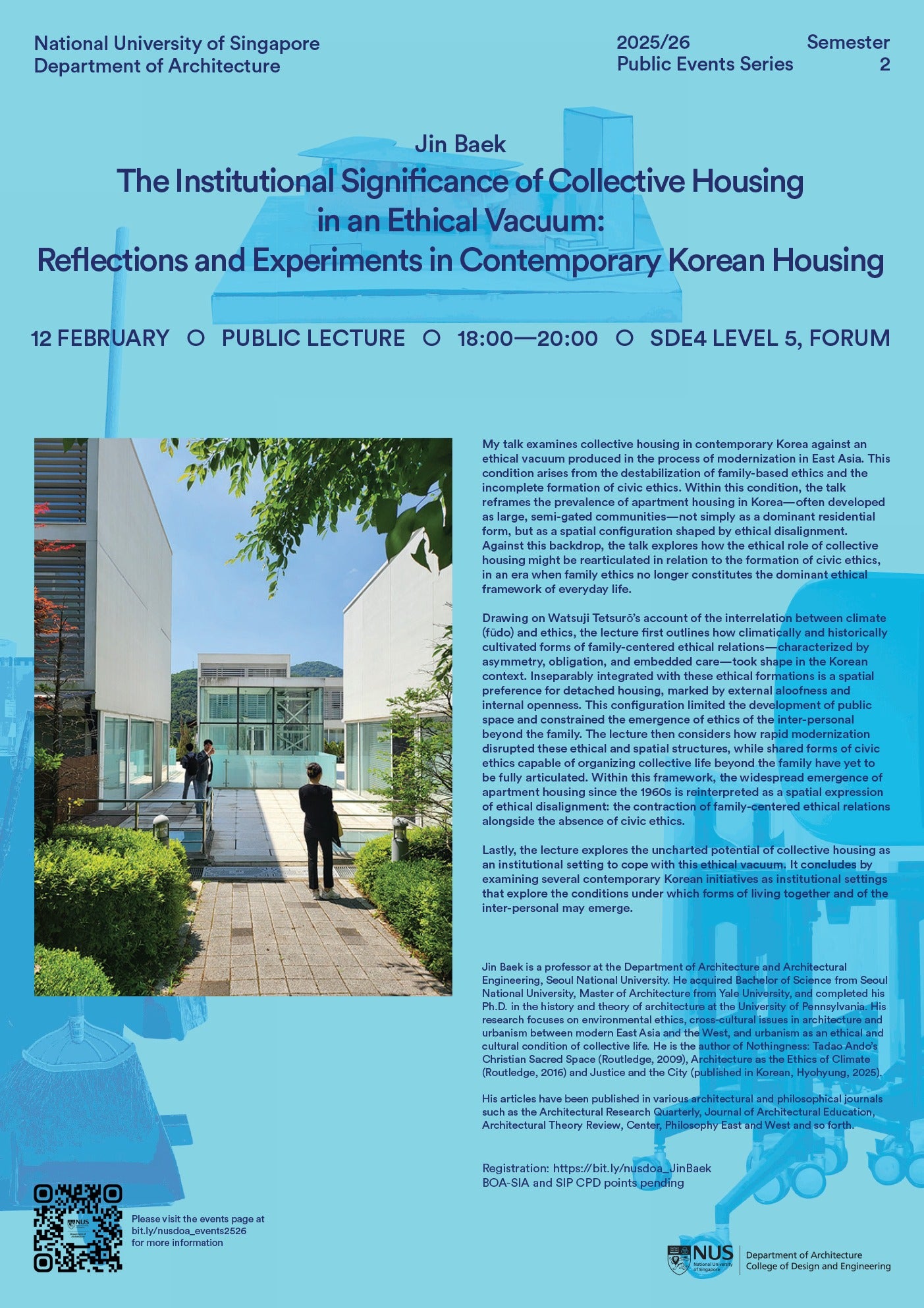


This talk examines collective housing in contemporary Korea against an ethical vacuum produced in the process of modernisation in East Asia. This condition arises from the destabilisation of family-based ethics and the incomplete formation of civic ethics. Within this condition, the talk reframes the prevalence of apartment housing in Korea—often developed as large, semi-gated communities—not simply as a dominant residential form, but as a spatial configuration shaped by ethical disalignment. Against this backdrop, the talk explores how the ethical role of collective housing might be rearticulated in relation to the formation of civic ethics, in an era when family ethics no longer constitutes the dominant ethical framework of everyday life.