Achieving sustainability is about more than just new technologies. It is about navigating constraints, making trade-offs, and turning ideas into real-world impact.
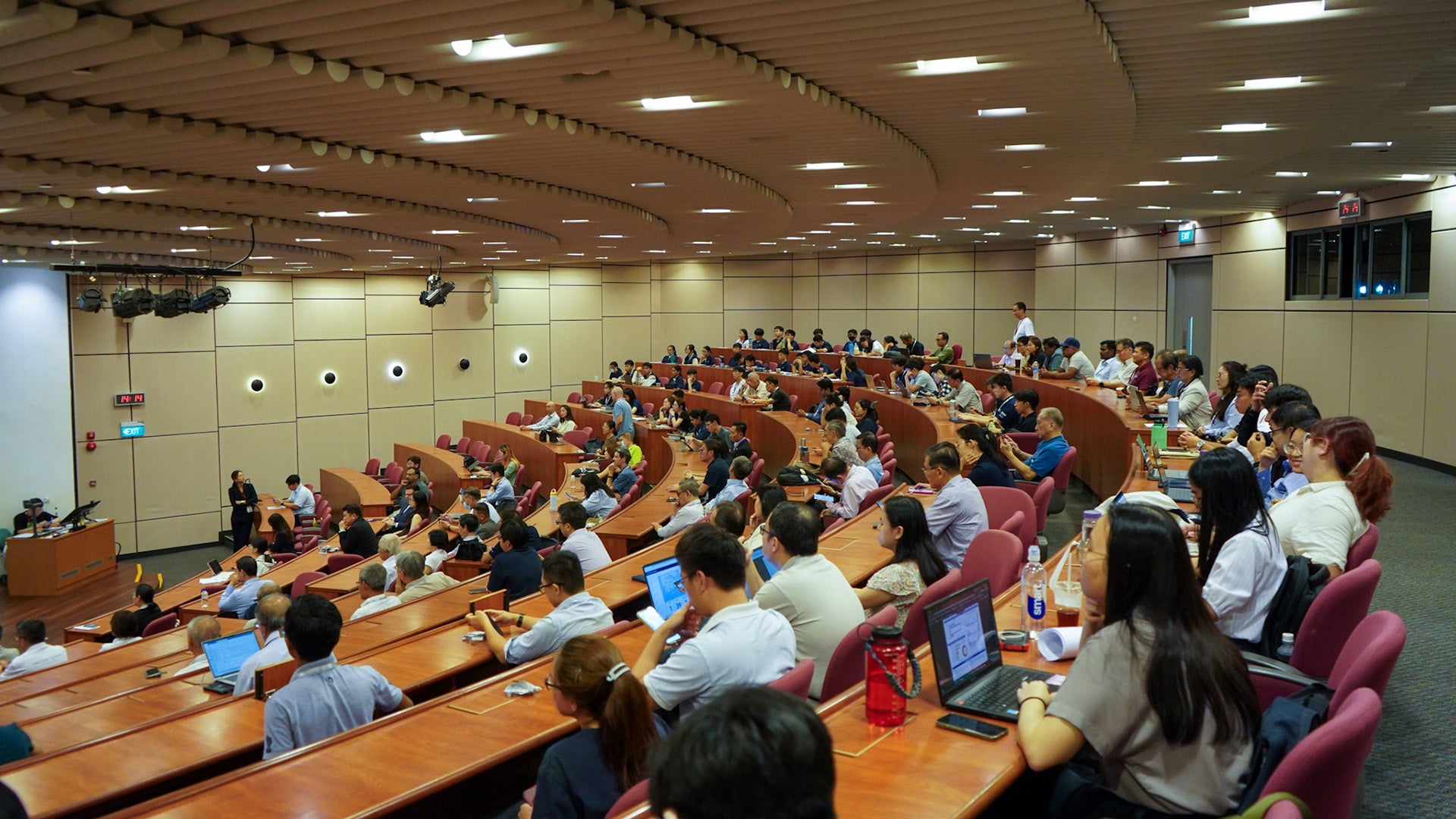
That was the message of speakers at the Environmental and Sustainability Engineering Symposium 2026, held on 8 April at CDE, gathering researchers, industry leaders and students to examine how engineering must evolve in response to climate change and resource pressures.
Setting the scene, Assistant Professor Iris Yu (Civil and Environmental Engineering), who organised and emceed the symposium, highlighted both the breadth of the field and the purpose of the event.
“Spanning topics from emerging pollutants and advanced treatments to resource recovery from waste and CO2, the Symposium highlights the breadth of contemporary environmental engineering,” she said.
As well as being a research showcase, she said , it is a space where “students and industry leaders converge to exchange ideas, build synergies, and co-create practical solutions.”
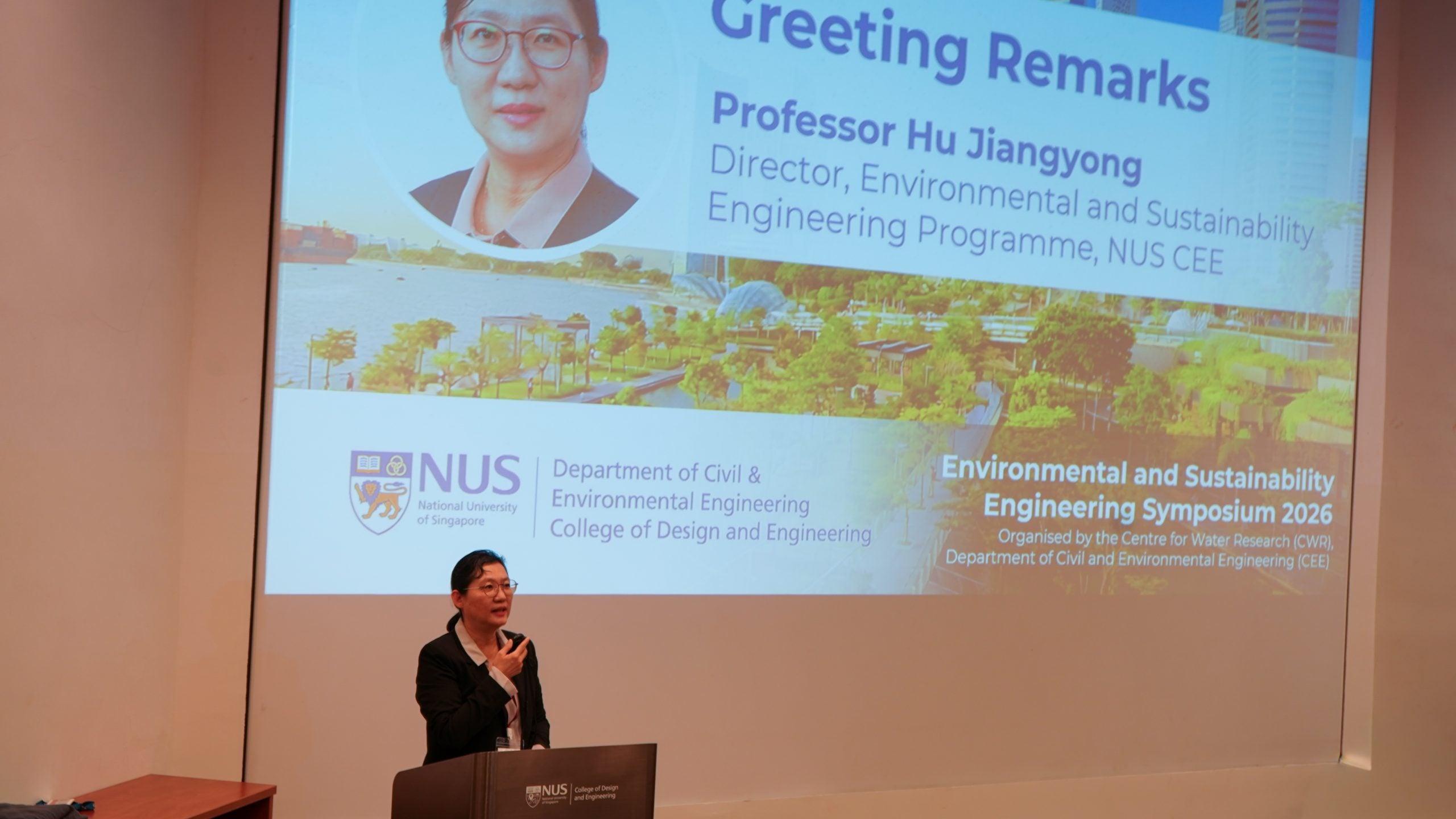
The emphasis on connection and collaboration was echoed in the event's welcome speech by Professor Hu Jiangyong, Director of the Environmental and Sustainability Engineering Programme at NUS, who positioned the symposium as a platform linking academia, industry and government “to share the advances in sustainable development… and to foster future collaborations.”
Student poster presentations
Prof Hu also pointed to the breadth of research on display, with 18 student projects exhibited addressing challenges ranging from emerging pollutants and advanced treatment processes, to sustainable cities and resource circularity.
Among the students presenting work at a poster exhibition held as part of the Symposium was Joyan Khoo (Year 4, Environmental Engineering, Second Major in Business Management) who developed a machine learning model to estimate air quality across Singapore, helping identify areas at risk even without sensor coverage. “Instead of only improving model accuracy, the focus was on how the results could be useful in everyday life,” he said.
Another student Oh Jia Zhi (Year 4, Environmental Engineering, Minor in Geoscience) explored the use of satellite data to monitor coastal water quality, enabling faster detection of pollution and algal blooms across large areas. “Working with Professor Gin Yew-Hong (Civil and Environmental Engineering) helped me refine both my approach and analysis, especially when dealing with challenges like data quality and cloud-covered satellite images,” she said.
Also presenting his work was Nigel Teh (Year 4, Environmental Engineering, Second Major in Sustainable Urban Development) who investigated electrochemical methods for treating pharmaceutical wastewater, aiming to develop solutions scalable for real-world application. One of his key challenges was working with unfamiliar equipment. “Through a lot of trial and error, I eventually understood both how the system works and how it supports our research,” he said. Nigel was also named a recipient of the Best Poster Award.
‘Doing things with less’
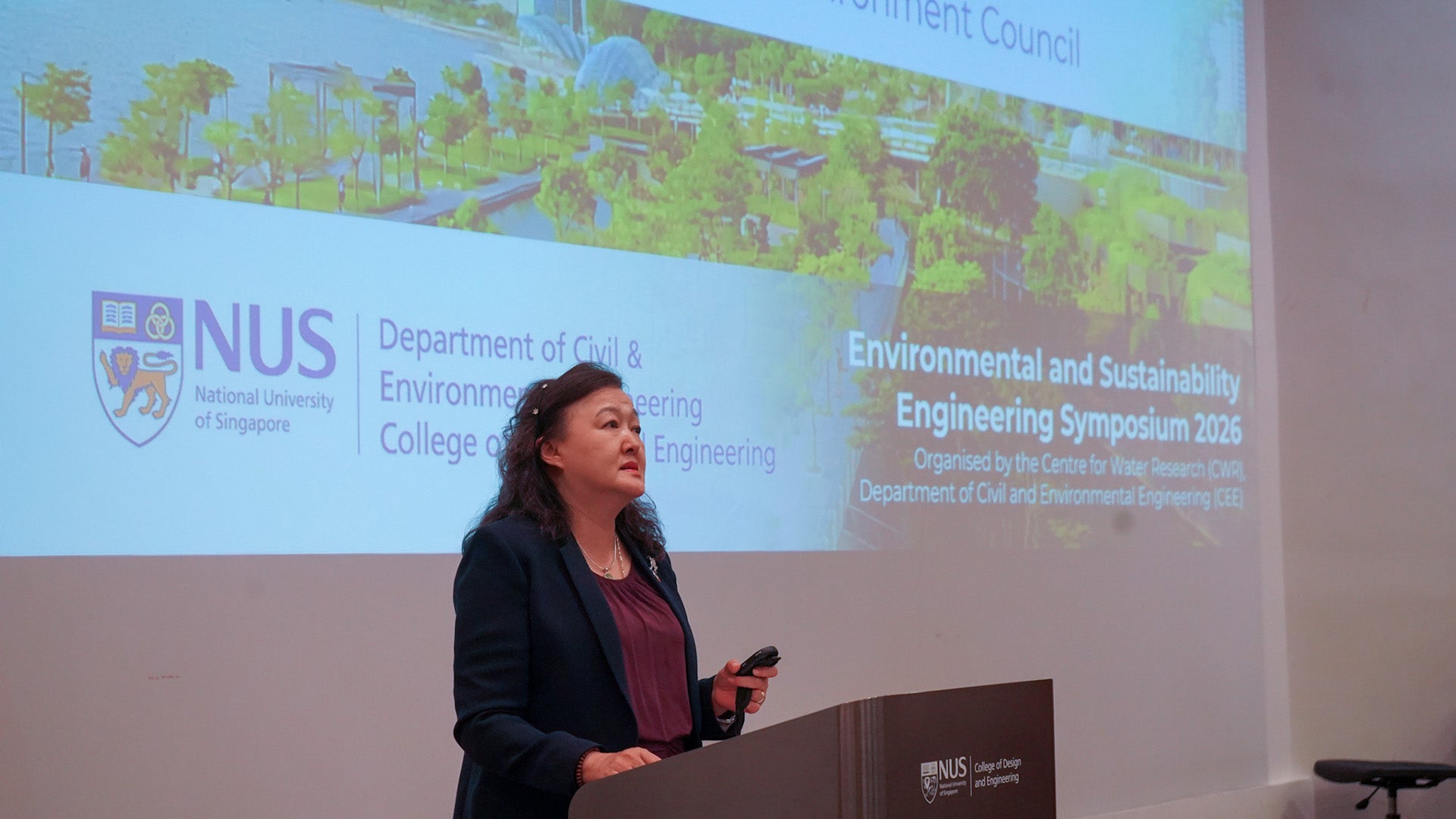
At its core, the symposium pointed to a broader shift in how sustainability is understood. As Ms Isabella Huang-Loh, Chairman of the Singapore Environment Council, noted in her opening speech, the principles of sustainability are not new, but the context in which they are applied has changed dramatically.
“Engineering has always been about doing things with much less… that remains the essence of sustainability,” she said, framing the challenge for today’s engineers as one of responding to growing climate risks and resource constraints.
What that shift looks like in practice was reflected in the perspectives of two CDE alumni among the symposium’s invited speakers working at the forefront of industry.
Mr Tuck Wai Lee, Founder and CEO of Upconverge and an alumnus of Civil Engineering at NUS, pointed to a persistent gap between innovation and implementation, arguing that engineers must take on a more active role in shaping decisions and outcomes.
“Models don’t make decisions. We do. People do,” he said, highlighting the need for engineers to move beyond analysis and engage with the complexities of real-world deployment.
That complexity is especially apparent in industry, where sustainability must be balanced against economic realities. Mr Tridansh B. Pandey, Director and Chief Operating Officer of JTS Holdings (SG) Pte. Ltd. and a graduate of the NUS Master’s programme in Environmental Engineering, described the tension at the heart of resource recovery efforts.
Systems-level approach
“We are trying to get less waste, but we’re also dealing with not making enough money… it’s a paradox,” Mr Pandey said, pointing to the challenge of aligning environmental goals with business viability.
Together, these perspectives underscored a common theme across the symposium: the need to move beyond isolated solutions and adopt a systems-level approach.
In the built environment, this means looking past visible technologies to understand how different components interact. Mr Heng Liong Tiong, General Manager and Finance Director at Vector Green Pte. Ltd., argued that focusing on individual solutions risks overlooking where the greatest impact lies.
“A building is no longer just a collection of technologies… we need to see it as a living system,” he said, highlighting the importance of coordinating energy systems, cooling, controls and user behaviour to achieve meaningful efficiency gains.
This systems thinking becomes even more critical at the scale of national infrastructure. Ms Hui Chng Chan, Executive Director and Head of Sector for Water at Jacobs, showed how projects such as the Tuas Water Reclamation Plant are evolving to recover water, energy and nutrients while operating within tight physical constraints.
“Land is actually a very important resource for us in Singapore… it drives a lot of the decision making,” she said, underscoring the need for compact, integrated solutions in a resource-limited context.
Taken together, the symposium painted a picture of the road ahead.
Sustainability cannot be defined by single solutions or technologies. It is shaped by interconnected systems, competing constraints and human decisions, and by engineers who must increasingly operate at the intersection of all three.