

Architecture
The foundations of change: Building with mass timber in the tropics
Follow CDE
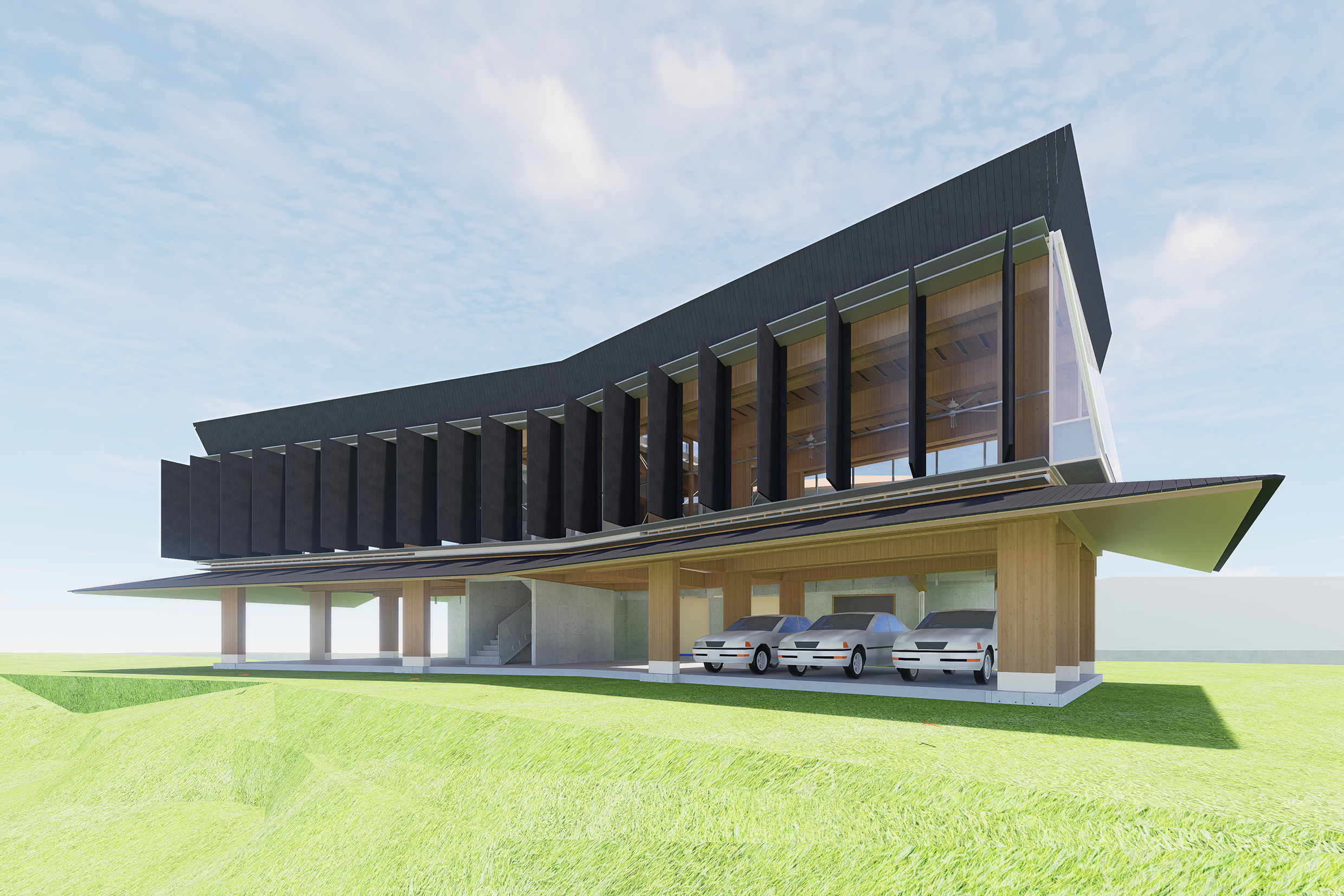
Tropical plantation timber grows several times faster than its temperate counterparts. Engineered into structural panels and beams, it could turn Southeast Asia’s buildings from carbon sources into carbon stores.
The production of concrete, the world’s most widely used construction material, accounts for around 8% of global emissions each year. Together with steel, commonly used to reinforce buildings, the materials make up approximately 16% of embodied carbon emissions in the built environment and are a major source of construction waste.

Associate Professor Shinya Okuda leads a research platform dedicated to developing mass engineered timber from fastgrowing tropical plantation species for structural use in buildings.
Associate Professor Shinya Okuda from the Department of Architecture, College of Design and Engineering, National University of Singapore (NUS), has been pioneering efforts to change that equation. In 2013, he founded SkyTimber Tropical Renewable Architecture Design Lab, an advanced, interdisciplinary design research platform dedicated to developing mass engineered timber (MET) from fast-growing tropical plantation species for structural use in buildings. The lab also aims to find solutions for the long-term durability of MET buildings in the hot and humid monsoon climate, addressing both human comfort and timber durability, contributing toward carbon neutral Southeast Asia.
Most Singaporeans are familiar with seasonal haze caused by land-clearing fires on regional tropical plantation. What is less visible is the scale of the carbon stakes: tropical forests store an estimated 68% of the planet’s terrestrial carbon stock, and tropical deforestation contribute to roughly one-tenth of greenhouse gas emissions between 2005 and 2010, with 41% of that share originated from Southeast Asia.
Engineered to perform: Tropical mass engineered timber (MET)
Tropical MET transforms relatively weak, fast-growing plantation lumber into high-performance structural components. Sawn boards are graded, finger-jointed and bonded in layers — along the grain to form glued laminated timber (glulam) for columns and beams, or cross-layered to produce crosslaminated timber (CLT) for floors and walls. The resulting material achieves compressive strength comparable to concrete at roughly one-fifth of the weight.
The tropical advantage is speed. For instance, a sengon tree on a Javanese plantation can reach up to 20 metres in just three to four years — growth rates that temperate spruce, the current industry standard for MET, cannot match. “Due to year-round sunlight, some plantation species in the tropics may grow several times faster than those in temperate climates. Currently, most of their use is limited to furniture, plywood, pulp and chips, and not structural components. Tropical MET can retain substantial quantities of atmospheric carbon in solid form over the long-term, becoming an effective carbon sink and a true gamechanger in a warming world,” says Assoc Prof Okuda.
“Tropical MET can retain substantial quantities of atmospheric carbon in solid form over the long-term, becoming an effective carbon sink and a true gamechanger in a warming world.”
“Tropical MET can retain substantial quantities of atmospheric carbon in solid form over the long-term, becoming an effective carbon sink and a true gamechanger in a warming world.”

Tropical MET as a carbon sink in built form
Regulatory efforts to improve building operational efficiency have successfully reduced energy-related emissions, such as SDE 1-4 net-zero energy premises in NUS, yet embodied carbon — the emissions associated with building’s construction — is largely unchanged.
The carbon arithmetic is compelling. A comparative life-cycle study conducted in Central Chile under a sub-tropical climate found that a mass timber structure carries 42% lower net embodied carbon than an equivalent reinforced concrete building, partly because timber production generates fewer emissions, and partly because the wood itself stores carbon absorbed during the tree’s growth. Every timber building, in effect, becomes a long-term carbon bank.
Singapore’s rising carbon tax sharpens the economic case. The rate climbed from SGD 5 per tonne of CO2-equivalent in 2019 to SGD 25 in 2024 and is set to increase fifteenfold to SGD 50–80 by 2030. Several Southeast Asian neighbours, including Malaysia and Vietnam, are developing their own emissions trading systems. “Timber buildings may mitigate the future trajectory of Scope 3 carbon emissions, and that could fundamentally change the economic calculation,” adds Assoc Prof Okuda.
Climate-adaptive mass timber architecture for the tropics
The path from plantation to building site presents challenges unique to the region: constant high humidity, intense rainfall, biological degradation and termite attacks — conditions that temperate design guides were never written to address. In hot-humid climates, moisture moves inward from the exterior, the opposite of its behaviour in colder regions, demanding fundamentally different building envelope strategies.
SkyTimber’s interdisciplinary collaboration across Architecture, Built Environment, Civil Engineering, Material Science and Biological Science addresses these barriers through material innovation, tectonic design and performance analytics. Since prototyping the first tropical MET from fast-growing plantation species in 2018, early structural testing suggests the material may meet the Eurocode strength classes required for mid-rise to tall building construction in Singapore. The lab conducts real-time moisture monitoring on cladding prototypes exposed to Singapore’s tropical climate, and the Inno-hub Living Lab, now in the design phase, will test timber durability and human comfort under real tropical conditions at full scale.
Biophilic healing: Well-being design-research with MOH, HDB and MOE
SkyTimber has also been advancing biophilic healing design-research through BioHeal projects, exploring how timber-based environments enhance healing, reduce stress and improve cognitive well-being.
Commissioned by Alexandra Hospital, SkyTimber led design-research on tree upcycling initiative for a new Rehabilitation Centre, demonstrated how locally sourced timber can be transformed into therapeutic architectural elements that passively support patients’ faster recovery.
Singapore’s public housing stock presents a significant opportunity to scale these benefits. Leveraging MET’s lightweight and ease of assembly, SkyTimber’s research how low-rise Housing and Develoment Board (HDB) blocks, mainly built in 1960s and 70s, could be rejuvenated and extended with additional floors and facilities, with minimal increases in loading. This could extend the liveable life of existing housing while providing residents with environments with more natural materials.
The lab’s NatureNurture project, conducted with the Ministry of Education (MOE), investigates biophilic learning environments built with MET, with findings suggesting classrooms surrounded with timber can reduce student stress and support cognitive development.

Nature-urbanism symbiosis
The regulatory landscape is evolving concurrently. Singapore’s adoption of the Eurocode framework has opened a formal legislative pathway towards mass timber buildings, though tropical-specific design guides remain under development. Assoc Prof Okuda points to Japan’s CLT legislation roadmap — a concerted effort from 2013 to 2016 spanning regulation, R&D, manufacturing and professional training — as a model the region could adapt and is working closely with the Building Construction Authority (BCA) to advance the local regulatory pathway.
“Creating tropical renewable architecture is our central goal,” says Assoc Prof Okuda. “We also want to foster a symbiosis between sustainable forestry and renewable urbanism in the tropics. By bridging research and real-world application, integrating sustainability with human well-being and positioning Singapore as a global innovation hub, SkyTimber aims to lead a new architectural paradigm: Nature-Urbanism Symbiosis in the Tropics.”
Read More
View Our Publications ▏Back to Forging New Frontiers - June 2026 Issue
If you are interested to connect with us, email us at cdenews@nus.edu.sg