

Follow CDE

From London’s flood-prone streets to Miami’s searing hot spots, a pair of new studies trains AI to answer a question bewildering urban planners: when the next climate shock arrives, who is protected and who is not?

Associate Professor Rudi Stouffs led a team to tackle urban climate injustice using AI, arming planners with sharper tools to see it and act on it.
Picture two neighbourhoods in the same city. One sits behind a seawall, shaded by mature trees, a short walk from a park. The other sprawls inland on low ground, hemmed in by asphalt, its nearest green space a bus ride away. When a heatwave strikes or a flash flood sweeps through, the consequences are drastically different, and the factors include geography, infrastructure and income.
That is urban climate injustice in action. And in cities from London to Miami to Singapore, it is widening. A pair of studies led by Associate Professor Rudi Stouffs from the Department of Architecture, College of Design and Engineering, National University of Singapore, is arming planners with sharper tools to see it and, subsequently, act on it.
The streets tell the story
The first study tackled a long-standing data problem. Census statistics in the UK are collected once a decade. Satellite imagery, while taken more frequently, often cannot distinguish one street from the next.
Assoc Prof Stouffs turned instead to crowdsourced street view images — almost 334,000 of them from the platform Mapillary — covering Greater London. A computer-vision model segmented each image into 30 categories of urban objects, from trees and fences to road surfaces and building facades, producing a fine-grained portrait of every neighbourhood’s physical character.
But raw imagery alone does not suffice. To classify how vulnerable each area is to flooding, heat stress, or both, the researchers developed a new AI framework called the Multi-Hyper Graph Neural Network, or MHGNN, which works on two levels simultaneously. A multigraph captures direct connections between neighbourhoods — shared roads, waterways and physical boundaries — reflecting the principle that nearby places influence each other. A hypergraph links areas that may be far apart on the map but share similar socio-economic profiles, land cover or tree density, connecting places that look alike, not just places that sit side by side.
"Proximity to a climate hazard is not the only contributing factor to urban climate injustice.”
"Proximity to a climate hazard is not the only contributing factor to urban climate injustice.”
“Proximity to a climate hazard is not the only contributing factor to urban climate injustice,” adds Assoc Prof Stouffs. “Two neighbourhoods on opposite sides of a city can face very similar vulnerabilities if they share similar socio-economic conditions
and built environments. Our model captures both of these spatial dimensions.”
MHGNN achieved roughly 72% accuracy in classifying overall urban sensitivity to combined flood and heat risk — a nearly 24% improvement over conventional methods. Further studies revealed that socio-economic indicators contributed more to performance than any other variable, underlining how deeply intertwined wealth, demographics and climate risk are.

Overview of the proposed method. Image by Pengyuan Liu.
More than a green view
Where the London study mapped vulnerability, a second study asked a different question: are the cooling resources cities already have distributed fairly?
Led by Assoc Prof Stouffs, the researchers examined Miami-Dade County in Florida — a region marked by stark income inequality and diverse racial demographics. Previous evaluations of green space equity look at a single snapshot in time and consider only the presence of parks. The team introduced two critical additions: tracking changes over eight years (2016 to 2023), and mapping not just where cooling resources were, but where extreme heat was concentrated, incorporating urban high-temperature hot spots into the equity calculation.
Their findings cut both ways. Communities with high socio-economic status consistently enjoyed abundant green space and low exposure to extreme heat. Certain affluent neighbourhoods held disproportionately large shares of cooling green space while remaining almost entirely shielded from hot spots.
Lower-income communities did see improvements in green space provision over the study period, but those same neighbourhoods simultaneously experienced rising exposure to hot spots, as surrounding land was converted into built-up areas.
“Planting trees in disadvantaged areas is necessary, but it is not sufficient if the built environment around those communities keeps generating heat,” notes Assoc Prof Stouffs. “We need to look at the full picture — cooling resources and heat sources together, across time — to know whether your interventions are pulling their weight.”
"Planting trees in disadvantaged areas is necessary, but it is not sufficient if the built environment around those communities keeps generating heat.”
"Planting trees in disadvantaged areas is necessary, but it is not sufficient if the built environment around those communities keeps generating heat.”
Bringing it home
Though neither study examines Singapore directly, the implications are close to home. At just 734 square kilometres, the city-state is acutely vulnerable to both flooding and urban heat, and its compact geography means disparities in green space access can play out over short distances. Singapore’s Green Plan 2030 commits to planting one million more trees and adding 1000 hectares of green spaces — but the question of where those trees go entails exactly this kind of data-driven equity analysis.
“Singapore has excellent geospatial data and a strong planning culture,” says Assoc Prof Stouffs. “The methods we’ve developed can be adapted to Singapore’s context, helping planners ensure that investments in climate resilience reach the communities that need them most.”
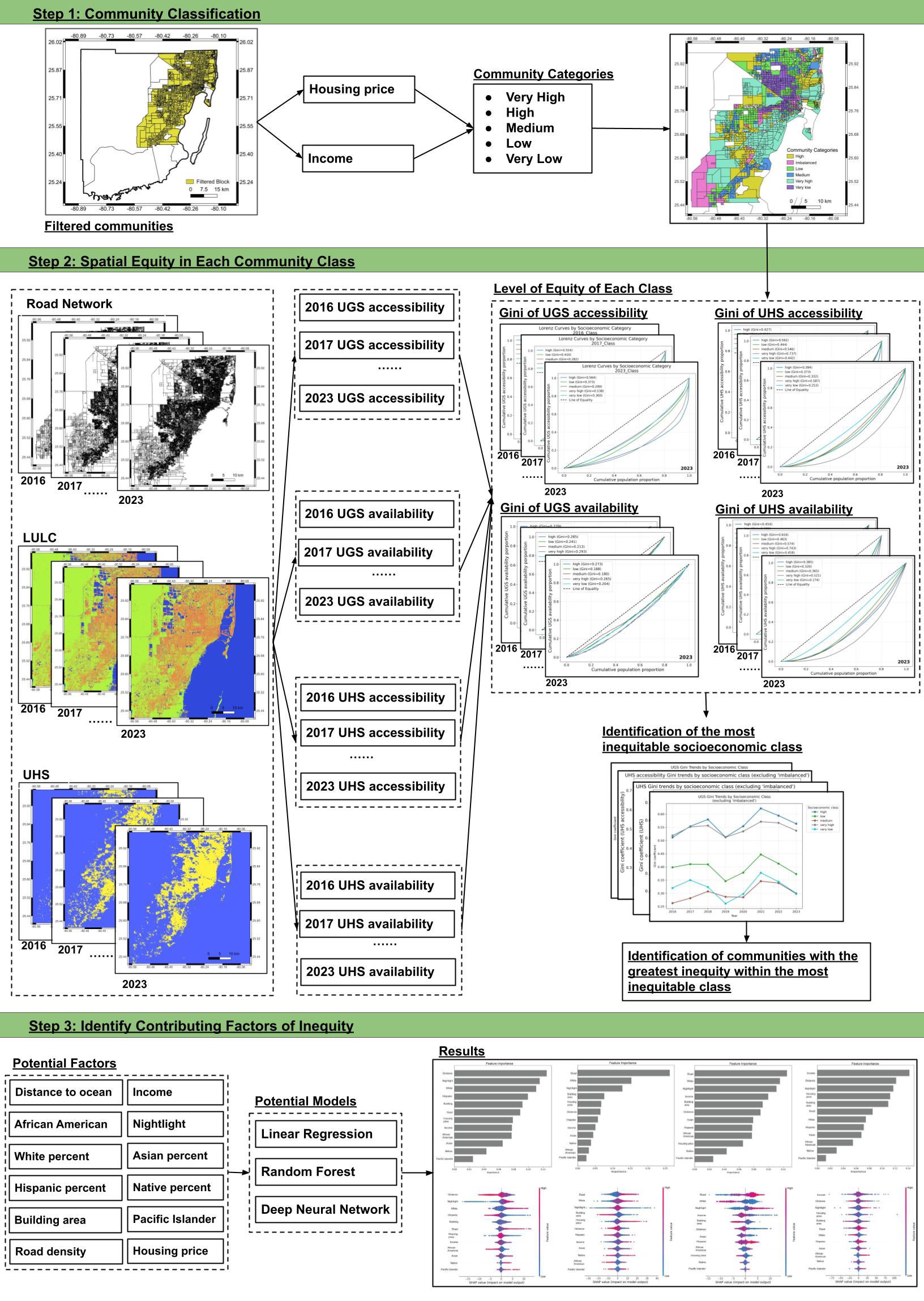
Diagram of general research workflow.
Image by Jiongye Li.
Read More
View Our Publications ▏Back to Forging New Frontiers - June 2026 Issue
If you are interested to connect with us, email us at cdenews@nus.edu.sg