


Underwater environments are among the harshest operating conditions for electronic devices. Divers and underwater robots depend on sensors to navigate, communicate and handle objects, but conventional sensors are fragile, reliant on an external power source and unable to recover when damaged. A punctured sensor underwater typically means lost functionality with little prospect of on-the-spot repair, presenting a limitation that shortens the working life of underwater machines and raises safety concerns for divers.
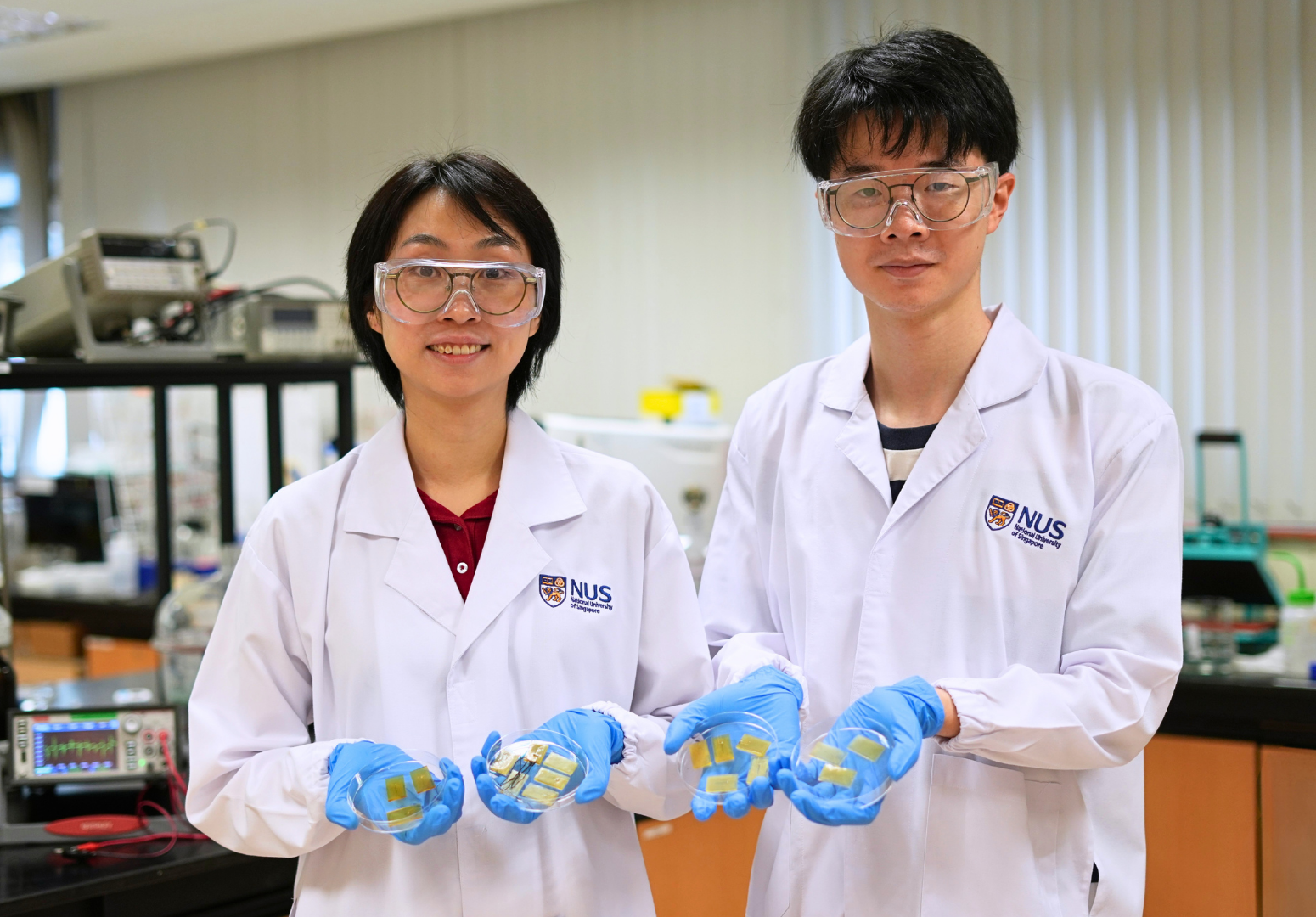
A research team led by Assistant Professor Tan Yu Jun from the Department of Mechanical Engineering at the College of Design and Engineering, National University of Singapore (NUS), has developed a self-healing magnetoelectric sensory system (SMES) that overcomes these challenges in a single device. The system combines self-powered touch and proximity sensing with built-in damage detection and autonomous self-repair, functioning reliably in both air and water.
The team demonstrated the SMES technology in a smart diving glove that lets divers communicate wirelessly through hand gestures, and in a robotic hand that can grasp objects under water while monitoring and recovering from damage in real time. The technology could find wider use in soft robotics, electronic skins and other underwater human-machine interfaces where durability and self-sufficiency are critical.
The work is published in Advanced Materials on 18 April 2026.
Sensing and repairing damage like living skin
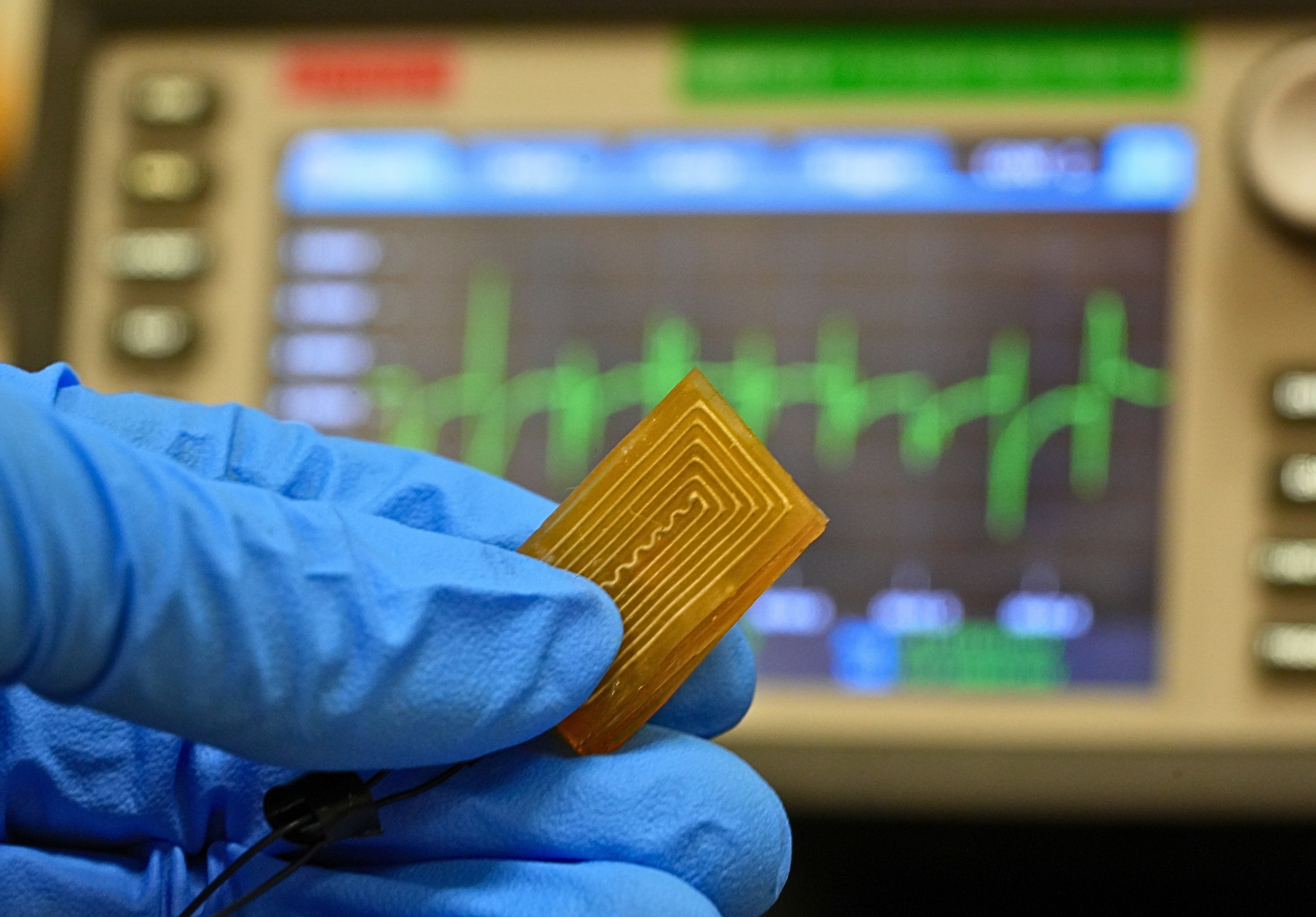
The SMES is inspired by biological skin, which can feel both touch and pain, and heal itself after injury. The device stacks several layers, including a top damage-sensing layer that sits above an electromagnetic sensing layer. Both are built on a stretchable, self-healing elastomer (a rubber-like polymer) laced with liquid-metal conductors.
When the top layer of the sensor is pricked, punctured or cut, its electrical resistance spikes, mimicking the pain response in living tissue. The system can then self-repair because the soft material contains reversible molecular interactions. When two damaged surfaces come back into contact, the molecular groups from either side have the tendency to reconnect, allowing the material to bind back together or “heal”. For instance, after being subjected to needle pricks, the sensor recovers its original electrical performance within seconds and without any external intervention. For more severe damage such as cuts, brief mechanical pressure triggers an initial repair, and the sensor regains full functionality after a longer healing period.
The self-healing elastomer achieves up to 92 per cent elastic recovery and, under mild heating, reaches approximately 82 per cent healing efficiency in air after seven days and nearly 100 per cent under water after 10 days. Remarkably, the sensor retains its damage-detection and self-repair abilities even when fully submerged, where many materials usually struggle to bond back together, and can regain its mechanical integrity and sensing function after damage.
“In our bodies, pain is a protective alarm. It tells us when something is wrong so we can respond before more damage is done,” said Asst Prof Tan. “Our work gives underwater electronics that same capability, enabling devices to sense injury and begin healing autonomously.”
Self-powered and built to last
The SMES generates its own electrical signals through electromagnetic induction — the same principle behind generators and transformers that form the backbone of power systems. Inside the device, a small magnet and a coil of liquid-metal wire sit in adjacent layers. When an object presses on the sensor or moves close to it, the magnet shifts relative to the coil, and the changing magnetic field induces a voltage, enabling both proximity sensing (detecting nearby objects without physical contact) and tactile sensing (measuring applied pressure). This self-powered design eliminates the need for an external power source, a practical advantage in underwater settings where battery access is limited.
The sensor demonstrated a response time of approximately 41 milliseconds, roughly ten times faster than the blink of an eye and maintained stable output after 10,000 cycles of usage – a widely respected benchmark for electronic skins, showing mechanical durability needed for repeated underwater use. In addition, its proximity-sensing performance remained consistent after 10 days of underwater immersion, including in simulated seawater.
From diving gloves to robotic hands
The team built two prototypes to demonstrate real-world use. The first is a smart diving glove for wireless underwater communication: sensors on each fingertip generate distinct voltage patterns for different hand gestures, which are transmitted via Bluetooth to a smartphone. Five gestures map to commands such as “Normal”, “Going up”, “Going down”, “Holding” and “Help” allowing divers to relay status updates without speaking. Red LEDs on the glove light up when the damage sensor detects severe damage, providing a real-time visual warning.
The second prototype is a robotic hand fitted with the SMES technology for underwater grasping and delivery tasks. Three LEDs indicate the sensor’s damage status in real time: green for normal operation, yellow for minor damage that self-repairs rapidly and red for severe structural damage requiring intervention. During testing, the hand successfully grasped and transported objects underwater while detecting and recovering from puncture damage caused by sharp shells.
“The SMES, our electronic skin, can feel, detect damage, and recover after damage be it on land, up in the air or under water, yet does not require power,” added Asst Prof Tan. “We hope to integrate SMES with real robots, prosthetics and wearable devices. The ultimate goal is to develop soft machines that can, even in unpredictable environments, sense their surroundings, recognise when they are damaged, and recover their function, much like living skin.”