


From real estate transactions to transport flows and even individually mapped trees, cities such as Singapore are producing vast quantities of data about how they function.
“Cities today generate enormous amounts of data,” says Assistant Professor Filip Biljecki (Presidential Young Professor, Department of Architecture). “What’s changed is that much of it is now openly available.” That change, he says, “is transforming how we study cities, allowing researchers to analyse urban environments at a scale and level of detail that would previously have been very difficult, expensive or simply impossible.”
Open urban data refers to datasets about cities that are freely accessible and reusable. These include building information, mobility patterns, environmental data and street-level imagery. Over the past two decades, governments, researchers and companies have moved towards sharing such data, driven by goals of transparency, public value and innovation.
For Asst Prof Biljecki, who leads the Urban Analytics Lab at NUS, this shift is tied to a broader principle. Science, he says, “should be open, transparent and reproducible.”
That focus on open, data-driven approaches to understanding cities has also gained international recognition. Asst Prof Biljecki was recently presented with the 2026 Gill Memorial Award by the UK-based Royal Geographical Society for his contributions to urban analytics, geospatial data science and digital twins.
For urban research, the impact has been transformative. “It lowered the barriers to accessing data,” he says. “Before, researchers either could not obtain the data or had to pay for it.”
In one study, Asst Prof Biljecki and his team analysed how people perceive urban environments using thousands of street-level images sourced from open platforms. “If this data was not available openly, we would have had to travel to these cities to collect it ourselves, or be quite limited in the imagery we could use, limiting our study” he explains. “Instead, we were able to download it.” In another line of work, open datasets on buildings and vegetation are combined to simulate environmental conditions such as solar exposure and heat. These models can help identify where solar panels would be most effective and how urban design affects thermal comfort.
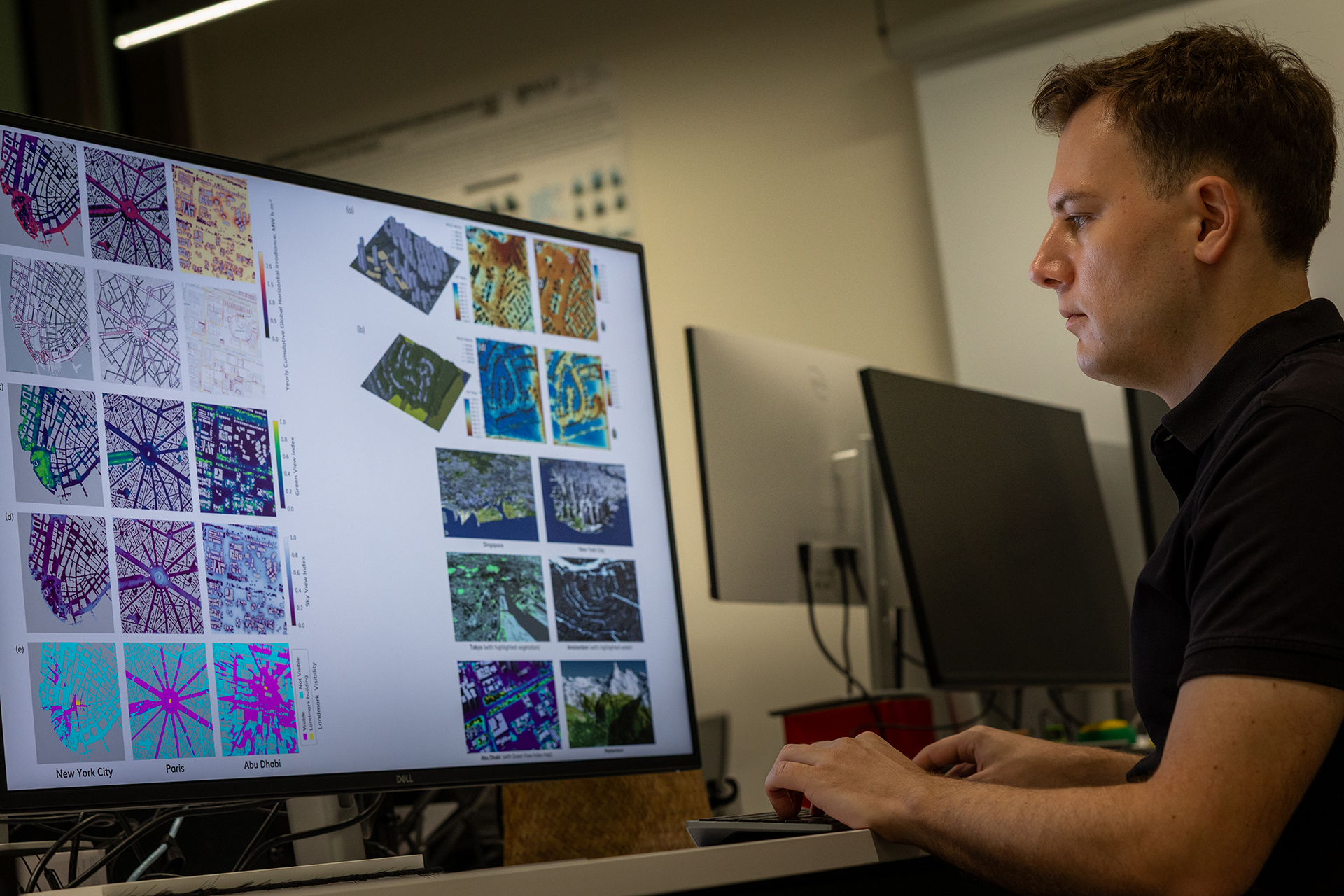
Such studies depend on bringing together multiple sources of data.
In Singapore, these range from centralised government platforms such as data.gov.sg and those of individual agencies, as well as crowdsourced platforms, global datasets and contributions from researchers and community developers. Together, they form a broad ecosystem of urban data spanning government, academia, industry and the public.
What makes this ecosystem powerful is not just the amount of data available, but how it is used and built upon.
Beyond using open data, Asst Prof Biljecki’s research also focuses on understanding it. His group studies the quality, availability and structure of urban datasets, examining how they are released and how they can be improved. In some cases, the team enhances existing datasets and releases improved versions back to the community.
This breadth of data is reflected in both everyday applications and specialised research. The authorities in Singapore, for example, release detailed information on HDB resale transactions, including prices, locations and flat characteristics, updated regularly. Other datasets provide real-time information such as taxi availability or bus arrival times. Many digital services rely on this data, from transport applications to navigation tools.
In some cases, the level of detail is striking. Singapore has mapped more than half million individual trees, with data on their species and characteristics, offering researchers a highly granular view of the urban environment. In the Netherlands, the government has detailed information of more than 10 million buildings, such as their year of construction, function and floor area, all released openly without restrictions for their use.
The availability of such data is shaping how cities are taught. Asst Prof Biljecki incorporates open datasets into his courses, allowing students to work directly with real-world data about Singapore. “Students can analyse real urban data and explore questions about the city they live in,” he says.
Assignments might involve analysing housing transactions or studying transport systems, helping students develop technical skills alongside a deeper understanding of the local context. Open data introduces students to core research principles, including reproducibility. “Anyone should be able to take the same data and replicate the analysis,” he says.
This same openness is also enabling new forms of collaboration. Asst Prof Biljecki’s lab, which actively releases its own datasets, has seen how sharing data can lead to new partnerships. In one case, a team in Hong Kong used the lab’s dataset to build on the work and later reached out to collaborate. “This would not have happened if we had not released the data openly,” he says.
For Asst Prof Biljecki, openness is largely about impact. “When data is shared, it allows others to build on the work and take it further,” he says.
As more data becomes available, the ability to study cities in detail will continue to expand. By making urban data more accessible, researchers are gaining new tools for analysis and opening new possibilities for understanding and improving the cities people live in.