

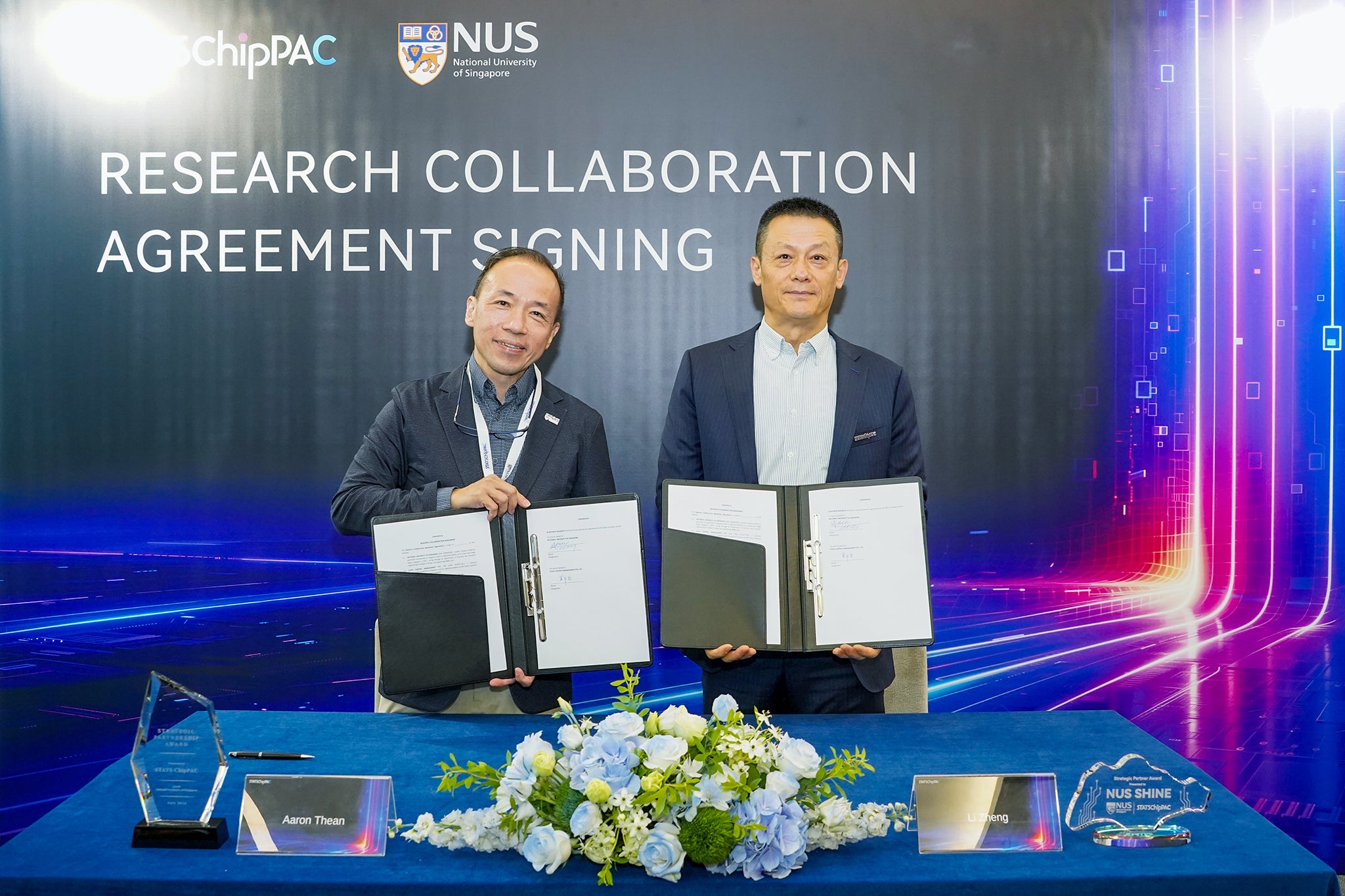
On 6 July 2026, Singapore Hybrid-Integrated Next-Generation µ-Electronics Centre (SHINE) at CDE has signed a Research Collaboration Agreement with STATS ChipPAC to advance photonic packaging technologies that could power the next generation of AI, high-performance computing and data-centric systems. The agreement was signed by SHINE Director Prof Aaron Voon-Yew Thean, Deputy President (Academic Affairs) and Provost, and STATS ChipPAC CEO Li Zheng.
Building on a Memorandum of Understanding (MoU) signed in 2025, this collaboration focuses on developing manufacturing technologies for photonic and semiconductor systems, with a particular emphasis on detachable Fibre Array Unit (FAU) technology for wafer-level optical testing. This allows known good dies to be identified prior to packaging, thus improving manufacturing yield, reducing waste, and enhancing the scalability, reliability and cost-effectiveness of photonic integration.
The agreement brings together STATS ChipPAC’s strengths in advanced semiconductor packaging, system integration, and manufacturing with the SHINE Centre’s research strengths. Hosted at CDE, SHINE serves as a multidisciplinary platform for next-generation hybrid-integrated microelectronics, connecting academia, public-sector research and industry to advance future heterogeneous integration technologies. It highlights CDE’s focus on translating deep research into practical applications that address industry needs and strengthen Singapore’s innovation ecosystem. This work also contributes to Singapore’s Semiconductor Research, Innovation and Enterprise (RIE2030) Flagship, supporting the country’s broader ambitions in advanced semiconductor innovation.
SHINE Programme Director Prof Yeow Kheng Lim (Electrical and Computer Engineering) said, “Singapore’s ability to lead in next-generation semiconductors will depend on how effectively we translate deep research into manufacturing-ready technologies. This collaboration reflects our commitment to building strong industry partnerships, advancing photonic packaging innovation, and developing talent that can drive the future of computing.”
Beyond research outcomes, the collaboration will also create opportunities for researchers, graduate students and engineers to work on joint projects, knowledge exchange and industrial attachments — strengthening Singapore’s semiconductor innovation ecosystem and growing future-ready talent.