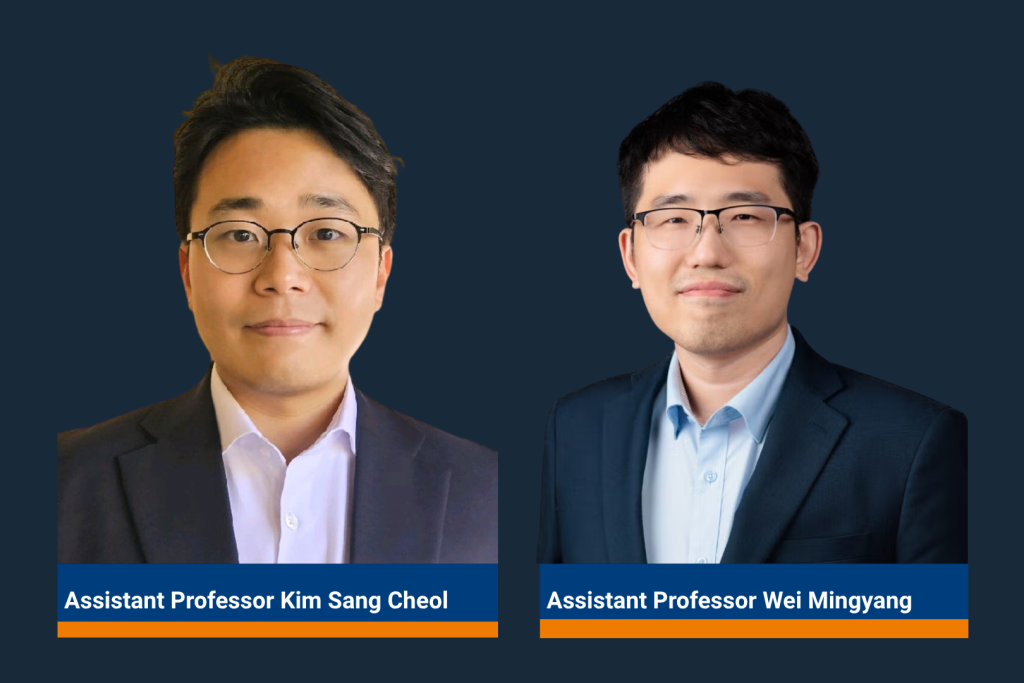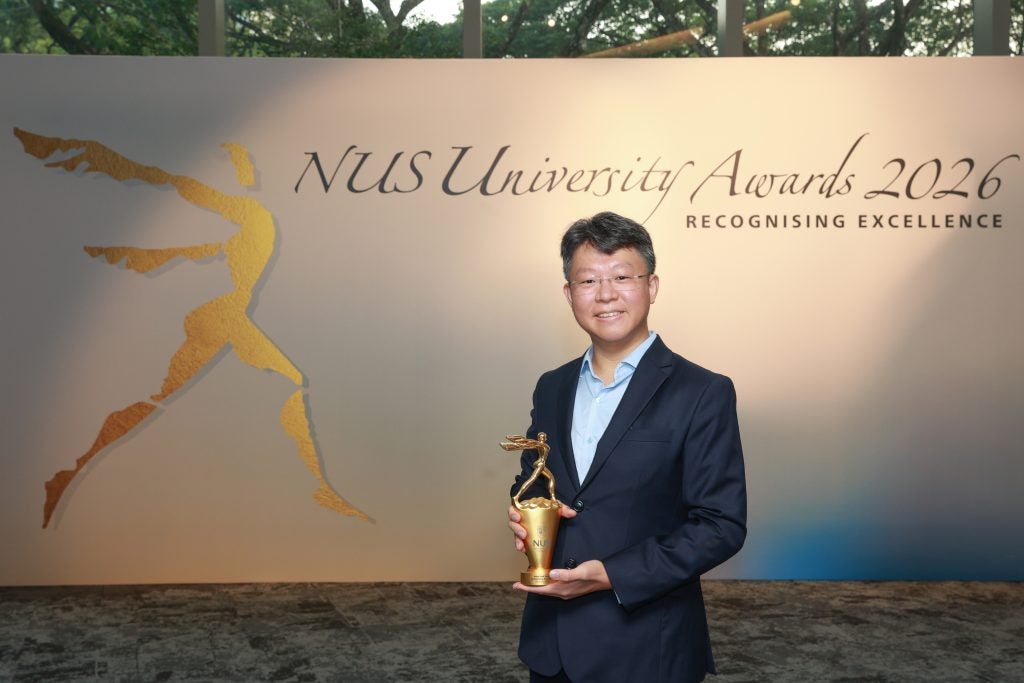
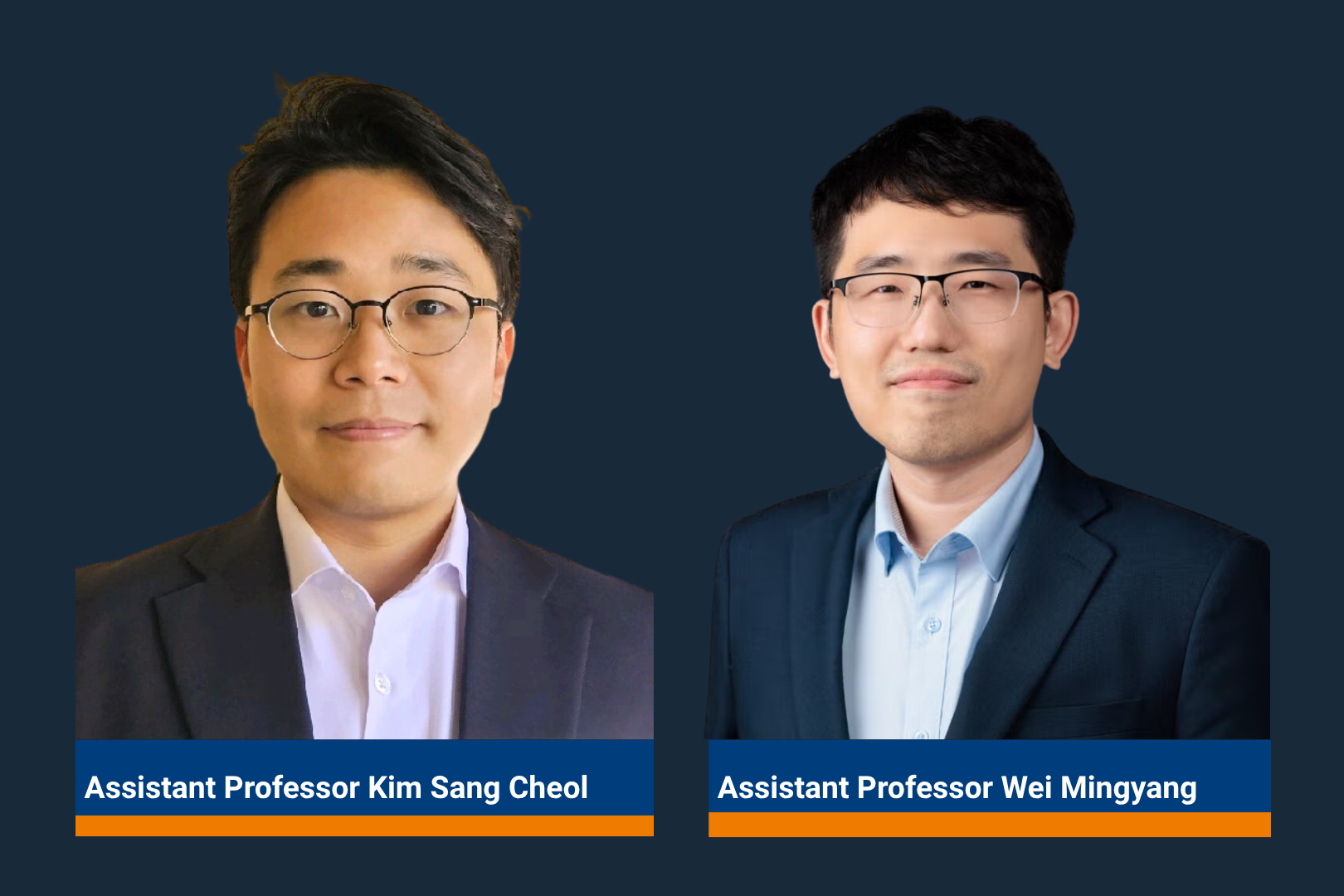
Two faculty members from the College of Design and Engineering (CDE) have been named National Research Foundation (NRF) Fellows in the Class of 2026.
Under the Fellowship programme, Assistant Professor Kim Sang Cheol(opens in new tab) (Department of Chemical and Biomolecular Engineering(opens in new tab)) will use automation and machine learning to design better battery electrolytes, whilst Assistant Professor Wei Mingyang(opens in new tab) (Department of Materials Science and Engineering(opens in new tab)) will develop a simpler, greener way to manufacture the semiconductor devices behind solar cells and LEDs.
Both also hold NUS Presidential Young Professorships.
The NRF Fellowship gives outstanding early-career scientists and engineers the freedom and funding to lead independent research programmes in Singapore. The Fellowship is part of Singapore’s Research, Innovation and Enterprise RIE efforts to grow Singapore’s talent ecosystem. It supports promising researchers, local and global, to advance their scientific journeys and to contribute to research that advances knowledge and creates impact.
Asst Prof Kim Sang Cheol: Designing better batteries with automation
The liquid electrolyte that carries charge inside a battery is one of the biggest levers on performance, but the best electrolytes are complex mixtures with an impractically large number of possible recipes to test by hand.
Asst Prof Kim's project, Data-driven Autonomous Design of Electrolytes for Energy Storage, will build an automated laboratory that mixes and tests electrolytes without manual intervention, guided by machine learning. The platform will handle solid powders as well as liquids, widening the range of recipes it can prepare. The aim is both to discover high-performance electrolytes for next-generation lithium and sodium batteries and to reveal why certain formulations work.
During his PhD at Stanford, Asst Prof Kim pioneered "high-entropy" electrolytes in a highly cited 2023 Nature Energy paper. He later conducted postdoctoral research with 1997 Nobel Laureate Professor Steven Chu and spent three years as an engineer at LG Chem.
More about his research at: https://www.sckimlab.com/
Asst Prof Wei Mingyang: Rethinking how semiconductors are made
Making semiconductor devices is traditionally slow, costly and energy-intensive, relying on high-temperature, high-vacuum processing to build up one thin layer at a time.
Asst Prof Wei's project, One-step heterostructure formation for next-generation semiconductor manufacturing, aims to lay all those layers down in a single step instead. He works with halide perovskites, a class of materials that can be applied from a solution at low temperatures rather than baked in a vacuum. As the liquid dries, specially designed molecules automatically arrange themselves into the correct stack of layers, forming, in a single coating step, a structure that would normally require many steps. The approach aims to cut both the cost and the carbon footprint of making solar cells, LEDs and sensors, positioning Singapore as a leader in more sustainable semiconductor manufacturing.
Asst Prof Wei has been named a Clarivate Highly Cited Researcher in 2022 and 2023, and listed among Forbes' 30 Under 30 in Europe in 2022.
More about his research can be found at: https://www.wei-lab-at-nus.org/