


In Memoriam:
Dr Liu Thai Ker (1938-2026)
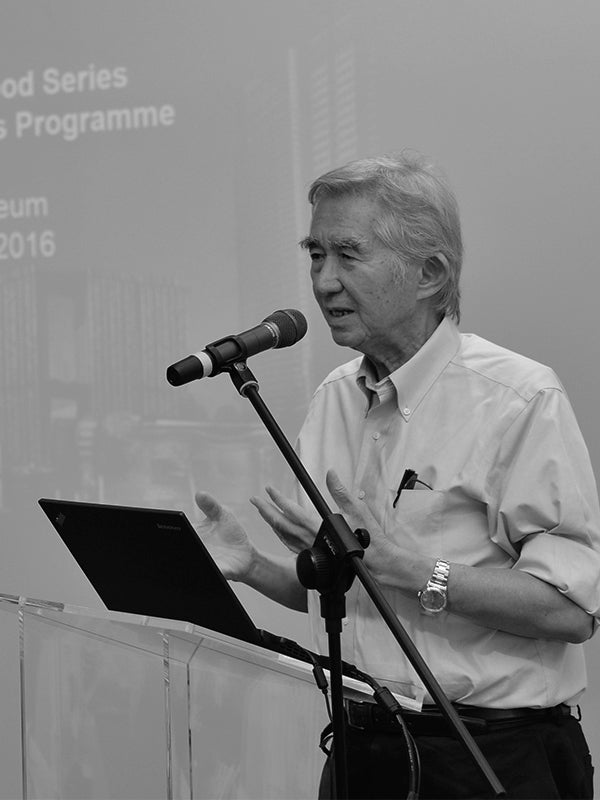
We are saddened by the loss of architect Dr Liu Thai Ker, who passed on the morning of 18 January 2026. Our deepest condolences to his family and loved ones.
Dr Liu was the former Chair of the Advisory Committee for the Department of Architecture. He was also an adjunct professor at the former School of Design & Environment (SDE), which has since merged with the Faculty of Engineering to form the College of Design and Engineering.
Recognised as Singapore’s pioneer master planner and often called the father of urban planning, he is credited with the successful rollout of public housing in Singapore during the 1970s and 1980s. He championed the principle of ‘good housing before good architecture’, prioritising environmental concerns, affordability, and social aspects.
Always a visionary, he understood early on the importance of examining complex issues, such as Singapore's urban planning, from every angle. As part of the NUS Greater Good Series in a sharing session in April 2016, entitled “Humanist’s Heart, Scientist’s Mind and Artist’s Eyes – Stories behind my Planning Journey” he stated “To be a good urban planner, you need to have a humanist’s heart for the people and the land, a scientist’s head for designing a perfect machine for living, and an artist’s eyes for romancing the land. It’s like being a symphony conductor; all elements must come into place.”
Besides his contribution to the housing and urban planning of Singapore and beyond, Dr Liu has also left a significant impact on Singapore's architectural education. The Department of Architecture owes much to Dr Liu, who played a pivotal role in the Department’s major curriculum review in the early 1980s during his tenure as Chairman of the School of Architecture Advisory Committee.
He was instrumental in the appointment of Professor Eric Lye to undertake a comprehensive study of the architecture programme and to make recommendations for its renewal. This review led to the replacement of the then four-and-a-half-year programme with a five-year, two-tier structure that incorporated a ten-month period of practical industry immersion. In addition to local accreditation, the restructured programme subsequently achieved international accreditation by the RIBA. Under Dr Liu’s chairmanship, the Department and its academic programmes grew steadily from strength to strength.
"At CDE, we join the nation in mourning the loss of Dr Liu Thai Ker. His legacy is deeply etched into our community — an embodiment of the ideals we uphold, integrating human-centric design with practical engineering to serve society. His life's work stands as a powerful testament and an enduring source of inspiration for students, faculty, and future generations. Though we have lost a pioneer, his visionary spirit will continue to inspire and guide architects, planners and engineers committed to shaping a better world.”
Professor Teo Kie Leong, Dean, CDE.
“Dr Liu Thai Ker’s celebrated accomplishments as a leading planner of Singapore demonstrate how architects and planners can make a significant and lasting contribution to society. From housing to planning for new towns, he did so through a holistic understanding of the built environment and the social life of citizens and communities. For the Department of Architecture, he will be remembered fondly as a pioneer, a mentor, and a member of our community.” Professor Jeff Hou, Head, Department of Architecture.
“Beyond his contributions to housing and urban planning in Singapore and internationally, Dr Liu left a lasting legacy in architectural education. As Chairman of the Department of Architecture Advisory Committee in 1982, he guided a major curriculum review that led to the introduction of a five-year, two-tier architecture programme with a ten-month industry immersion, later accredited locally and by the RIBA. Under his chairmanship, the Department and its programmes grew steadily from strength to strength." Professor Heng Chye Kiang, Deputy Dean CDE, who had first worked with Dr Liu in the 1990s as the then Deputy Head of Architecture.
Reflections In Memoriam
Emeritus Professor Yong Kwet Yew, Department of Civil & Environmental Engineering and former Senior Vice President, University Campus Infrastructure (2000-2022)
Dr Liu left not only a legacy of city and urban planning, he also left a legacy of his architecture design and campus planning at NUS. I was privileged and honoured to have worked with Dr Liu on three NUS projects in the 2000s when I was then Vice President of University Campus Infrastructure - University Hall, Yong Siew Toh Conservatory of Music and the initial campus planning of University Town at the old Warren Golf Course in Dover Road. As a civil engineer by training, I learnt from Dr Liu the finer points of Architectural design and spatial planning at a human scale. Dr Liu also played a significant role in helping the university obtain the land at the old Warren Golf Course at Dover Road for the development of University Town (UTown). His strategy to develop a walkable residential college campus at UTown and connected to the main campus through a NUS owned bridge convinced the Cabinet to lease the land to the University. This strategy provided the Campus Planning team with the blueprint for the successful development of University Town.
Professor Heng Chye Kiang, Deputy Dean, CDE
My first professional engagement with him was when he served as Chairman of the Department of Architecture’s (DOA) Advisory Committee. Subsequently, I also worked with him for nine years as a board member of the Centre for Liveable Cities (CLC) under his chairmanship. Beyond these formal roles, I have also interacted with him during and after this period as both a friend and a junior colleague.
While he was invariably serious, thoughtful, and wise in matters of work—whether as Chairman of the DOA Advisory Committee or of the CLC Board—he was, in personal interactions, warm, friendly, and often humorous. I had the good fortune to work with him on several separate projects and consistently found him to be a discerning, nurturing, and generous individual who was keen to create opportunities for others.
On a couple of occasions, although he himself was the invited guest, he recommended me in his place as a keynote speaker. Similarly, he nominated me to serve as editor or author for 50 Years of Urban Planning in Singapore and Singapore Chronicles: Urban Planning. Despite being a veritable expert on Chinese cities, he consulted me when planning Greater Xi’an, recognising my long-standing research on the history and digital reconstruction of Tang-period Chang’an, upon which modern Xi’an is founded. He was also always generous with his time, readily sharing his experience and expertise with our students whenever we invited him to give lectures, whether public or academic. He particularly enjoyed engaging with young people, often telling them that planning requires 人文心、科学脑、艺术眼—a humanistic heart, a scientific mind, and an artistic eye—and that it is ultimately 与大地谈恋爱, a dialogue, even a romance, with the land.
Professor Khoo Teng Chye, Founding Director, NUS Cities
I had the opportunity to work with Dr Liu twice.
When he was appointed the first CEO and Chief Planner in 1989, I was his deputy and was able to see first hand his brilliant stewardship in giving shape and substance to the revamped urban planning system that MND had worked out which was aimed to be more open and transparent with 3 levels of planning: the long term Concept Plan, the Masterplan ( a composite of 55 Development Guide Plans(DGPs) ) and Urban Design plans. Dr Liu was able to meticulously guide the URA team to undertake the detailed , gruelling task of preparing the first Concept Plan under the new system in 1991, as well as the DGPs and some urban design plans. He famously guided the idea of planning for a Year X, which would give us the buffer for an additional 1 million people on the island, as we are a country with only one city, and we could not afford to go wrong in our planning. This long term thinking as a professional urban planner is what made him to keep advocating that we need to plan for ( as opposed to having a population target) 10 million.
More than 2 decades later, I returned to MND to be Executive Director of the Centre for Liveable Cities, which Dr Liu was the Founding Chair of the Advisory Board. He was passionate about the mission of CLC. Singapore had accomplished so much in our urban development but we had not documented the thinking, the policies and the trade-offs in considering different policy options and that it was not all plain sailing. This led to a system of interviews assisted by the Oral History department of the National Archives and the writing of case studies known as Urban Systems Studies. He helped distil the Liveability Framework which articulated the urban systems approach of solving our urban problems. This is the Framework and the USSs, which now anchor the NUS Cities pedagogy. He was adamant that CLC focused on this key aspect of its work and not get too embroiled in overly theoretical research.
Singapore has lost a unique individual who devoted his life to transforming Singapore to the liveable, sustainable and resilient city that it now is, and a model for all cities. NUS Cities has a role to continue the legacy of our urban pioneers like him to educate a new generation of city leaders in what practical urban planning and development is all about.
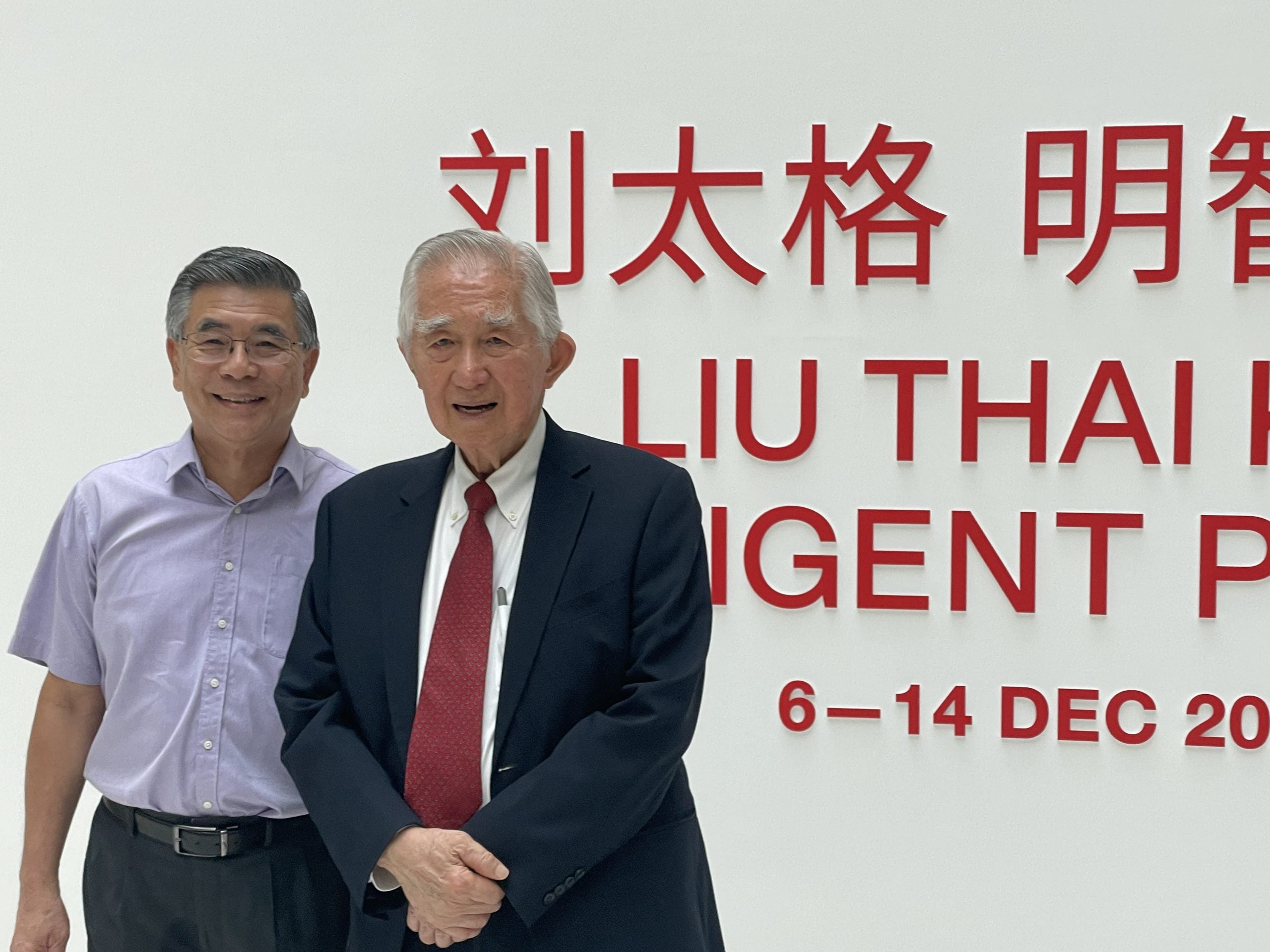 | Professor Lam Khee Poh, Department of Architecture & the Built Environment and former Dean, School of Design & Environment As Acting Dean of the then Faculty of Architecture, Building and Real Estate (FABRE) (1998-2000), I had the privilege of working with Dr Liu Thai Ker, then Chairman of FABRE Board, to restructure the Faculty to become the School of Design and Environment. We shared a common belief of the pre-eminence of design thinking across multi disciplines engaged in creating a holistic environment, integrating the natural and the built components. |
 | Associate Professor Johannes Widodo, Department of Architecture Liu Thai Ker was a respected figure in Singapore’s urban development, and to me, a gentle and memorable presence. He was soft spoken, thoughtful, and calm in manner. I met him several times over the years at various academic occasions, moments I now recall with quiet warmth. I last met him on 11 August 2023 at an event at NUS Alumni House. Our exchanges were always short, yet meaningful. He listened with patience and spoke with simple, deep wisdom. His legacy lives on in the cities he helped shape and in the personal kindness he shared so generously. Rest in peace. |
 | Wisely Ong, PhD Candidate, Department of Civil and Environmental Engineering Really saddened to hear of Dr Liu Thai Ker’s passing. A visionary and very much ahead of his time, he played a defining role in shaping Singapore’s urban growth and development. His groundbreaking and thoughtful ideas and philosophy to urban planning and design have left an indelible mark on our city and cities abroad. I am deeply fortunate and honoured to have met him a few times through the World Cities Summit and Singapore Institute of Planners events and have learnt much from our brief yet provocative discussions. May his legacy continue to guide and inspire all of us, and may he rest in peace. |
Professor Lee Poh Seng, Head, Department of Mechanical Engineering
Singapore’s success is often described in terms of policies and institutions. Dr Liu reminds us of something equally vital: the power of individuals who carry a lifelong commitment to getting the fundamentals right, quietly, relentlessly, and at scale. May we honour his legacy not only by remembering what he helped build, but by sustaining the standard he set: long-term thinking, systems clarity, and a relentless focus on liveability for all.
Emeritus Professor Yong Kwet Yew, Department of Civil & Environmental Engineering and former Senior Vice President, University Campus Infrastructure (2000-2022)
Dr Liu left not only a legacy of city and urban planning, he also left a legacy of his architecture design and campus planning at NUS. I was privileged and honoured to have worked with Dr Liu on three NUS projects in the 2000s when I was then Vice President of University Campus Infrastructure - University Hall, Yong Siew Toh Conservatory of Music and the initial campus planning of University Town at the old Warren Golf Course in Dover Road. As a civil engineer by training, I learnt from Dr Liu the finer points of Architectural design and spatial planning at a human scale. Dr Liu also played a significant role in helping the university obtain the land at the old Warren Golf Course at Dover Road for the development of University Town (UTown). His strategy to develop a walkable residential college campus at UTown and connected to the main campus through a NUS owned bridge convinced the Cabinet to lease the land to the University. This strategy provided the Campus Planning team with the blueprint for the successful development of University Town.
Professor Heng Chye Kiang, Deputy Dean, CDE
My first professional engagement with him was when he served as Chairman of the Department of Architecture’s (DOA) Advisory Committee. Subsequently, I also worked with him for nine years as a board member of the Centre for Liveable Cities (CLC) under his chairmanship. Beyond these formal roles, I have also interacted with him during and after this period as both a friend and a junior colleague.
While he was invariably serious, thoughtful, and wise in matters of work—whether as Chairman of the DOA Advisory Committee or of the CLC Board—he was, in personal interactions, warm, friendly, and often humorous. I had the good fortune to work with him on several separate projects and consistently found him to be a discerning, nurturing, and generous individual who was keen to create opportunities for others.
On a couple of occasions, although he himself was the invited guest, he recommended me in his place as a keynote speaker. Similarly, he nominated me to serve as editor or author for 50 Years of Urban Planning in Singapore and Singapore Chronicles: Urban Planning. Despite being a veritable expert on Chinese cities, he consulted me when planning Greater Xi’an, recognising my long-standing research on the history and digital reconstruction of Tang-period Chang’an, upon which modern Xi’an is founded. He was also always generous with his time, readily sharing his experience and expertise with our students whenever we invited him to give lectures, whether public or academic. He particularly enjoyed engaging with young people, often telling them that planning requires 人文心、科学脑、艺术眼—a humanistic heart, a scientific mind, and an artistic eye—and that it is ultimately 与大地谈恋爱, a dialogue, even a romance, with the land.
Professor Khoo Teng Chye, Founding Director, NUS Cities
I had the opportunity to work with Dr Liu twice.
When he was appointed the first CEO and Chief Planner in 1989, I was his deputy and was able to see first hand his brilliant stewardship in giving shape and substance to the revamped urban planning system that MND had worked out which was aimed to be more open and transparent with 3 levels of planning: the long term Concept Plan, the Masterplan ( a composite of 55 Development Guide Plans(DGPs) ) and Urban Design plans. Dr Liu was able to meticulously guide the URA team to undertake the detailed , gruelling task of preparing the first Concept Plan under the new system in 1991, as well as the DGPs and some urban design plans. He famously guided the idea of planning for a Year X, which would give us the buffer for an additional 1 million people on the island, as we are a country with only one city, and we could not afford to go wrong in our planning. This long term thinking as a professional urban planner is what made him to keep advocating that we need to plan for ( as opposed to having a population target) 10 million.
More than 2 decades later, I returned to MND to be Executive Director of the Centre for Liveable Cities, which Dr Liu was the Founding Chair of the Advisory Board. He was passionate about the mission of CLC. Singapore had accomplished so much in our urban development but we had not documented the thinking, the policies and the trade-offs in considering different policy options and that it was not all plain sailing. This led to a system of interviews assisted by the Oral History department of the National Archives and the writing of case studies known as Urban Systems Studies. He helped distil the Liveability Framework which articulated the urban systems approach of solving our urban problems. This is the Framework and the USSs, which now anchor the NUS Cities pedagogy. He was adamant that CLC focused on this key aspect of its work and not get too embroiled in overly theoretical research.
Singapore has lost a unique individual who devoted his life to transforming Singapore to the liveable, sustainable and resilient city that it now is, and a model for all cities. NUS Cities has a role to continue the legacy of our urban pioneers like him to educate a new generation of city leaders in what practical urban planning and development is all about.
Professor Lam Khee Poh, Department of Architecture & the Built Environment and former Dean, School of Design & Environment
As Acting Dean of the then Faculty of Architecture, Building and Real Estate (FABRE) (1998-2000), I had the privilege of working with Dr Liu Thai Ker, then Chairman of FABRE Board, to restructure the Faculty to become the School of Design and Environment. We shared a common belief of the pre-eminence of design thinking across multi disciplines engaged in creating a holistic environment, integrating the natural and the built components.
Associate Professor Johannes Widodo, Department of Architecture
Liu Thai Ker was a respected figure in Singapore’s urban development, and to me, a gentle and memorable presence. He was soft spoken, thoughtful, and calm in manner. I met him several times over the years at various academic occasions, moments I now recall with quiet warmth. I last met him on 11 August 2023 at an event at NUS Alumni House. Our exchanges were always short, yet meaningful. He listened with patience and spoke with simple, deep wisdom. His legacy lives on in the cities he helped shape and in the personal kindness he shared so generously. Rest in peace.
Wisely Ong, PhD Candidate, Department of Civil and Environmental Engineering
Really saddened to hear of Dr Liu Thai Ker’s passing. A visionary and very much ahead of his time, he played a defining role in shaping Singapore’s urban growth and development. His groundbreaking and thoughtful ideas and philosophy to urban planning and design have left an indelible mark on our city and cities abroad. I am deeply fortunate and honoured to have met him a few times through the World Cities Summit and Singapore Institute of Planners events and have learnt much from our brief yet provocative discussions. May his legacy continue to guide and inspire all of us, and may he rest in peace.
Professor Lee Poh Seng, Head, Department of Mechanical Engineering
Singapore’s success is often described in terms of policies and institutions. Dr Liu reminds us of something equally vital: the power of individuals who carry a lifelong commitment to getting the fundamentals right, quietly, relentlessly, and at scale. May we honour his legacy not only by remembering what he helped build, but by sustaining the standard he set: long-term thinking, systems clarity, and a relentless focus on liveability for all.