Graduate Research Symposium 2025
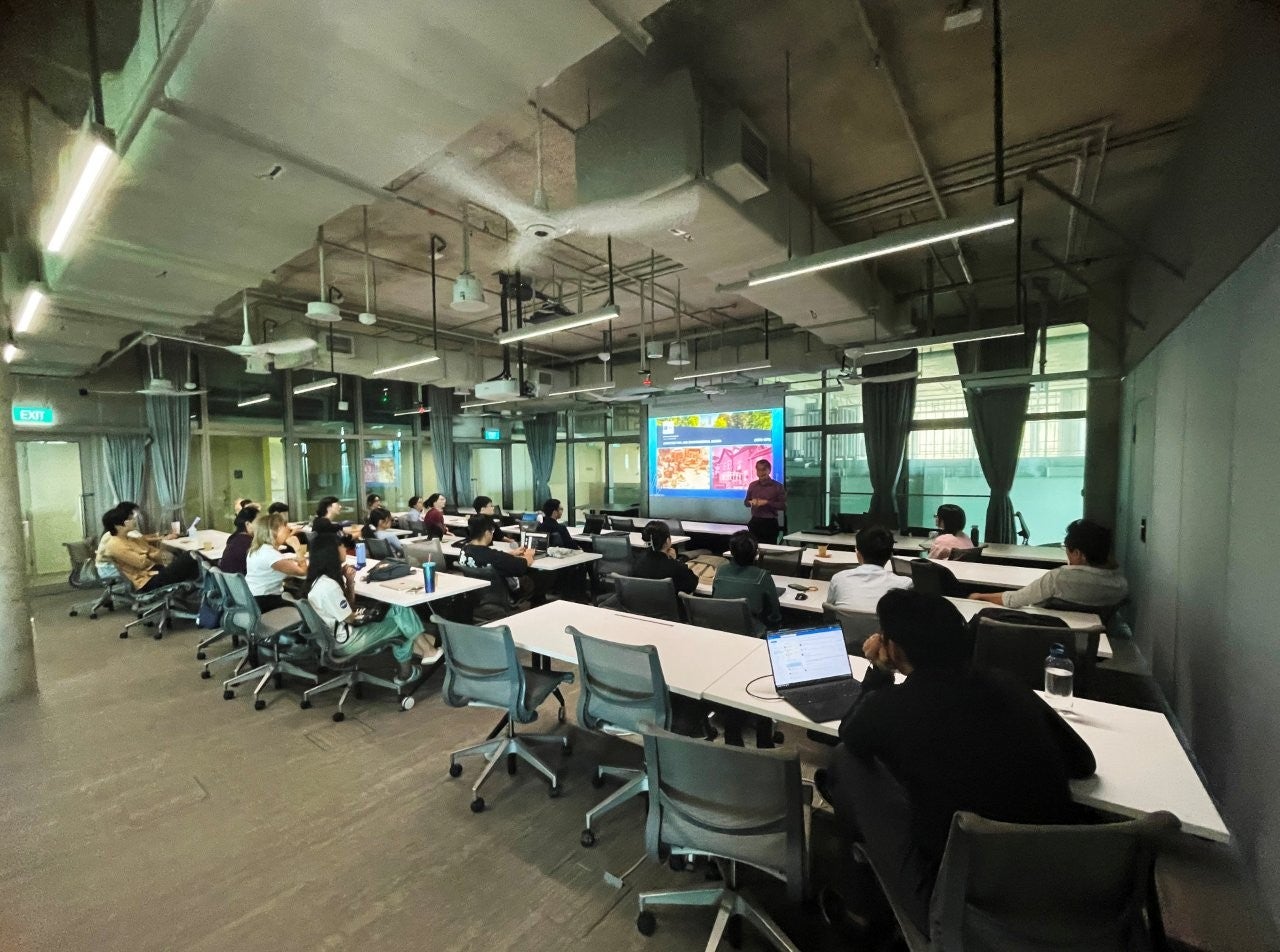
PANEL A: Social Inclusion & Space
Time: 10:30AM – 12:10 PM
Moderated by: Dr. Li Shengxiao Alex, Assistant Professor
Venue: Executive Room 1, SDE4
Speakers:
XIANG XIAOTONG
Ageing in Place while Living Alone in Singapore’s Urban Context
In Singapore, as population ages and household structures shift, the number of older adults living alone has more than doubled over the past decade, growing faster than the overall older population. While Singapore has embraced ageing in place (AIP) as a national priority to promote independence and wellbeing in later life, the realities of living alone in later life complicate this goal. AIP is commonly defined as enabling older adults to live relatively independently, safely and comfortably in their home and community for as long as possible. However, older adults who live alone often confront vulnerabilities linked to declining physical capacity, limited social support and the demands of navigating environments that may not always be designed with their needs in mind. Understanding the lived experiences of living alone in later life is therefore essential for supporting successful ageing in place in Singapore. While much of the existing empirical research on ageing in place and older adults living alone focuses on Western, low-density contexts, there is limited understanding of how older adults living alone navigate high-rise, high-density urban environments like Singapore. This study aims to develop a conceptual foundation for studying ageing in such settings. It begins by unpacking the definitional ambiguities of living alone in Singapore’s context, and explores life-course variations of living alone shaped by gender and generational cohorts. This study then traces the evolution of person-environment theories, noting the shift from static models of ‘fit’ to more dynamic approaches that foreground agency, belonging, autonomy and identity. By synthesising these strands of research, this study argues for an adapted conceptual framework that captures the complexities of ageing in place while living alone in Singapore’s urban context. This conceptual groundwork will inform the empirical component of the author’s doctoral research.
Keywords: Ageing in place, living alone, high-rise high-density, person-environment relationships, gender
WANG JUN
When Canteens Meet Riders – Reimagining Social Support for Older Adults through Hybrid O2O Food Spaces
Digital technologies increasingly extend physical public spaces into digital realms, generating new forms of connection as well as exclusion, particularly within ageing societies. This study examines hybrid online-to-offline (O2O) food-space models in high-density ageing districts: (1) Hawker Centre @ Our Tampines Hub integrated with Grab Mix & Match in Singapore, and (2) community canteens linked with Ele.me in Putuo, Shanghai. While both adopt O2O logistics, Singapore’s universal model emphasizes inclusive participation across generations, whereas Shanghai’s age-prioritized model focuses on older-adult-first design and promotes intergenerational interaction and community spill-over. Rather than contrasting physical and digital realms, the study investigates how their integration shapes older adults’ access, experiences, and social support within everyday food environments, and how these hybrid practices are represented—or neglected—within policy frameworks across differing demographic, financial, and governance contexts.
At this stage, three progressive methods are applied for iterative evaluation: the Two-Step Floating Catchment Area (2SFCA) method, small-sample text mining of online reviews, and policy coding and mapping. By integrating geographic data, online comments, and policy documents, the research assesses the developmental potential of hybrid food spaces. Preliminary findings suggest that hybrid O2O dining environments may serve as social catalysts, enhancing participation, interaction, and resilience within older adults’ support networks, while fostering intergenerational encounters in shared urban contexts. Furthermore, the comparison between the universal and age-prioritized models reveals reciprocal insights that can inform age-inclusive design and governance. Future work will extend the analysis through field data collection, observations, and stakeholder interviews to validate and deepen these findings.
Keywords: Hybrid Online-to-Offline (O2O); Food-based Public Spaces; Older Adults; Social Support
NGUYEN DANG DAO
Planning with Citizens in Urban Vietnam: Civic Urbanism under Authoritarian Regimes
The rapid expansion of community-based and citizen-participatory practices in urban planning has prompted critical reflection on the complex interactions between the government and citizens across Asia. However, in less democratic contexts such as Vietnam and China, there is still a substantial gap in understanding how the participation of urban residents in urban planning and governance, or civic urbanism, manifests, what impacts it generates, and how it reshapes city governance. This gap exists not only because of the scarcity of participatory planning initiatives in many authoritarian societies but also due to the political and ethical constraints of conducting research. Nevertheless, examining the absence or limited presence of participatory planning is as crucial as studying its emerging manifestations. This helps reveal how community-based practices are performed, negotiated, controlled, and experienced in different contexts and emphasizes the enduring relevance of promoting citizen engagement even in societies where it has been historically undermined. Focusing on urban Vietnam, this paper examines how an important yet overlooked social group, undereducated women in Tam Ky City, engage in the process. It goes beyond the binary framework of top-down (political elites, experts) versus bottom-up (fishermen, women, youth) actors, which can obscure the power dynamics underlying participatory processes. The participation of women has not only been overlooked by the government but also by families due to discrimination. The key question explores to what extent participatory planning in Tam Ky meaningfully involves women and how outcomes are shaped by intersecting power dynamics. Fieldwork (2024–2025) involved ethnography, interviews, and archival analysis. Findings show women’s participation is often tokenistic, though they negotiate agency through everyday practices and subtle resistance. The research challenges assumptions that participatory practices do not exist in non-Western cities, revealing hybrid, negotiated forms of civic urbanism.
Keywords: participatory planning; civic urbanism; gender and urban governance; Vietnam; authoritarian contexts
SOWMYA SATHISH
The Mindful Classroom: A framework for Design-Mediated Cognition
Over the past decade, schools and universities have increasingly embraced flexibility in classroom design as they move away from the fixed, teacher centric models. This shift reflects a growing belief that adaptable spaces can better support collaboration, creativity, and learner agency, competencies central to 21st-century education. This shift has created a new paradox: the same spatial openness that encourages interaction can also generate cognitive overload, demanding constant adaptation and attentional switching. Learners who thrive in structured environments may struggle to regulate focus or sustain engagement in highly variable settings, revealing an emerging inequity within the very ideal of inclusion.
This paper introduces the concept of Functional–Cognitive Alignment (FCA) to address this paradox. FCA proposes that inclusion in learning spaces depends not only on what environments permit learners to do but on how they support the mental processes required to do it. Drawing on Affordance Theory, Cognitive Load Theory, Cognitive Flexibility Theory, and Socio-Material perspectives, the framework conceptualises learning spaces as triadic systems in which spatial form, pedagogical function, and cognitive process operate as co-regulating conditions for learning. Inclusion is achieved when these dimensions reach equilibrium, when flexibility empowers without overwhelming.
The central research question guiding this concept paper is: How can classroom flexibility be designed to sustain cognitive alignment and equitable participation in twenty-first-century learning?
Future work will operationalise this framework through construct development, instrument design, and empirical validation linking spatial features to cognitive load and learning outcomes. By repositioning cognition as a design parameter, FCA reframes flexibility not as freedom alone, but as the discipline of creating spaces that think with their users.
Keywords: Cognitive Inclusion, Flexible Learning Environments, Design-Mediated Cognition, Spatial Alignment
NIRIT RIVKA ELLENBOGEN
Negotiating continuity and familiarity in the context of displacement processes: Evidence from Singapore public housing community
In Singapore continuous displacement phenomenon, resulting from the Selective En-bloc Scheme (SERS, ongoing since 1995) is expected to intensify with the launch of new Voluntary Early Redevelopment Scheme (VERS) from early 2030’s. In such rising uncertainty and change the sense of continuity and familiarity, both inherit stability and taking long-time to occur, may be challenged.
My research examines the role of continuity and familiarity in residents’ negotiation over displacement process and other changes, over time. The study focusses on Tanglin Halt public housing community as it has undergone its third SERS project, which is SERS’ largest and most complex so far, involved with displacing 3,600 households to 5 replacement sites and redeveloping the old and new neighborhood centers.
An original methodology proposes a conceptual framework to examine residents’ negotiation over continuity/familiarity, comprises four interdependent dimensions: continuity/familiarity, socio-spatial network, community-ties and negotiation. Theory of affordances is employed to trace the dynamic adaptation to change and how through acquiring affordances in the old and the new neighborhoods, residents negotiate familiarity and continuity.
As part of ongoing longitudinal qualitative study (started in September 2020), this methodology is operationalized through policy review, GIS geo-spatial mapping, first-person observations and recurring interviews with residents and visitors of Tanglin Halt and Margaret Drive neighborhoods. The study highlighted the residents’ capacity in negotiating the change as a fundamental need, critical for successfully navigating displacement. Surprisingly, the findings uncovered varying patterns of negotiations, not related to age, which were shaped by individual familiarity thresholds. It explained how through negotiating old and new familiarity, residents restore or reproduce sense of continuity. By so doing, the research redefined familiarity and continuity as intertwined dynamic processes and the core of transformative attachments.
Keywords: Displacement processes, continuity, familiarity, negotiating change.