
Minor in Sustainability Solutions
A Minor in Sustainability Solutions is offered by the Department of Civil and Environmental Engineering through the College of Design and Engineering (CDE). This Minor complements students' primary majors and provides them with interdisciplinary knowledge and practical skills to address sustainability challenges
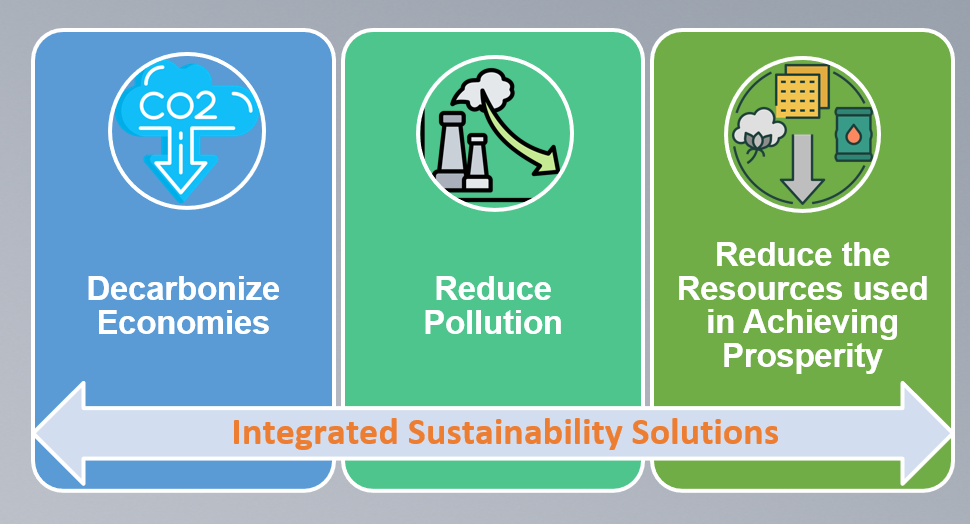
The objectives of the Minor are to provide students with broad exposure to the principles and practices of sustainability and to equip them with the ability to develop innovative and equitable solutions for issues such as climate change, sustainable energy, urban resilience, and the circular economy.
The Minor is distinctive in its interdisciplinary approach, integrating perspectives from science, engineering, business, social sciences, and policy. It enables students from diverse academic backgrounds to apply sustainability principles within their chosen fields while preparing them to contribute to a more sustainable and resilient future.
Student Learning Outcomes
Students doing the Minor would be able to:
- Analyse sustainability challenges by integrating environmental, social, and economic dimensions
- Apply and analyse systems thinking frameworks to identify interactions within coupled human–environment systems
- Assess environmental, social, and economic impacts of proposed sustainability interventions using appropriate analytical and assessment tools
- Design interdisciplinary, evidence-based sustainability solutions
- Evaluate and refine sustainability solutions through iterative feedback, reflection, and collaboration
Curriculum Structure
To be awarded the Minor in Sustainability Solutions, students must earn a minimum of 20 Units of approved courses during their undergraduate candidature. However, the two core courses can be double counted to satisfy the requirements of both general education and the Minor. The programme structure is divided into 8 Units of core courses with 12 Units of elective courses.
| Course Code and Title | Pre-requisites | Core/ Elective | Units |
|---|---|---|---|
| Pass BOTH of the following requirements (8 units) | |||
| GEC1040 A Culture of Sustainability | Nil | Core | 4 |
| CDE2501 Sustainable Systems for Liveable Cities
OR |
Nil | Core | 4 |
| GESS1014 Managing Singapore's Built Environment
OR |
Nil | ||
| GEN2004 Green Communities in Action: Climate, Species, Crisis | Nil | ||
| 3 Elective Courses (12 units) Elective courses are organised into four pillars to guide students in selecting courses aligned with their disciplinary backgrounds and career aspirations. Students are encouraged to select: at least two elective courses from a single pillar to develop depth in a specific area, while the remaining elective course(s) may be chosen from other pillar(s); or any three elective courses from across the four pillars according to their individual interests and academic goals. |
|||
| Pillar 1: Decarbonisation and Climate Resilience | |||
| CE2003 Energy, Environment and Economics | Nil | Elective | 4 |
| CE4001 Industrial Symbiosis and Decarbonisation | Nil | Elective | 4 |
| CE4002 Carbon Management in the Built Environment | Nil | Elective | 4 |
| CN4248 Sustainable Process Development | Yes | Elective | 4 |
| CN4252 H2 and Low Carbon Technologies: Industry Perspectives | Nil | Elective | 4 |
| IE4246 Decarbonisation: Principles, Metrics and Cases | Yes | Elective | 4 |
| Pillar 2: Green Energy | |||
| PF3210 Total Building Performance | Nil | Elective | 4 |
| PF3504 Sustainable Energy Management | Nil | Elective | 4 |
| ESE4406 Energy Systems and Climate Change Mitigation | Nil | Elective | 4 |
| EE4438 Solar Cells and Modules | Yes | Elective | 4 |
| EE4503 Power Electronics for Sustainable Energy Technologies | Yes | Elective | 4 |
| EE4511 Renewable Generation and Smart Grid | Yes | Elective | 4 |
| MLE4210 Materials for energy storage and conversion | Yes | Elective | 4 |
| ME4226 Energy and Thermal Systems | Yes | Elective | 4 |
| Pillar 3: Sustainable Urban Systems | |||
| ID2122 Ecodesign and Sustainability | Nil | Elective | 4 |
| AR3223 Introduction to Urbanism | Nil | Elective | 4 |
| AR3722 Sustainable Environmental System | Nil | Elective | 4 |
| CDE3504 Smart Cities in a Competitive Economy | Nil | Elective | 4 |
| CDE3505 Planning and Governing Cities | Nil | Elective | 4 |
| PF4502 Green Development | Nil | Elective | 4 |
| ESP4401 Optimisation of Energy Systems | Yes | Elective | 4 |
| Pillar 4: Circular Environmental Systems | |||
| CE3001 Water-Food-Energy Nexus | Nil | Elective | 4 |
| ESE3101 Resource Management and Circular Economy | Nil | Elective | 4 |
| ESE4408 Environmental Impact Assessment | Nil | Elective | 4 |
| EE4513 Electric Vehicles and their Grid Integration | Yes | Elective | 4 |
| IE4248 Energy and Green Economy | Yes | Elective | 4 |
| MLE4221 Emerging materials for renewable fuels and clean water | Yes | Elective | 4 |
Courses with prerequisites (pre-req) are identified in the pillars, and these requirements cannot be waived.
Eligibility
This Minor is open to students with any primary major.
Students can declare their interest no later than the end of the 4th semester of their study.
Application
Students can self-declare the Minor through the Academic Plan Declaration Exercise (APAD) before CourseReg begins.
Continuation & Graduation requirements
The Minor in Sustainable Solution will be awarded to students who complete 20 units according to the curriculum structure given above and students must complete the primary major requirements to graduate. Details of prevailing graduation requirements recommended by NUS can be found here.
Further Details
For queries on the Minor in Sustainability Solutions, please contact Prof Rajasekhar Bala at ceerbala@nus.edu.sg or Ms Juliana at ceejbm@nus.edu.sg .