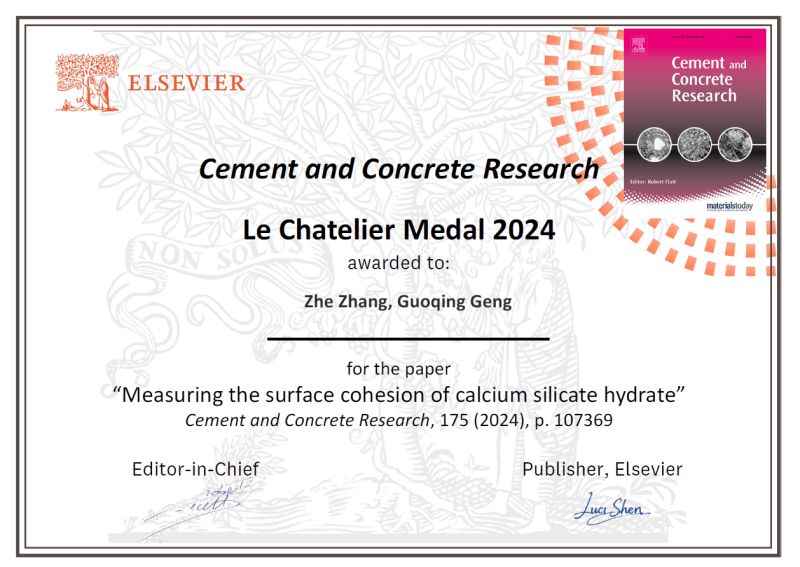

The paper from Dr Geng Guoqing’s group, “Measuring the surface cohesion of calcium silicate hydrate” has been selected for the Le Chatelier Medal 2024 by Cement and Concrete Research, arguably the most prestigious journal in the field of cement and concrete materials. The Le Chatelier Medal is a highly distinguished award that is presented to only one paper each year, recognising the most outstanding and influential research published in the journal each year.
The awarded study focuses on calcium silicate hydrate (C–S–H), the main binding phase in cement-based materials. While the research examines interactions at the nanoscale, it addresses a much broader question of great practical importance: where does the strength of concrete come from, and what factors influence it?
Concrete is the most widely used construction material in the world and is essential to modern buildings, transportation networks, and infrastructure systems. Its strength and long-term performance are closely tied to safety, durability, and sustainability. Yet despite its widespread use, the fundamental origin of concrete strength is still not fully understood. To address this challenge, the study developed a new experimental approach to directly measure the adhesion between C–S–H surfaces under different humidity conditions. The findings provide new insight into how concrete strength begins to develop at the smallest scale.
The significance of the work extends beyond the study of a single material phase. By improving understanding of the fundamental source of strength in the world’s most widely used modern construction material, the research offers valuable knowledge for the future development of stronger, more durable, and more sustainable construction materials.
The broader research interest of the group focuses on the sustainability and performance-based innovation of modern construction materials, combining multi-scale experimental characterization with advanced modelling tools to better understand the links between chemistry, interfaces, and mechanical behaviour.