Biography
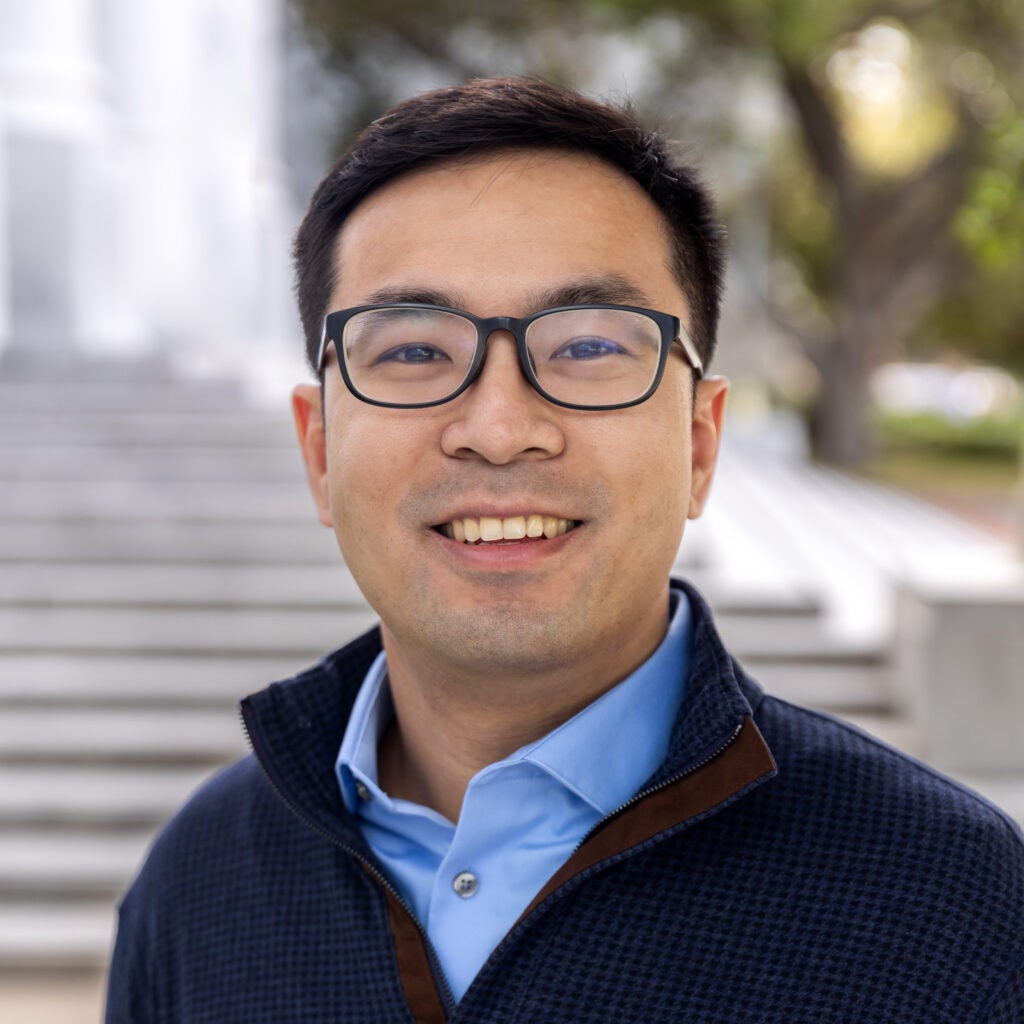
Dr Bodhinanda “Nanda” Chandra is an Assistant Professor in the Department of Civil and Environmental Engineering. Before joining NUS, he was a postdoctoral researcher in the Department of Mechanical Engineering at the University of California, Berkeley. He received his PhD in Geomechanics and GeoSystems Engineering from the Department of Civil and Environmental Engineering at UC Berkeley. He also holds a bachelor’s degree in Civil Engineering from Kyushu University, Japan, and a master’s degree in Computational Mechanics from the Technical University of Munich, Germany.
Chandra’s research focuses on the theoretical and computational modeling of geomaterials across a wide range of confinement conditions, including subsurface geomechanics, large-deformation surficial geotechnics, natural hazards, construction materials, and extraterrestrial regolith. His work integrates continuum mechanics, constitutive modeling, particle-based numerical methods, and high-performance computing to study multiphysics and multiphase processes in soils, rocks, and granular materials.
Qualifications
- PhD in Civil Engineering with Designated Emphasis in Computational and Data Science and Engineering, University of California, Berkeley, 2024
- MSc with honors, Computational Mechanics, Technical University of Munich, 2019
- B.Eng in Civil Engineering, Kyushu University, 2016
Position Held:
- Postdoctoral Researcher, Dept. of Mechanical Engineering, University of California, Berkeley, 2024-2026
- JSPS Visiting Postdoctoral Fellow, Dept. of Civil and Earth Resources Engineering, Kyoto University, 2025
- Visiting Researcher, Dept. of Mathematics, University of Padova, 2019
Honours & Awards
- JSPS Short-term Postdoctoral Fellowship (2025)
- UC Berkeley Outstanding Graduate Student Instructor Award (2025)
- Top cited paper, International Journal for Numerical and Analytical Methods in Geomechanics (2022)
- Jane Lewis Fellowship (2020-2022)
- TUM SOFiSTiK Prize 2019 (2019)
- Deutscher Akademischer Austauschdienst (DAAD) Scholarship (2017-2019)
- Kobayashi International Scholarship (2015)
- Japanese Government Monbukagakusho Scholarship (2012, 2015)
Research Interests
- Theoretical and computational modeling of geomaterials, fluids, and granular materials
- Computational micro- and macro-mechanics
- Particle-based numerical methods, including the material point method, discrete element method, and smoothed particle hydrodynamics
- Fluid-soil-structure interaction and large-deformation geomechanics
- Multiphysics modeling of geomaterials, including thermo-hydro-mechanical-chemical-electrical processes
- Fracture, failure, and natural hazards
- High-performance scientific computing
Selected Publications
- Liang, J. Given, B. Chandra, Z. Zeng, X. Zhang, and K. Soga. “The virtual stress boundary method to impose nonconforming Neumann boundary conditions in the high-order material point method.” International Journal for Numerical Methods in Engineering, 2026. doi: 10.1002/nme.70291
- Liang, B. Chandra, J. Yu, Z.-Y. Yin, and J. Zhao. “A total-Lagrangian material point method for fast and stable hydromechanical modeling of porous media.” International Journal for Numerical Methods in Engineering, 2025. doi: 10.1002/nme.70135
- Kurima, B. Chandra*, K. Soga. “Absorbing boundary conditions in material point method adopting perfectly matched layer theory.” Soil Dynamics and Earthquake Engineering, 2025, doi: 10.1016/j.soildyn.2025.109219
- Chandra, R. Hashimoto, K. Kamrin, K. Soga. “Mixed material point method formulation, stabilization, and validation for unified analysis of free-surface and seepage flow.” Journal of Computational Physics, 2024, doi: 10.1016/j.jcp.2024.113457
- Chandra, R. Hashimoto, S. Matsumi, K. Kamrin, K. Soga. “Stabilized mixed material point method for incompressible fluid flow analysis.” Computer Methods in Applied Mechanics and Engineering, 2024, doi: 10.1016/j.cma.2023.116644
- Molinos, B. Chandra, M. M. Stickle, K. Soga. “On the derivation of a component-free scheme for Lagrangian fluid-structure interaction problems.” Acta Mechanica, 2023, doi: 10.1007/s00707-022-03459-1
- Liang, B. Chandra, K. Soga. “Shear band evolution and post-failure simulation by the extended material point method (XMPM) with localization detection and frictional self-contact.” Computer Methods in Applied Mechanics and Engineering, 2022, doi: 10.1016/j.cma.2021.114530
- Kularathna, W. Liang, T. Zhao, B. Chandra, J. Zhao, K. Soga. “A semi-implicit material point method based on fractional-step method for saturated soil.” International Journal for Numerical and Analytical Methods in Geomechanics, 2021, doi: 10.1002/nag.3207
- Asai, L. Yi, B. Chandra*, S. Takase. “Fluid–rigid-body interaction simulations and validations using a coupled stabilized ISPH-DEM incorporated with the energy-tracking impulse method for multiple-body contacts.” Computer Methods in Applied Mechanics and Engineering, 2021, doi: 10.1016/j.cma.2021.113681
- Chandra, V. Singer, T. Teschemacher, R. Wüchner, A. Larese. “Nonconforming Dirichlet boundary conditions in implicit material point method by means of penalty augmentation.” Acta Geotechnica, 2021, doi: 10.1007/s11440-020-01123-3
- Yi, M. Asai, B. Chandra, M. Isshiki. “Energy-tracking impulse method for particle-discretized rigid-body simulations with frictional contact.” Computational Particle Mechanics, 2020, doi: 10.1007/s40571-020-00326-5