

Follow CDE
It is an oxymoron until you see it working across five rewilding projects in Singapore, illustrating how designing for “messiness” can change a city’s relationship with Mother Nature.
Green spaces fill almost half of Singapore. The city-state has over 844,000 trees planted since 2020 under its One Million Trees movement, threaded 190 km of naturalistic corridors through its streetscapes and earned a reputation as one of the most verdant high-density cities on Earth. Most of that greenery is meticulously planned. Pruned, weeded, manicured to civic specification. What happens when a tropical city that has mastered the art of managed nature decides to let parts of it go wild?

Associate Professor Hwang Yun Hye and her team examined five rewilding projects in Singapore, tracing how each defines, designs and negotiates “wildness” within a systematically managed urban landscape.
That question drives research by Associate Professor Hwang Yun Hye from the Department of Architecture, College of Design and Engineering, National University of Singapore (NUS). Her new article examines five rewilding projects across Singapore, tracing how each defines, designs and negotiates “wildness” within a systematically managed urban landscape. The findings suggest that urban rewilding, done well, can serve more than its ecological purpose — it can reshape how citydwellers relate to nature, to place and to one another.
“We believe rewilding in cities also has a socio-cultural significance to it — it could change people’s expectations of what a landscape should look like, and what it can do,” says Assoc Prof Hwang.
Five shades of wild
The five projects span a wide range. Nature Ways, launched in 2001 by Singapore’s National Parks Board, threads a 190 km swathe of naturalistic green corridors through the city’s streetscapes, connecting fragmented parks and reserves with a four-tiered planting structure designed to mimic native forest. At the other end of the spectrum sits Square Forest, a small 4 m² patch of dense planting in a private garden corner. Between them are the Nature Society of Singapore’s (NSS) corridor restoration along a disused railway line; an alumni-led reforestation effort on NUS’ Kent Ridge; and the “NUS Naturalized Gardens,” a researcher driven initiative transforming manicured lawns into biodiverse habitat since 2010.
“Rewilding” is the common denominator for these projects. But what separates them is almost everything else: scale, method, maintenance intensity and the degree to which nature is allowed to do its own thing. Nature Ways, despite its naturalistic appearance, involves regular pruning and weeding. The NSS project, by contrast, envisions decades of unmanaged succession, aiming for a self-sustaining ecosystem within three decades. The Naturalized Gardens occupy an intriguing middle ground — what Assoc Prof Hwang dubs “intentional wildness,” a balance of spontaneous growth and selective human intervention.
"When people draw closer to nature and observe how uniquely dynamic and diverse our plants are, something magical transpires."
"When people draw closer to nature and observe how uniquely dynamic and diverse our plants are, something magical transpires."
A sense of belonging takes root
A distinctive finding of the study is that urban rewilding projects double as living labs, not only for ecology, but also for design, education and public perception. These initiatives drive participants to engage with ecosystems that are unfamiliar and unfinished. In particular, students monitor flora and fauna across multiple periods of time; landscape managers trial maintenance strategies without a playbook; and researchers test how novel ecosystems respond to selective intervention. In essence, the learning is longitudinal and reciprocal.
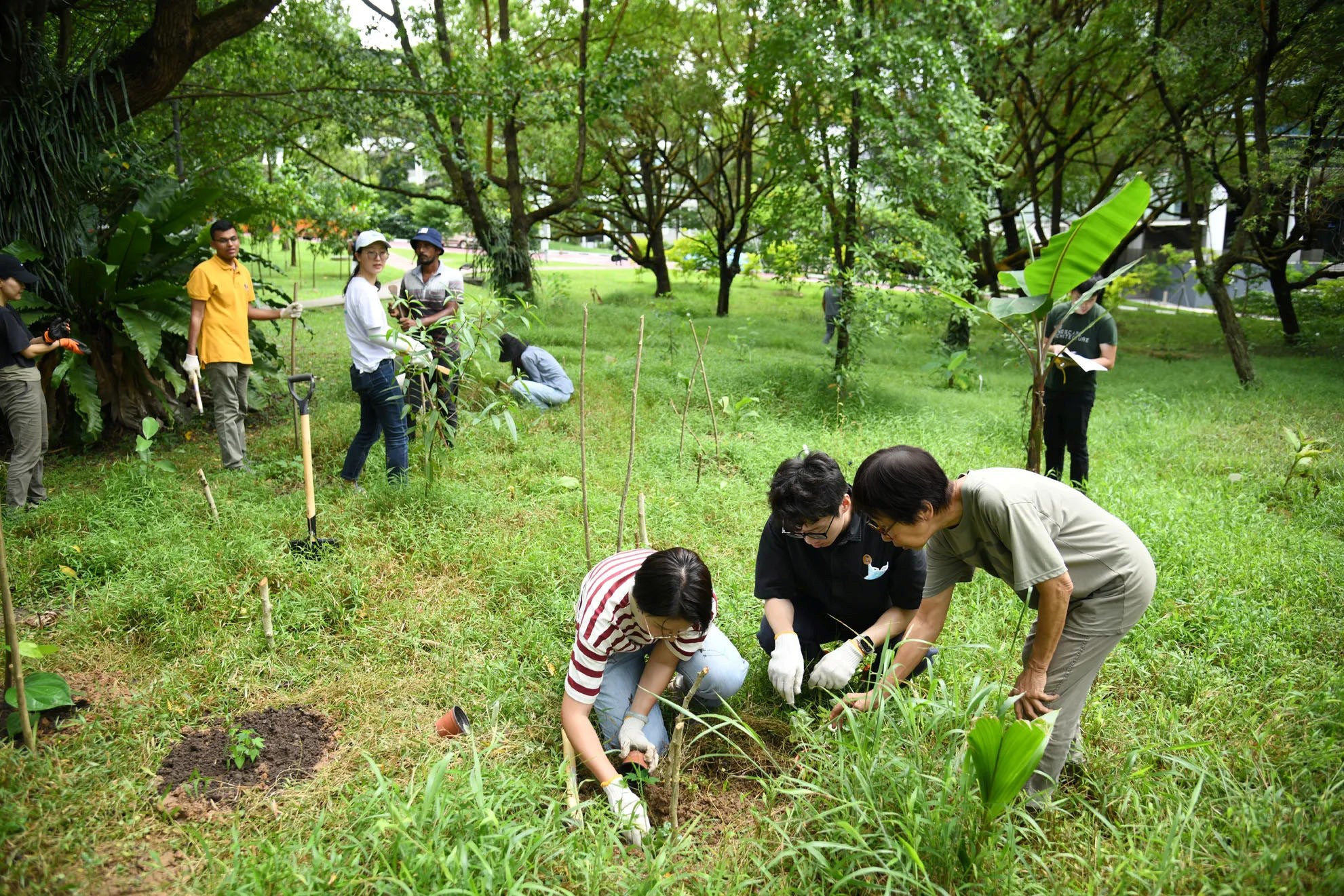
For instance, the NUS Naturalized Gardens rewilding project, launched in 2010 by the Urban Wild Lab, has drawn in researchers from architecture, geography and biology to assess the gardens’ biophysical functions through soil surveys and temperature measurements, while the NUS Natural History Museum has conducted flora and fauna monitoring. Students in the Bachelor of Landscape Architecture programme have organised planting events since 2022, handling publicity, guiding volunteers and documenting vegetative changes, while passing logbooks to each incoming cohort. NUS lecturers, meanwhile, have woven the gardens into coursework, using them as testbeds for creative environmental design and plant identification. It is a multidisciplinary undertaking — ecologists, designers and facility managers learning from the same patch of soil.
“When people draw closer to nature and observe how uniquely dynamic and diverse our plants are, something magical transpires,” adds Assoc Prof Hwang. “That sense of identity is what makes rewilding last.”
Boardwalks and paradoxes
Yet the study does not overlook the tensions. Boardwalks and paved footpaths in the Naturalized Gardens make for pleasant walking — but may hinder animal and plant dispersal. At Kent Ridge, trees were planted on flatter ground for volunteer safety, even though steeper ridge edges would have done more for erosion control.
Square Forest’s 4 m² footprint, determined by its homeowner’s preference rather than ecological logic, sits isolated from neighbouring green patches.
These are design trade-offs. The projects employ what landscape researchers call “cues to care”: straight edges on forest patches, selective maintenance of footpath borders, elevated walkways through wilder zones. These features reassure the public that someone is minding the mess.
The bigger structural challenge, the study highlights, is participation depth. Across all five projects, community involvement was largely limited to volunteering for pre-planned tasks. Decision-making remained with coordinators and experts. Future projects, Assoc Prof Hwang suggests, should move towards co-creation, involving community members and specialists in plant science, biology and design from the outset.
The research also underlines the importance of strategic siting — projects embedded within Singapore’s ecological network attracted stronger public engagement than those positioned opportunistically — and of long-term leadership: a committed core team capable of reading a landscape’s trajectory years into the future.
Read More
View Our Publications ▏Back to Forging New Frontiers - June 2026 Issue
If you are interested to connect with us, email us at cdenews@nus.edu.sg