

Adaptive resuscitation kit
Cardiopulmonary resuscitation (CPR) is a vital emergency technique designed to preserve blood circulation during cardiac arrest. The American Heart Association recommends a compression rate of 100 to 120 beats per minute and a depth of one-third of the chest thickness, with complete chest recoil after each compression. Despite this, manual CPR rapidly declines in quality as rescuers fatigue, with evidence indicating effectiveness can fall to as low as 18 percent within five minutes.
Mechanical CPR have were introduced to provide consistent, continuous compressions independent of human performance limitations. However, while adoption among emergency medical services such as the Singapore Civil Defence Force (SCDF) has increased, hospital utilisation remains minimal. Interviews with emergency care staff highlight key barriers, including challenges of equipment integration, limited adaptability to patient variability, and concerns regarding safety.
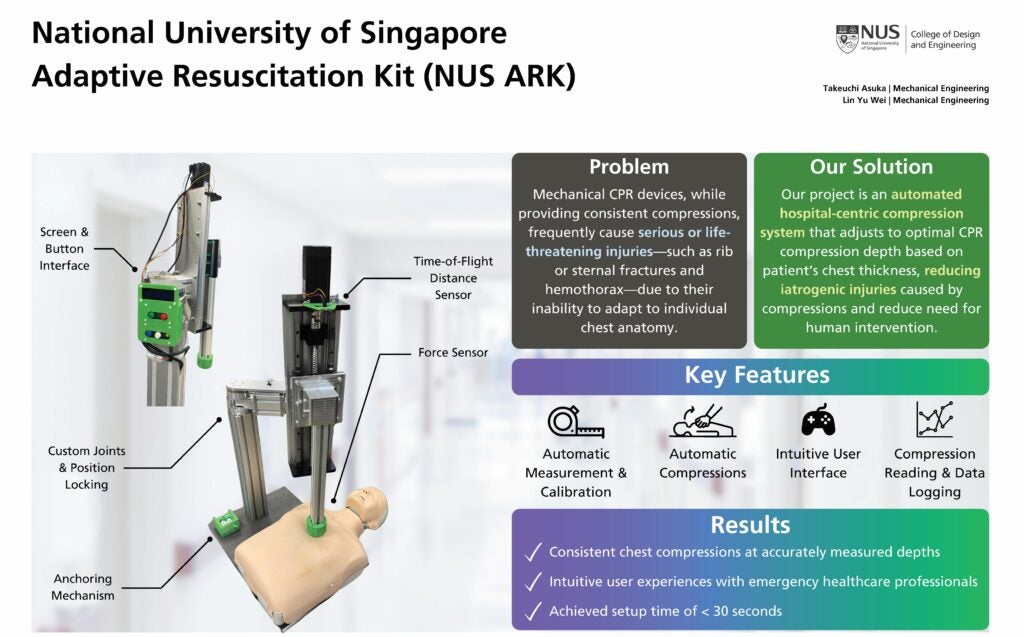
To address these issues, we aim to develop an intelligent, adaptive mechanical CPR system that is capable of delivering effective compressions across a wide range of body sizes while minimising iatrogenic injuries. Our proposed solution measures patient chest thickness and calculates optimal compression depth using integrated force and distance sensors. An intuitive screen-and-button interface guides users through calibration and CPR initiation, reducing healthcare worker stress during cardiac arrests. This frees manpower for ventilation and drug administration. A proof-of-concept prototype of our proposed solution has successfully demonstrated its automatic measurement and execution of mechanical CPR at optimal compression depth with minimal human intervention.
Project Team
Students:
- Lin Yu Wei (Mechanical Engineering, Class of 2027)
- Takeuchi Asuka (Mechanical Engineering, Class of 2027)
Supervisors:
- A/Prof Lim Li Hong Idris (lhi.lim@nus.edu.sg)
- Mr Graham Zhu (graham88@nus.edu.sg)