
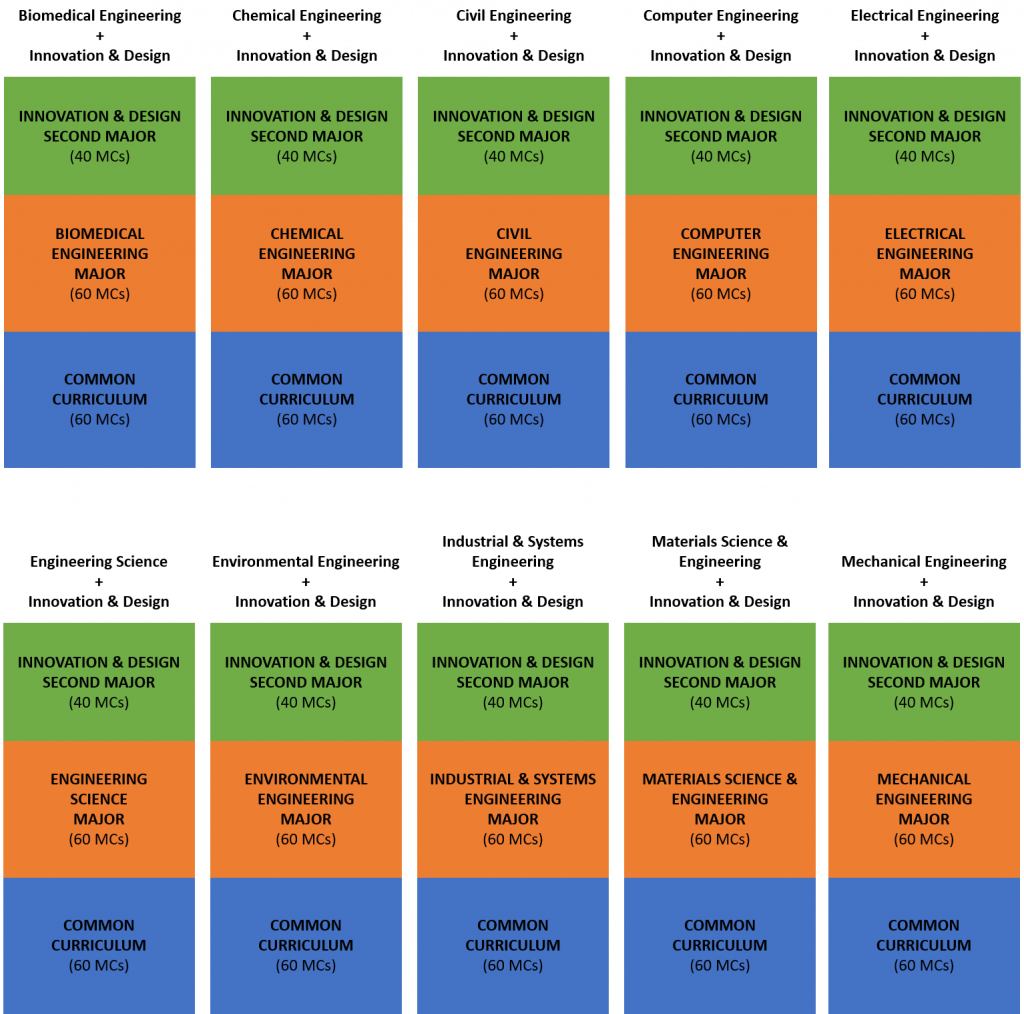
The Innovation & Design Programme (iDP) is offered as a Second Major that can be paired with any primary major in NUS. It comprises 40 modular credits (MCs) out of a total of 160 MCs required for a 4-year degree programme in NUS. The figure below gives examples of Engineering majors that can be taken by students in the iDP. Students from non-Engineering majors, such as Business, Computing, Asian Studies and Humanities, Social Sciences, and Sciences can also enrol in the iDP as a Second Major.
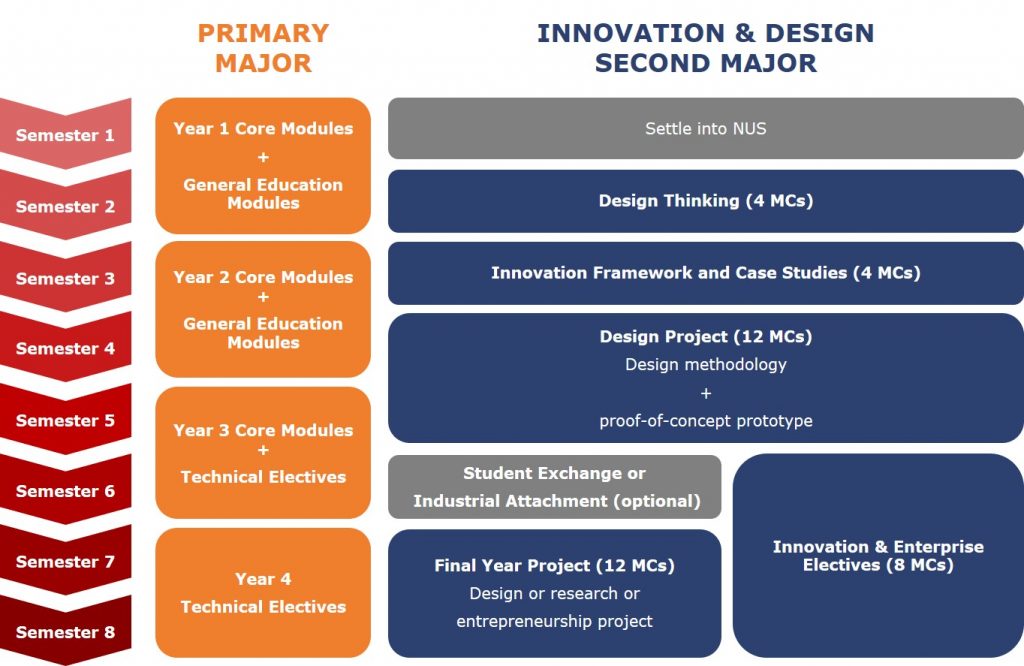
The iDP consists of a series of project-based modules and electives that run throughout a student’s candidature. A student who is enrolled in the iDP can complete all graduation requirements within 4 years with no extension of candidature. The figure below gives a schedule of the modules in the iDP. On average, in each semester, an iDP student will read one module that contributes towards the iDP requirements.
Key modules in iDP
Students are expected to develop their knowledge, skills, and abilities in innovation and design in a cumulative manner through our modules. The learning journey begins with a foundation in Design Thinking, followed by an introduction to the basic concepts in innovation and design. These two modules culminate in a major design project and a final year project where students are expected to apply their design knowledge and skills to develop solutions to real problems. Students will also take a number of Innovation & Enterprise electives to widen their knowledge about topics in design, business, and entrepreneurship.
Design Thinking
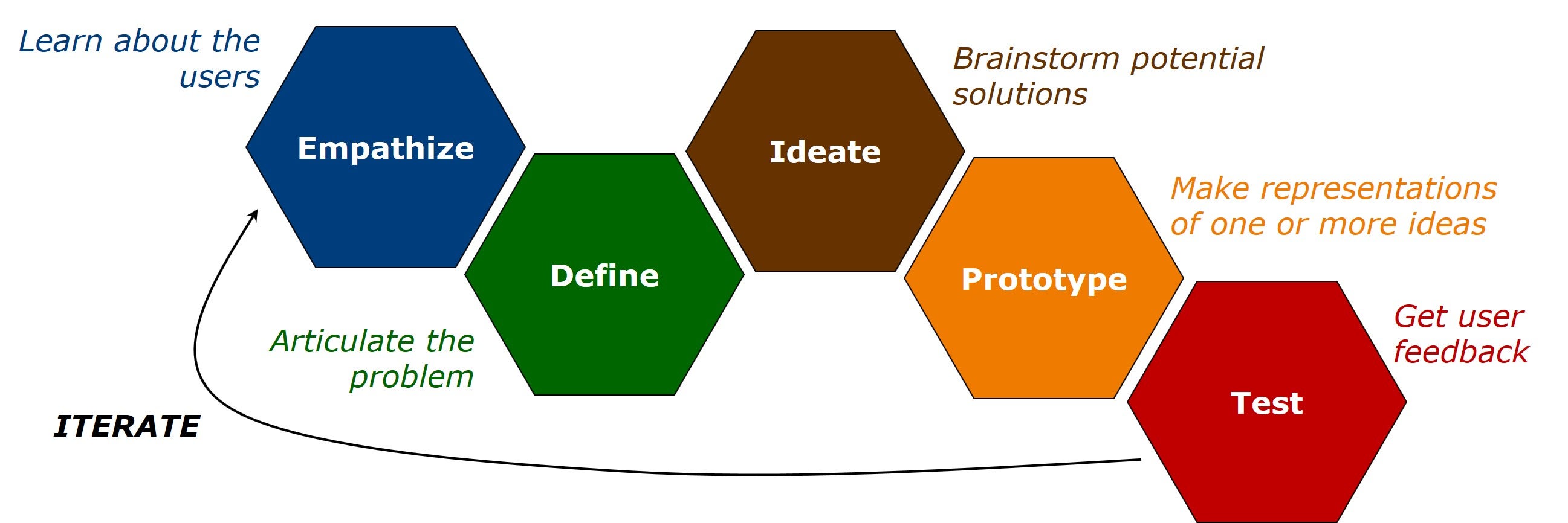
Design Thinking is a human-centred approach to innovation to arrive at solutions that meet the needs, wants, and desires of target users. Students learn to understand users, build personas, gain insights, identify opportunities, generate ideas, and validate their ideas through prototyping.
Innovation Framework
Innovation happens when users’ needs and desires are met in a technologically feasible manner and matched with a viable business strategy. Students learn a variety of tools that help them to generate innovative solutions to a wide range of problems in a manner that creates value to end users as well as exploit market opportunities.

Design Methodology
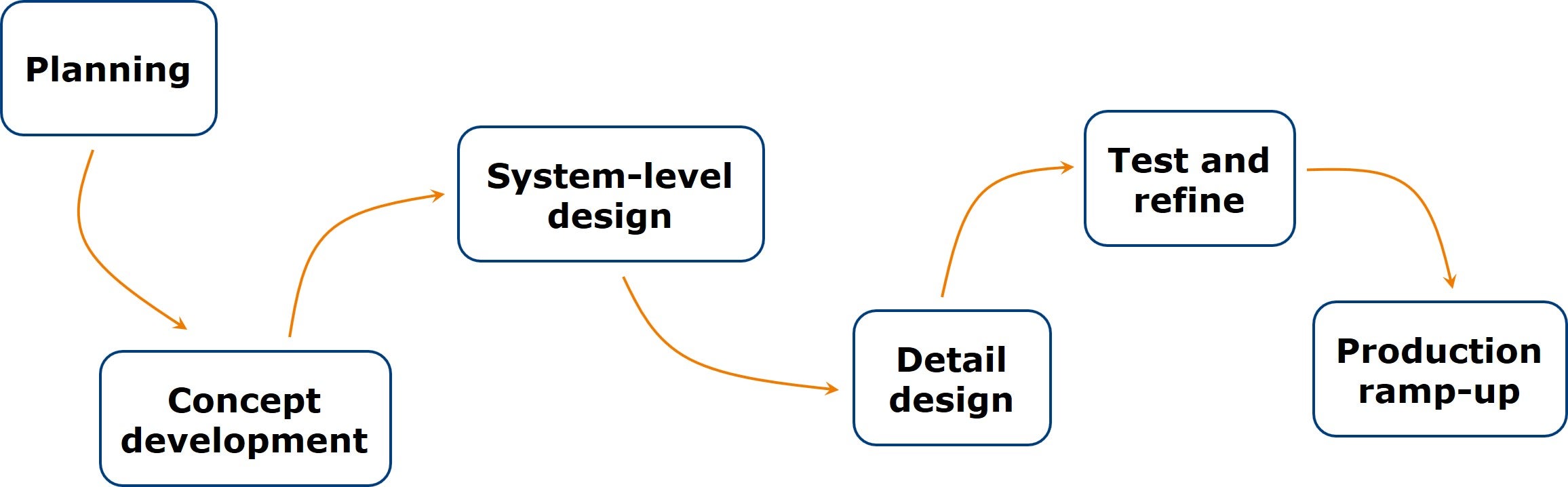
Design is taught through a systematic process that consists of distinct, coherent, and well-organized steps. Using well-established design methodologies, students learn how to transform ideas into functional prototypes and thereafter viable products and services.
Innovation and Enterprise
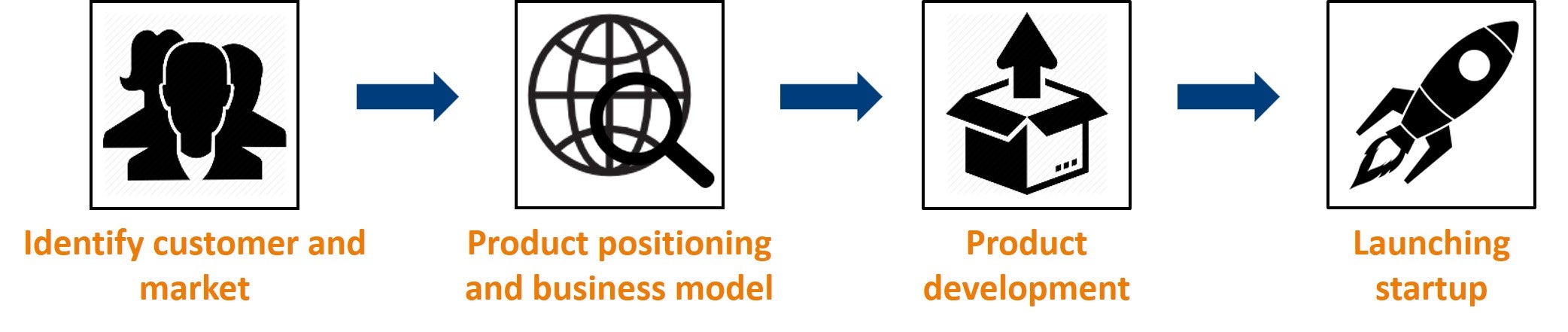
Students learn strategies to create business ventures and establish market value for their ideas through a set of innovation and enterprise electives in our curriculum. They also learn about intellectual property protection and gain deeper understanding of the economics of entrepreneurship. Students who are keen to develop their ideas for commercialization can join a module called “Ideas to Startup” in their final year.
Multidisciplinary Project-Based Learning
Innovation needs a team-based process to succeed. From day one, our students learn to work together with teammates from different disciplines and are mentored by faculty members with diverse backgrounds. Through open-ended projects, students learn how to apply their design skills as well as their disciplinary knowledge to solve real-world problems. Such an approach helps students to develop transversal skills such as teamwork, leadership, communication, and project management. It also develops important character qualities such as resilience, persistence, and self-motivation.