
Valorising coffee waste
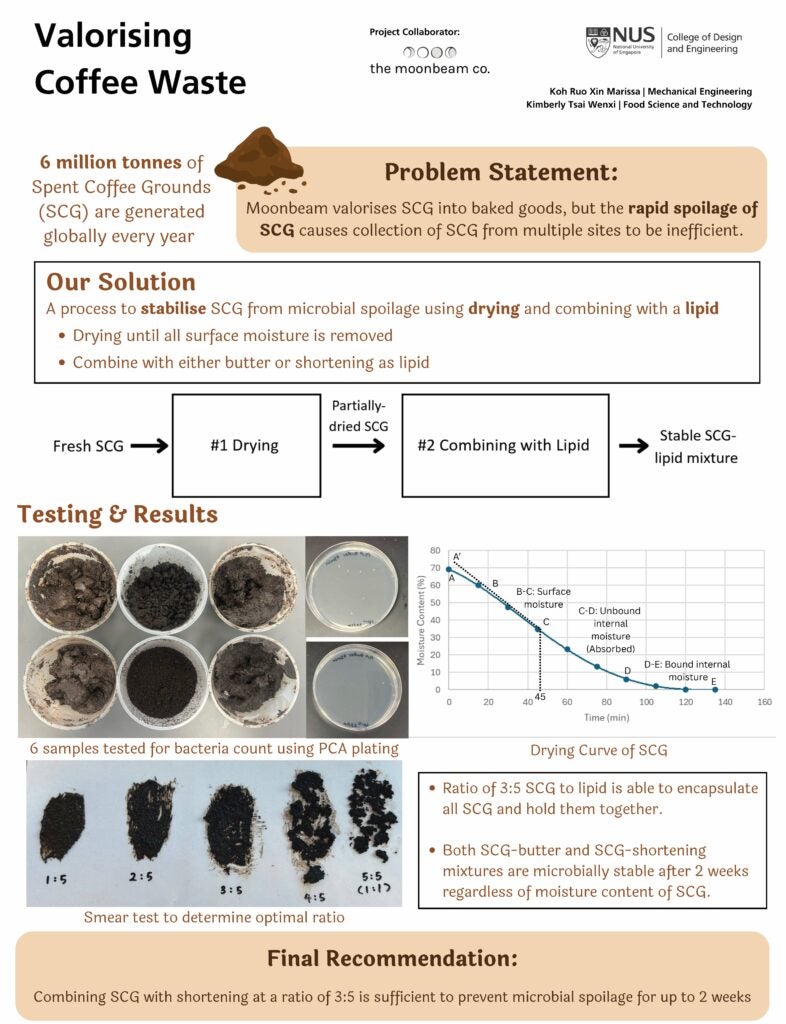
Spent coffee grounds (SCG) are the solid residues remaining after the coffee brewing process, accounting for up to 80% of the original coffee bean mass. Presently, as there is little demand for SCG on its own, it is typically seen as waste and disposed of via incineration and sent to landfills. However, SCG may be valuable in food applications as it is rich in dietary fibre and antioxidants. The underutilisation of SCG represents a missed opportunity for recovery and adds unnecessarily to the industry’s environmental footprint.
However, SCG spoils quickly due to its high moisture content, which encourages microbial growth and prevents storage at the point of generation. As a result, presently it must be collected frequently and quickly from generation sites such as cafes to be viable for use in food applications by other companies. This limits the operational efficiency and scalability of using SCG for food applications.
To address this problem, we developed a simple on-site stabilisation method that allows SCG to be safely stored without microbial spoilage before collection. Through lab-scale experiments, we explored the effects of different moisture content levels, type of lipid, and ratio of SCG to lipid on stability of SCG up to a duration of two weeks. We found that removing moisture from the SCG could slow down microbial growth but was insufficient to achieve full stability on its own. In contrast, combining SCG with lipids such as butter or shortening effectively prevented microbial growth and maintained stability over two weeks. Our findings provide a basis for the future development of a technology that can automate this process at generation sites and be implemented in real-world operations.
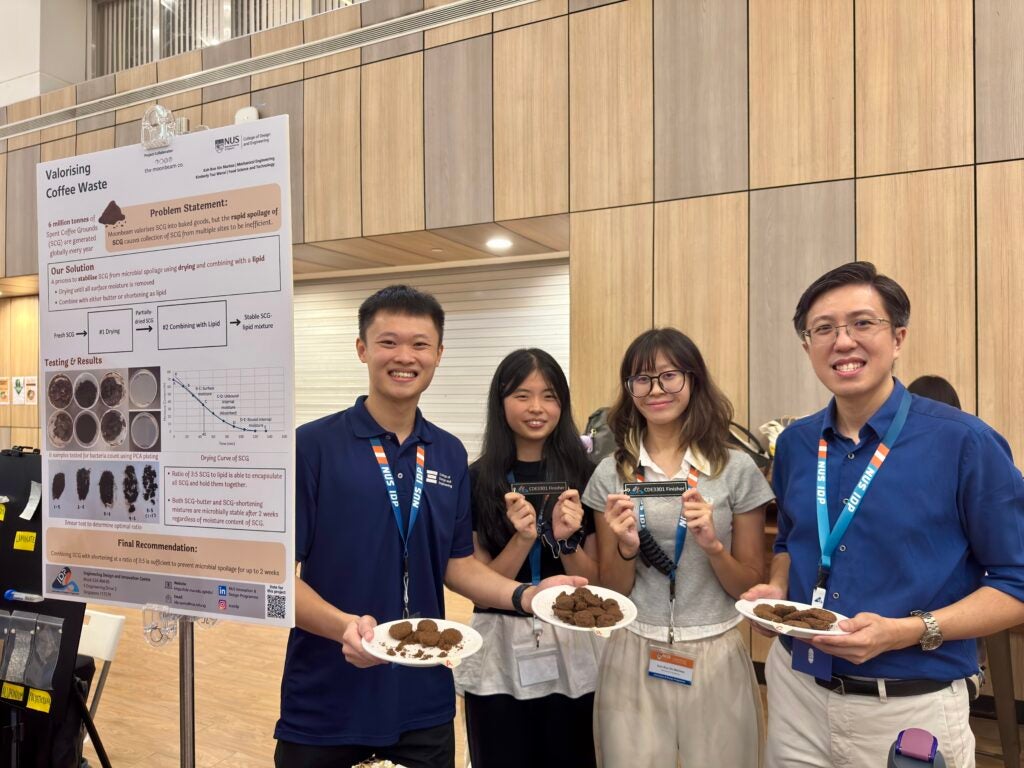
Project Team
Students:
- Kimberly Tsai Wenxi (Food Science & Technology, Class of 2027)
- Koh Ruo Xin Marissa (Mechanical Engineering, Class of 2027)
Supervisors:
- Dr Jovan Tan(jovan@nus.edu.sg)
- Dr Elliot Law (elliot.law@nus.edu.sg)