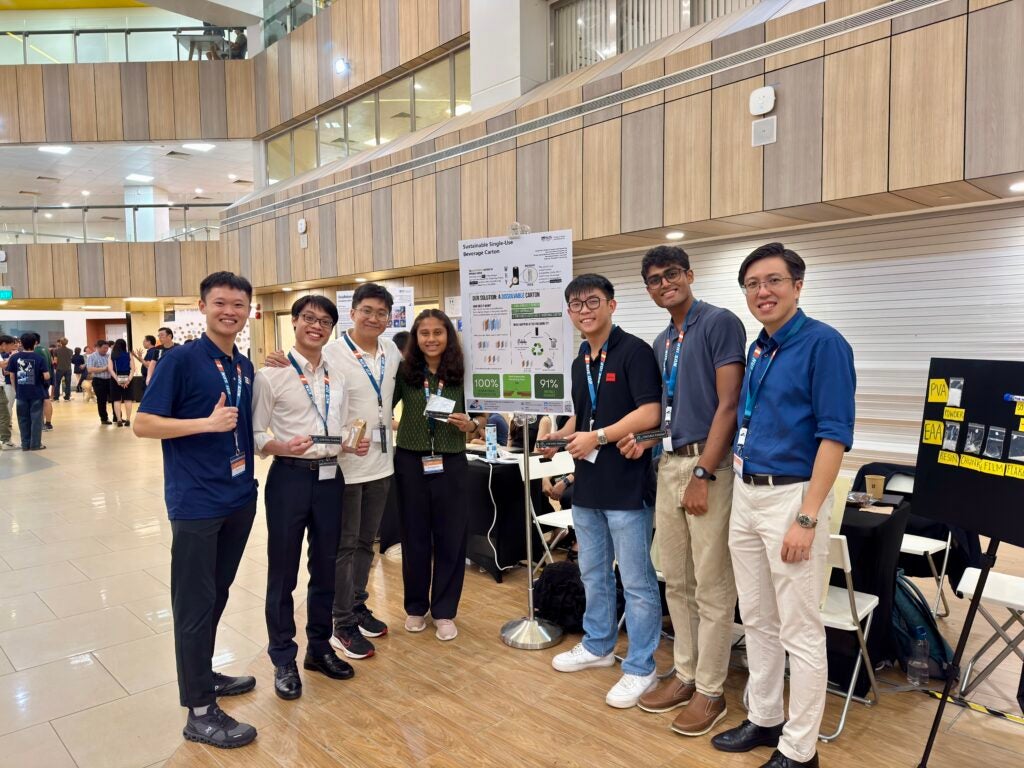

Sustainable single-use beverage carton
Beverage cartons are often perceived to be more sustainable because they are mainly paper-based, but they are actually not as eco-friendly as they seem. Globally, only 26% of beverage cartons are recycled, meaning nearly 3 out of 4 cartons end up polluting oceans, beaches, or landfills. This low recycling rate is due to their complex multilayer composition which comprises layers of paper, plastic, and aluminium that are permanently bonded. In particular, the composite formed by the plastic and aluminium layers cannot be separated using current methods.
Despite this problem, beverage cartons remain the best single-use packaging today. Their advantages include aseptic properties that extends shelf life of beverages, their flat-pack form that minimises cost of transportation, and versatility in storing a wide range of beverages. These factors enable cartons to outperform other single-use containers and sustain their market demand.
Therefore, to improve the recyclability of beverage cartons, we designed a novel copolymer that acts as a sacrificial adhesive between the paper, plastic, and aluminium layers. It bonds the layers strongly during use but dissolves in warm water, enabling clean separation of the paper, plastic, and aluminium layers during recycling. The process is also compatible with existing carton-manufacturing lines. Tests on prototypes of our improved carton demonstrate that it has comparable mechanical and functional properties compared to conventional cartons, and it is able to delaminate cleanly when immersed in warm water.
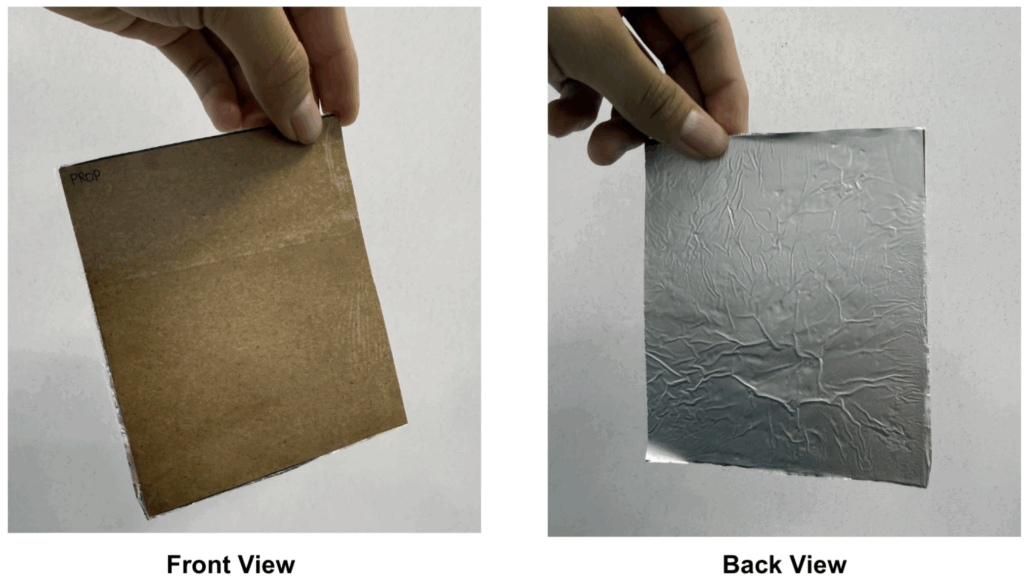
Overall, this project has established a scalable pathway toward circular beverage carton design — transforming the bonding layer from a permanent barrier into an enabler of recycling. With further refinement, our copolymer adhesive offers a viable foundation for next-generation recyclable carton packaging.
Project Team
Students:
- Evan Lim Shouwang (Biomedical Engineering, Class of 2027)
- Koh Jye Sheng, Zenson (Materials Science & Engineering, Class of 2027)
- Lee Zong Han Ryan (Chemical Engineering, Class of 2027)
- Manashree Krishnan (Economics, Class of 2027)
- Vihaan Jaswal (Materials Science & Engineering, Class of 2027)
Supervisors:
- Dr Jovan Tan(jovan@nus.edu.sg)
- Dr Elliot Law (elliot.law@nus.edu.sg)