

Built Environment, Ageisim, and Mental Well-Being
Lead PI: Emi Kiyota
Co-I: Jia Lile
Researchers: Darren Nel, Li Ying, Yang Siying
Duration: August 2024 to May 2026
Ageism — the stereotyping, prejudice, or discrimination against individuals or groups based on their age — influences how cities are planned and how older persons experience everyday places. The built environment can reinforce ageist assumptions through facilities location, how people move between them, how visible or welcoming public spaces feel, and overall design choices that either enable or constrain mobility, social participation, and dignity. This project investigates how spatial form and social attitudes interact, and how these interactions shape mental well-being in dense cities.
Because of these challenges, this project takes an integrated, systems approach to explore the interactions between ageism, the built environment, and mental well-being across diverse cultures. Utilizing tools such as systems thinking, geospatial and network analysis, and empirical experiments, the study seeks to uncover implicit ageist biases inherent in urban planning and architectural design, and their implications for global age-friendly infrastructure. Integrating evidence synthesis, spatial analytics, survey research, and policy translation, the project aims to build an actionable knowledge base for age-ready urbanism.
Project Aims:
- Identify implicit ageism in planning and architectural layouts to understand how built environments may reinforce or challenge inclusion.
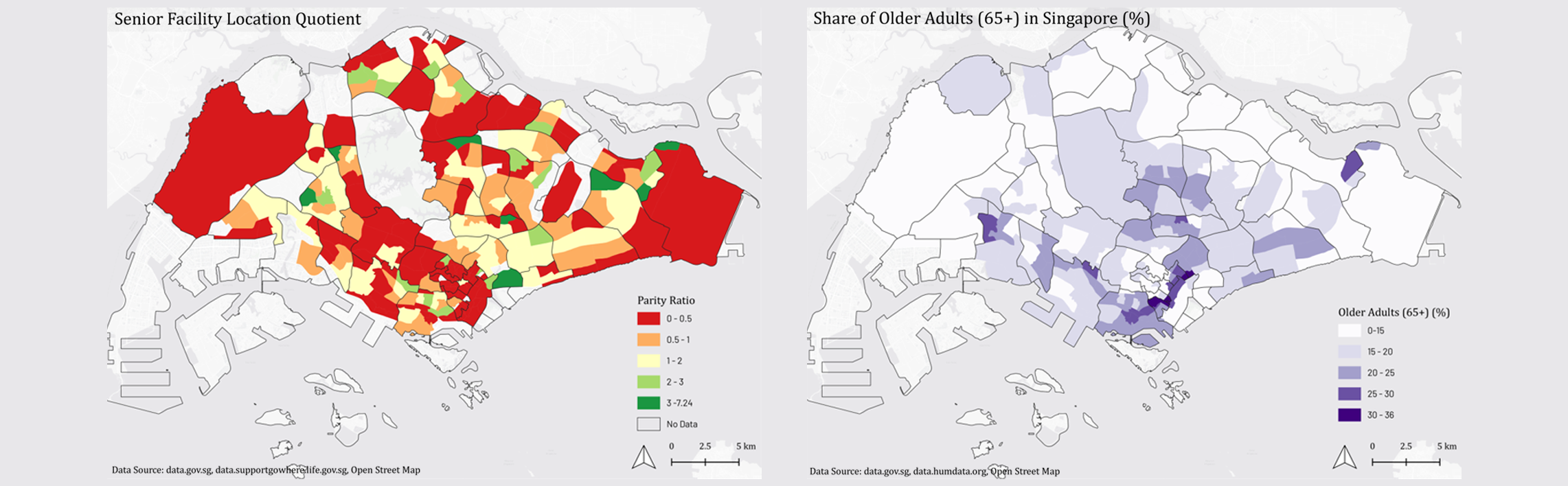
- Quantify spatial ageism using an index and inequality measures across cities, beginning with Singapore and extending to Hong Kong, Tokyo, London, and New York.
- Examine psychological ageism and spatial preferences through a multi-city survey and experimental tasks on segregation, accessibility, and design cues.
- Integrate spatial and survey findings to explore how built form and attitudes interact and translate these insights into practical guidance for age-friendly design and policy.