

Electrical and Computer Engineering
Injecting intelligence into tomorrow’s electrified world
Follow CDE
PDF Download
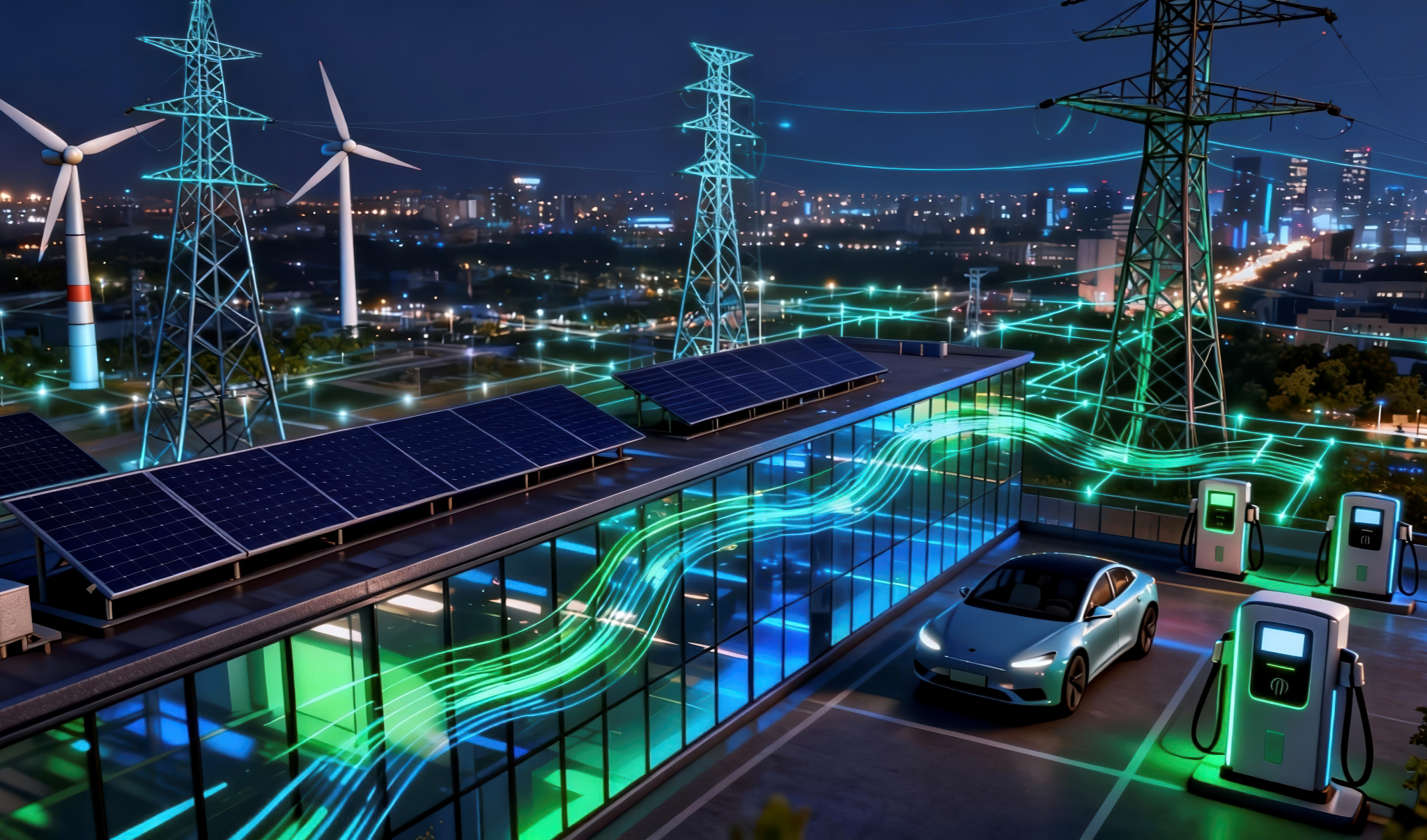
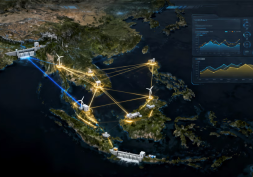
As the gears of electrification throttle at full speed, electrons are no longer flowing in one direction. They pulse across a dense, interconnected web of solar panels, offshore wind farms, high-capacity batteries and electric vehicles (EVs) — each node both consumer and supplier.

Professor Dipti Srinivasan leads teams to design optimisation frameworks that make renewable energy systems smarter, fairer and more efficient.
Managing this relentless current has become one of the defining challenges of the clean-energy era. One that requires keeping a network of moving parts in balance while demands balloon, data inundates and carbon budgets grip.
At the Department of Electrical & Computer Engineering, College of Design and Engineering, National University of Singapore, Professor Dipti Srinivasan studies this orchestration problem from a systems perspective, exploring how algorithms, economics and engineering can work in tandem to steer decentralised energy systems towards both efficiency and equity. Her body of work, spanning renewable forecasting, grid optimisation and smart mobility, sheds light on how intelligence, when woven into energy networks, can make them cleaner, more adaptive and inherently fair.
Forecasting the grid
Renewables have transformed the energy landscape, but their variability makes the grid harder to manage. Predicting when the wind blows or the sun shines can mean the difference between stability and chaos.
To meet this challenge, Prof Srinivasan and her team develop computational models that help the grid think ahead. They have built ensemble learning frameworks that blend multiple forecasting methods into a unified, self-correcting process — learning from past errors to predict power output more accurately. In other studies, they’ve tackled the heavy lifting behind large-scale optimisation, devising algorithms that can process thousands of variables in seconds rather than hours, cutting computation times without losing precision.
These advances allow renewable-rich power systems to dispatch electricity faster and more reliably, closing the gap between prediction and operation. As Prof Srinivasan puts it, “We want the grid to be anticipatory, to sense change before it happens, not react after the fact.
Fairness and coordination, at scale
Indeed, forecasting is only part of the bigger puzzle. As energy systems become more distributed, coordination, and fairness, come into the picture.
In one study, Prof Srinivasan’s team designed a multi-agent framework that lets different players within a port, from terminals to the authority itself, trade energy locally without giving up private data. The system balances the port’s energy costs while keeping transactions secure against cyber attacks.
“Fairness is not a side constraint. It is the condition that allows distributed systems to function sustainably.”
“Fairness is not a side constraint. It is the condition that allows distributed systems to function sustainably.”
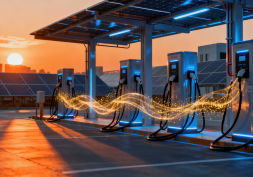
Another project took inspiration from social welfare theory to rethink how electric vehicle charging stations allocate their limited capacity. By using a lexicographic optimisation model — a kind of mathematical pecking order that weighs fairness and efficiency simultaneously — the system ensures that every driver gets a fair share of fast-charging power, even during peak hours.
These ideas, with ethics in their core as much as engineering, shed new perspectives on how cooperation can emerge in competitive energy markets. “Fairness is not a side constraint,” Prof Srinivasan explains. “It is the condition that allows distributed systems to function sustainably.”
“Fairness is not a side constraint. It is the condition that allows distributed systems to function sustainably.”
Driving electrification on the ground
The same principles now power Prof Srinivasan’s research in electrified transport — where vehicles, routes and batteries form yet another complicated energy network. Her team recently built a three-layer optimisation framework for electric bus fleets that spans from long-term charger planning to real-time charging schedules.
The framework works by modelling every bus’s usage pattern, battery health and charging opportunity, which enables it to trim lifecycle costs while extending battery lifespan. Case studies on campus shuttle systems showed up to a 90% reduction in uneven battery wear — evidence that smart planning can keep fleets running longer, cleaner and cheaper.
Looking ahead, Prof Srinivasan plans to advance her work in uncertainty modelling, EV-charging optimisation, demand-side management and renewable forecasting, while exploring new avenues that apply deep learning, multi-agent systems and optimisation techniques to strengthen power-system resilience.
“Our goal is to bridge research and real-world deployment by incorporating AI, multi-agent systems and optimisation into the fabric of tomorrow’s energy networks,” says Prof Srivinasan. “From port terminals and wind farms to virtual power plants and electric transport, these approaches help us build smarter, more sustainable grids — systems that can learn, adapt and ultimately make electrification more resilient.”
Read More
View Our Publications ▏Back to Forging New Frontiers - December 2025 Issue
If you are interested to connect with us, email us at cdenews@nus.edu.sg