

New capabilities in near atomic-scale, three-dimensional materials analysis have been opened up with the launch of the Invizo 6000 Atom Probe Tomography Facility, the first of its kind in Southeast Asia.
Located within the NUS Electron Microscopy Facility hosted at CDE, the facility was launched on 29 January 2026 alongside a symposium that brought together researchers and industry partners from Singapore and overseas.
Built by CAMECA, a specialist manufacturer of advanced materials characterisation instruments based in France, the Invizo 6000 atom probe enables three-dimensional chemical analysis at near atomic resolution, allowing researchers to visualise the distribution of elements with exceptional precision.
The system significantly expands the University’s advanced materials metrology and characterisation infrastructure and is expected to support research across fields including semiconductors, advanced alloys, energy materials and nanotechnology. The facility is intended as a shared research resource, with NUS encouraging collaborations with academic and industry partners in Singapore and across Southeast Asia.
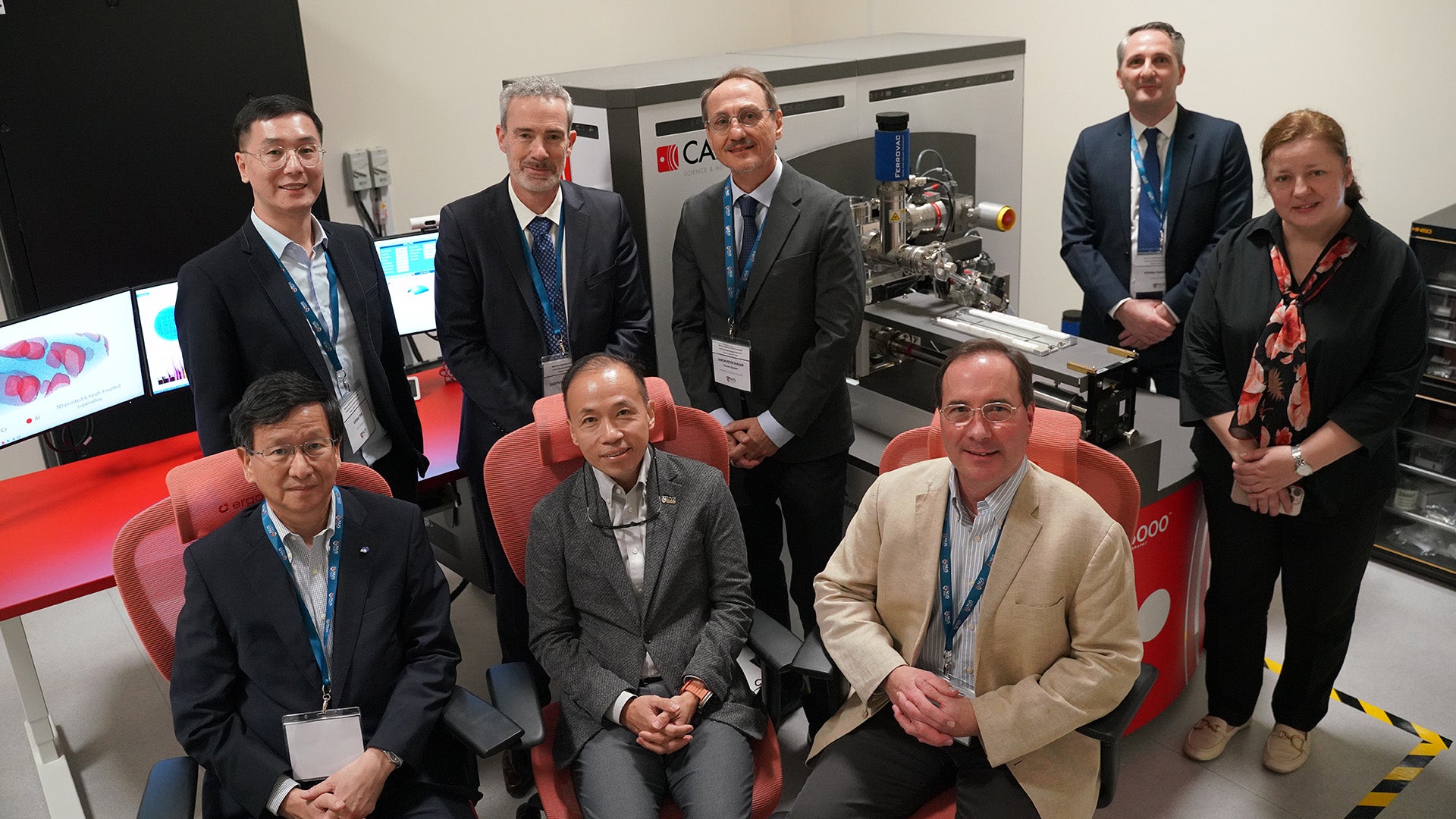
Assistant Professor Xipeng Tan (Mechanical Engineering), who played a central role in bringing the Invizo 6000 to NUS, said the new facility would be a critical tool for developing next-generation materials and devices.
“Before we were trying to understand a complex puzzle of materials structure by looking only at a few pieces,” Asst Prof Tan said. “With the full field of view using the Invizo 6000 we can see the entire puzzle at once – the complete structure of nanoscale features – and most importantly how they interact. This gives us the confidence to start engineering materials with atomic-level precision.”
Speaking at the opening of the symposium, Professor Silvija Gradecak, Vice Dean (Research and Technology) at CDE, highlighted the role of advanced characterisation in enabling interdisciplinary research. She noted that the Electron Microscopy Facility, established three years ago, was created to support materials research across multiple disciplines, and that the addition of atom probe tomography facility both complements existing capabilities and opens up new research directions.
The inauguration also marked the signing of a Memorandum of Understanding between NUS and CAMECA. The agreement sets out plans for regional collaboration, including support for atom probe activities in Southeast Asia, shared access to the instrument, and joint development of outreach and engagement efforts, with the aim of strengthening research capability while supporting both academic and industry users.
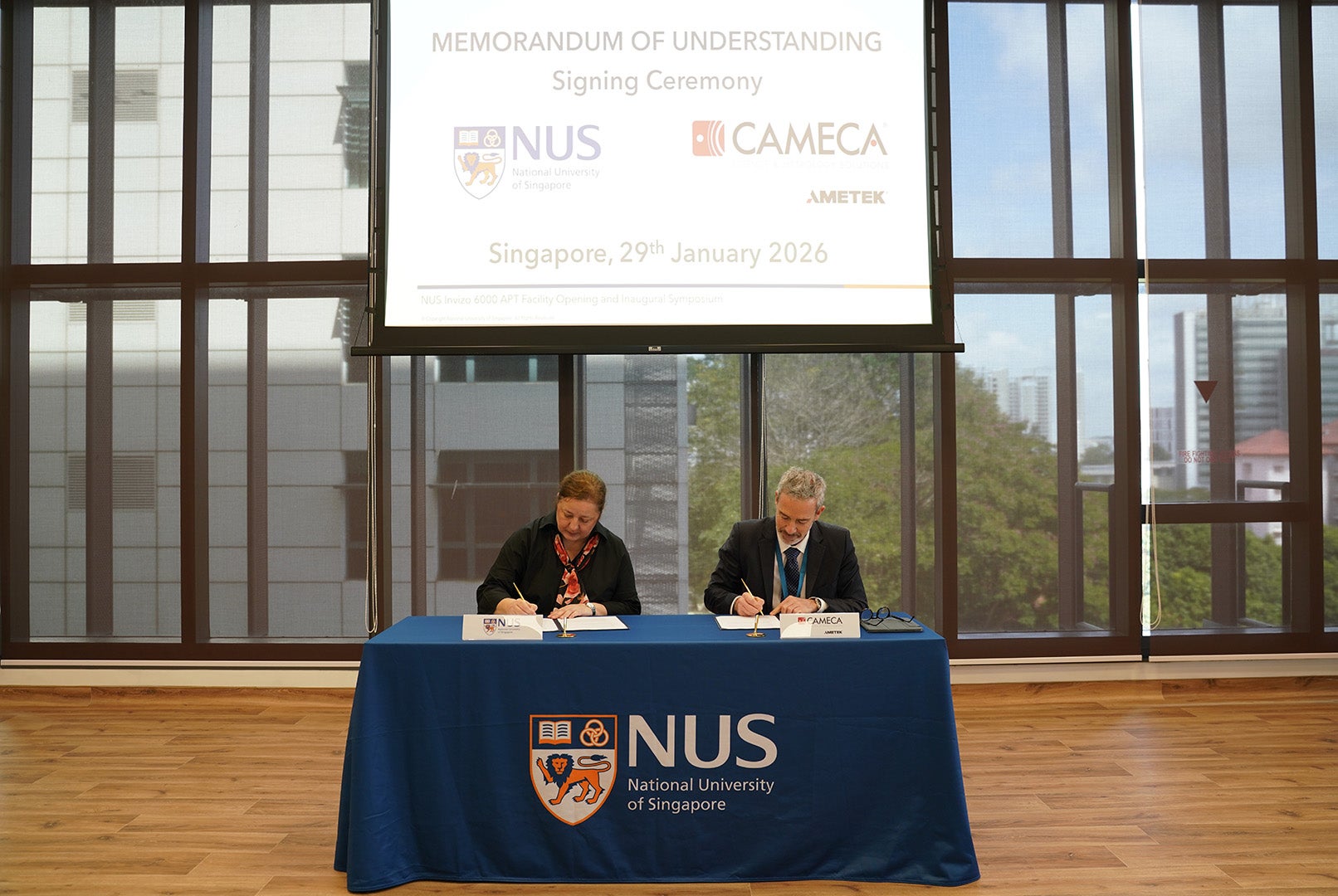
Speaking ahead of the MoU signing, Professor Aaron Thean, NUS Deputy President (Academic Affairs) and Provost, highlighted the growing importance of atomic-scale analysis in advancing materials and semiconductor research.
“Because of this trend, there is growing interest from industry in capabilities like atom probe tomography,” he said, adding that “we are proud to bring this capability to NUS to support research and development in this area.”
The inaugural symposium featured keynote presentations from leading figures in atom probe tomography. Dr Kazuhiro Hono, President of the National Institute of Materials Science, Japan, reflected on four decades of atom probe development and its impact on understanding materials at the atomic scale. Professor Simon Ringer, Pro-Vice-Chancellor (Research Infrastructure) of the University of Sydney discussed the use of atom probe techniques to study short-range chemical order in metallic materials and its implications for materials performance, while Mr Robert Ulfig of CAMECA presented recent advances in applying the technique to complex semiconductor devices.
Invited talks also highlighted emerging applications, including high-entropy composite catalysts for energy and chemical conversion.
With the opening of the Invizo 6000 Atom Probe Tomography Facility, NUS aims to provide a shared national and regional resource that supports advanced materials research and fosters collaboration between academia and industry.