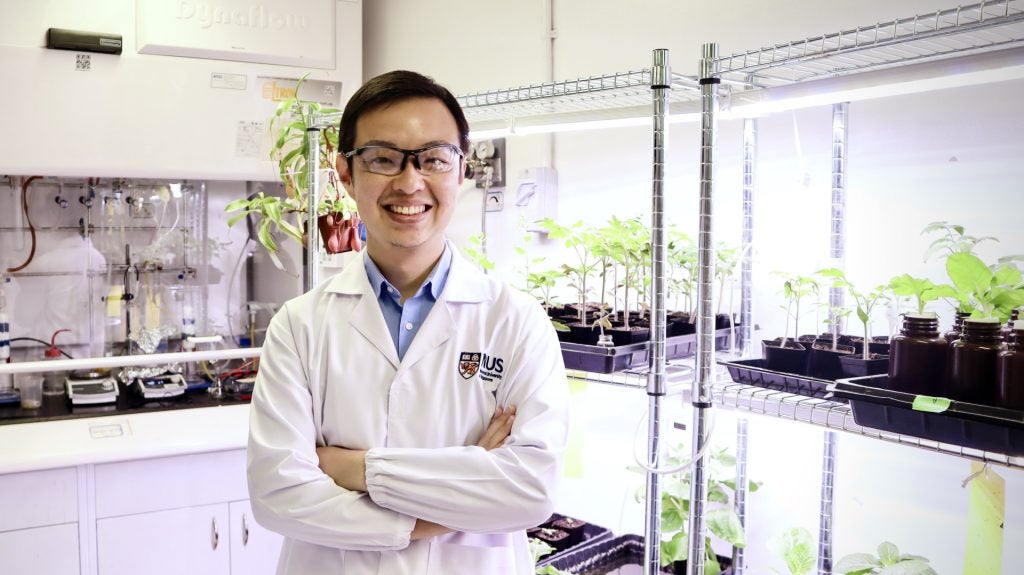


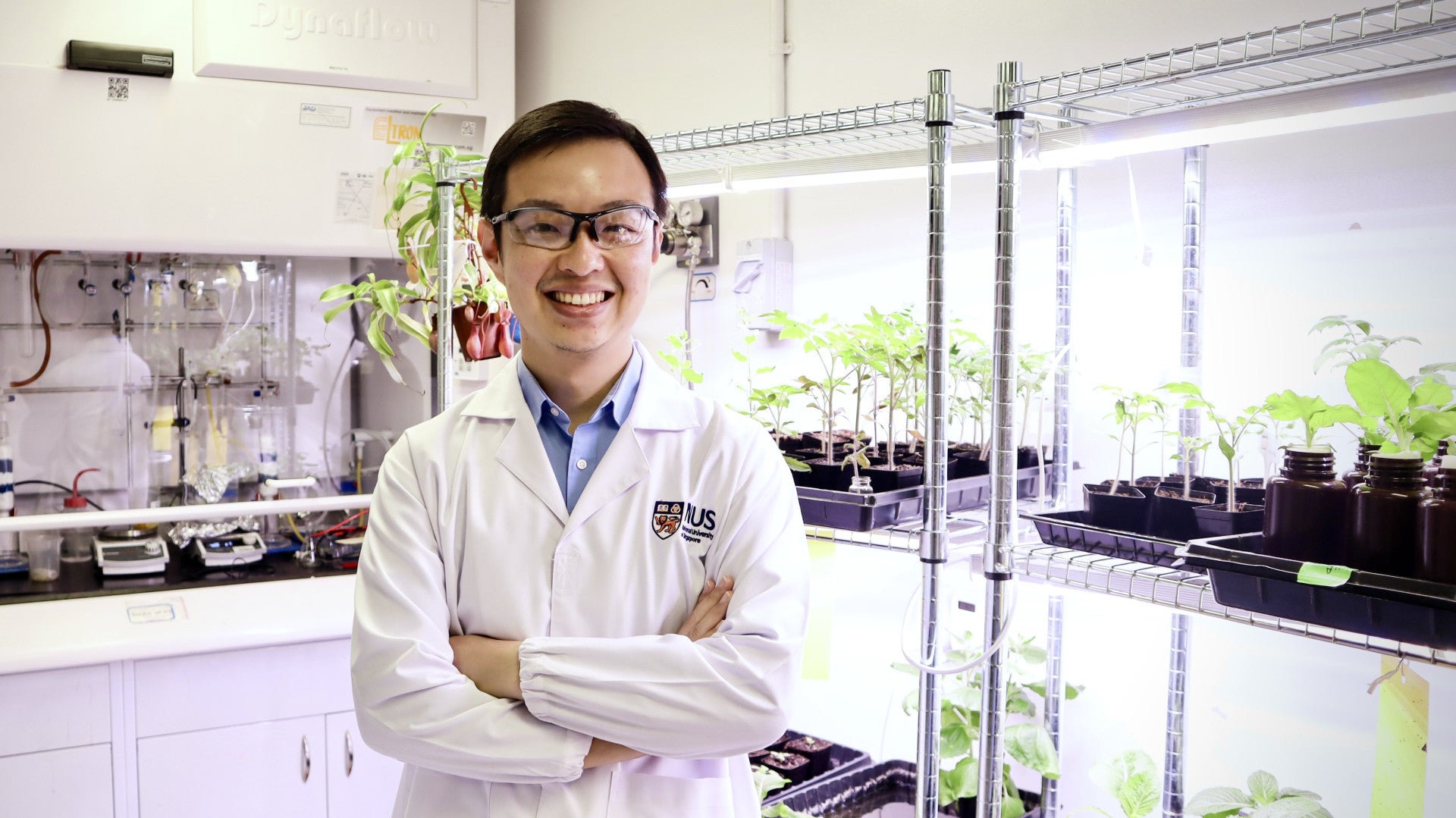
As a child with a keen eye for scientific inquiry, Assistant Professor Tedrick Lew (Chemical and Biomolecular Engineering) observed his mother glance at a backyard plant and decide, almost instantly, whether it was thriving or struggling. He could not always see what she saw. However, the question lingered: could plant health be measured early, clearly and without harming the plant?
That same curiosity now underpins his research — building tools that can both detect early signs of stress and deliver targeted help into living plants. Today, Asst Prof Lew, who is also a Presidential Young Professor at NUS, leads a multidisciplinary team developing nanotechnology-enabled tools that help plants better withstand a changing climate, from disease pressure to salinity and heat.
His latest work tackles one of the most stubborn bottlenecks in plant science: getting useful “cargo”, such as genes, proteins, hormones and even beneficial microbes, into living plants efficiently, especially when leaves are wet or fully submerged.
Published in Nature Communications on 24 November 2025, the study describes “amphibious” microneedles designed to deliver a wide range of biomolecules and living microorganisms into both terrestrial and aquatic plants.
Solving a stubborn delivery problem
Many established approaches for delivering functional cargo into plants are inefficient, difficult to control or limited to certain species. Wet leaves add another layer of complexity, as rainfall or irrigation can wash away sprayed molecules before they enter the plant. In aquatic environments, the challenge is more pronounced — payloads can disperse into surrounding water before the intended plant has a chance to take them up.
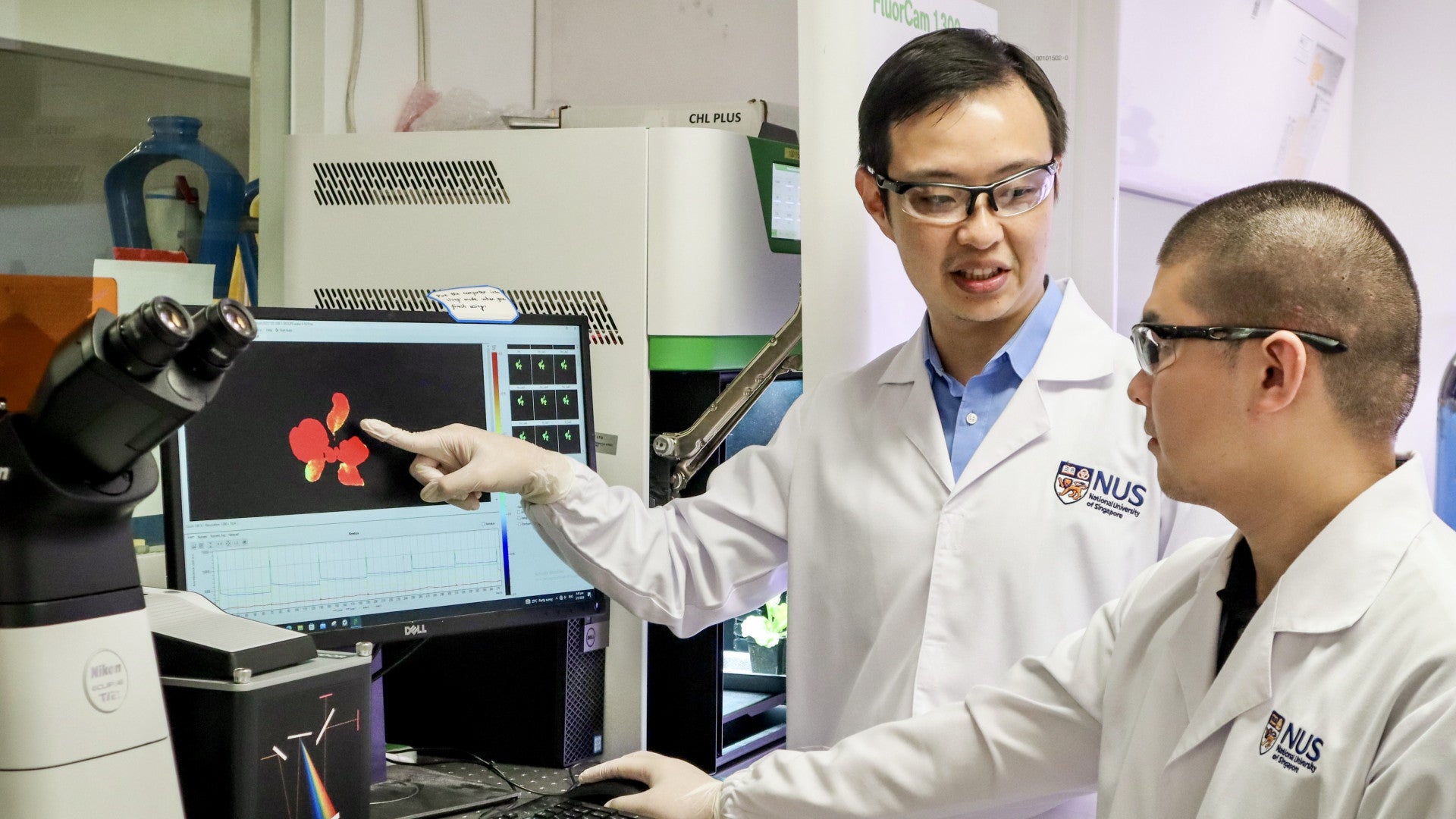
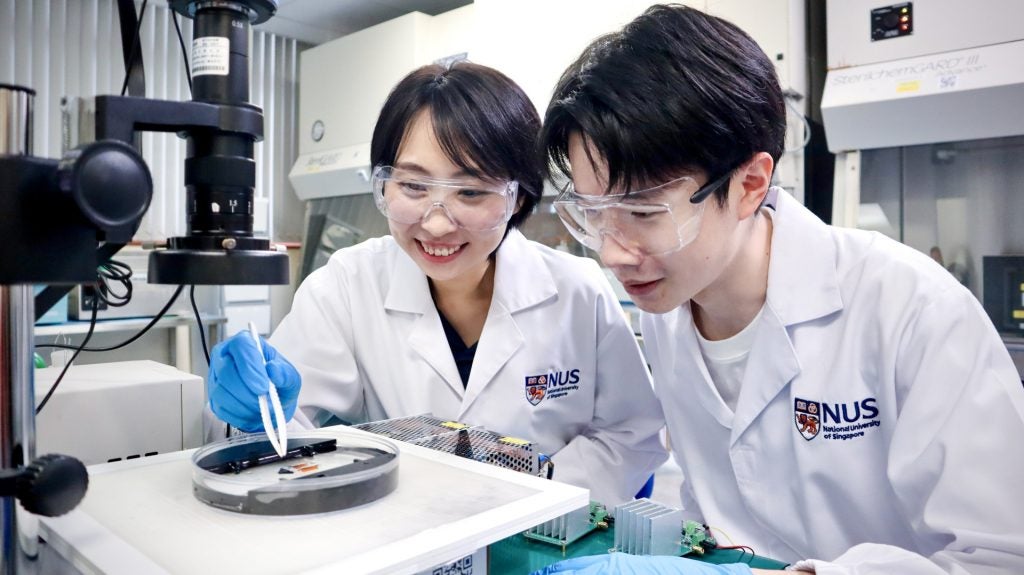
To address this, Asst Prof Lew and his team built a tiny patch covered in short microneedles that gently create microscopic pathways into plant tissue. Each microneedle is designed like a protective capsule: an outer layer helps it resist water exposure long enough for handling and application, while the inner core holds sensitive cargo. Once inserted, plant fluid gradually triggers a release mechanism that Asst Prof Lew compares to the “fizz” of an effervescent tablet, helping to push the payload into the surrounding tissue at a controllable pace.
In the study, his team showed the patch can transport a wide range of cargo types, including functional nucleic acids, proteins, plant hormones and live Agrobacterium (a soil-dwelling bacterium that functions as a natural genetic delivery system for plants), with evidence that the delivered genes remain active in plant cells. The platform also enabled underwater delivery of a salt-tolerance gene into a submerged freshwater plant, demonstrating a route to engineering stress resilience in settings where conventional delivery tools are difficult to use.
“This is the first demonstration of a programmable microneedle system that functions reliably in both land and aquatic plants,” Asst Prof Lew added. “Most delivery methods rely on spraying or injection, which fail on wet or submerged plants. Our system combines water resistance, controlled release — which we can tune — and biological compatibility in a single design.”
Aquatic plants such as watercress, water spinach, and seaweed stand to benefit from this technological breakthrough.
Beyond proving that the approach works in both dry and water-rich settings, Asst Prof Lew sees the patch as a practical delivery “bridge” between lab ideas and real plants in the field. The microneedles could be used to deliver biomolecules that help improve crop traits, such as stress tolerance and growth, or to introduce beneficial microbes more precisely with minimal loss or contamination to the surrounding environment.
Asst Prof Lew also pointed to the platform’s potential to deliver gene-editing tools to impart desirable traits, including improvements in flavour, nutrient production or other characteristics, while offering a new route for aquatic plant biotechnology, an area that remains difficult to access with standard spraying or injection methods. “In the longer term, the approach could support more efficient use of agricultural inputs, by placing bioactive payloads where they are needed rather than dispersing them broadly,” said Asst Prof Lew.
At the frontier of climate-resilient flora
The microneedle patch is part of a wider effort in The Lew Lab, a multidisciplinary research group led by Asst Prof Lew, to build plant-friendly technologies that can both read and shape plant responses to stress. Beyond delivery, the group develops nanosensors that monitor plant physiology in a non-destructive way, as well as nanoparticle-based strategies to target specific plant entry points and improve the efficiency of protective treatments. For example, Asst Prof Lew’s team is currently experimenting with a molecular “sunscreen” for plants to help them better withstand heat stress.
Established in September 2022, the lab also studies plant–microbe interactions and the biocompatibility of plant nanotechnologies, with the goal of designing tools that boost plant performance and resilience while minimising unintended impacts on crops and surrounding ecosystems.
Looking ahead, Asst Prof Lew is focused on translating the microneedle platform toward more scalable use. This involves optimising designs for field-like conditions, expanding the range of cargoes including gene-editing tools and stress-response regulators, and studying longer-term plant responses under realistic agricultural settings. He is also exploring manufacturing routes such as 3D printing and considering how patch-based delivery could pair with advances in agricultural and underwater robotics.