


Wearable health monitors have grown increasingly capable, but most are still limited by the fact that tracking different types of body signals still requires separate sensors, each with its own circuitry, each claiming its own patch of skin. That leads to bulkier devices, higher power consumption and greater discomfort for anyone who needs round-the-clock monitoring.
A research team led by Assistant Professor Liu Yuxin from the Department of Biomedical Engineering at the College of Design and Engineering, National University of Singapore (NUS CDE), has developed a cross-modal skin sensor that overcomes this constraint. Named X-Sig, the device fuses the body’s electrical impulses, such as heart rhythms and muscle signals, with its mechanical signals, such as pulse pressure waves and the forces generated by muscle contractions, into a single composite waveform transmitted through one channel. The work, published in Nature Sensors on 19 March 2026, paves the way for wearable health monitors that are simpler, smaller and more power efficient, which could encourage wider adoption of continuous health monitoring beyond clinical settings.
“Our bodies generate a rich mix of electrical and mechanical signals, but conventional wearables detect them in isolation, which requires separate hardware. We wanted to make things simpler by merging these signals at the sensor itself, before they ever reach the processing electronics,” said Asst Prof Liu.
Two sensing layers leading to one output
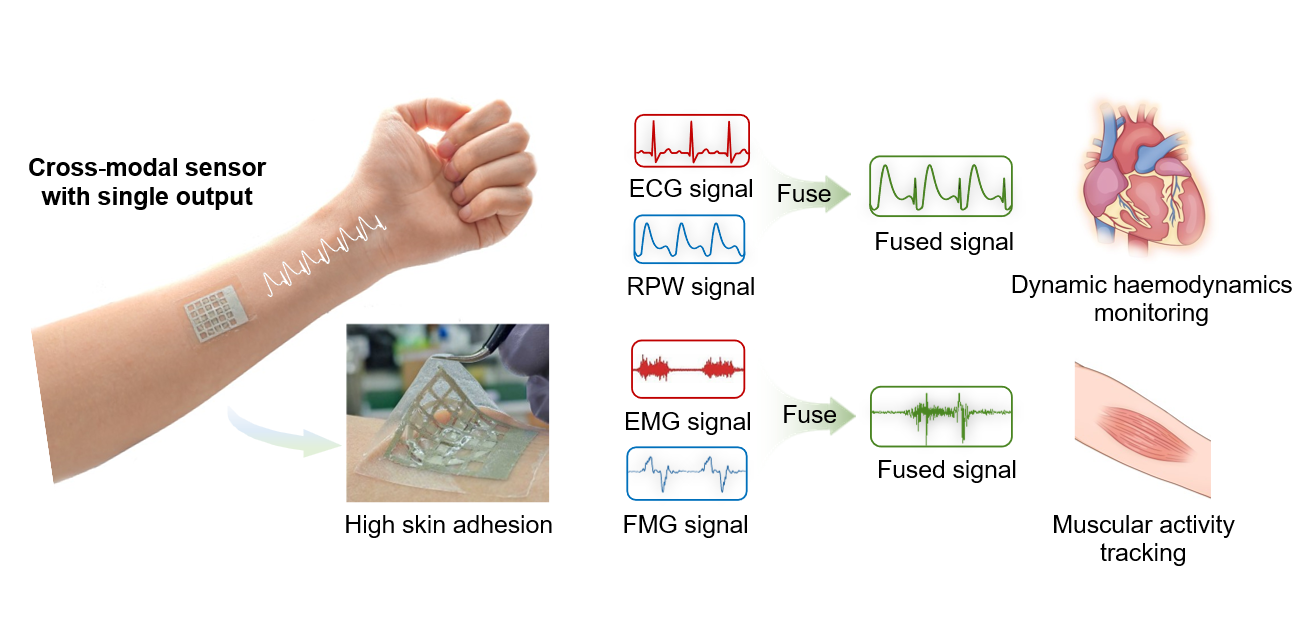
Conventional wearable systems rely on electrodes to record electrical signals such as electrocardiography (ECG, the electrical trace of heart activity) and electromyography (EMG, the electrical impulses driving muscle contractions). On the other hand, detecting mechanical signals, such as radial pulse waves from blood flow and force myography (FMG, the pressure changes when muscles contract beneath the skin), requires a different class of sensor. Each sensor type requires its own analogue front end, which is the dedicated circuit that conditions and digitises raw signals, adding bulk and power consumption.
The team’s X-Sig sensor makes this duplication redundant through a cross-layered architecture that vertically stacks two functional elements into one patch: a conductive electrode for capturing electrical signals, and an ultrathin piezoelectric film that generates voltage when pressed to detect biomechanical signals. As both layers produce voltage outputs, their signals combine naturally into a single waveform at the sensor itself, eliminating the need for separate processing circuits.
The electrode uses three molecularly engineered polyurethane layers — one elastic, one adhesive and one conductive — to overcome a longstanding materials trade-off whereby conductors that perform well electrically tend to adhere poorly to skin. Separating these functions across distinct stacked layers enables the electrode to achieve both strong skin adhesion and low electrical impedance, outperforming commercial gel electrodes on both measures. Both the electrode and piezoelectric layers are perforated so the adhesive can bond directly with skin through small openings, ensuring a secure fit on curved body surfaces. No skin irritation was observed after 24 hours of continuous wear, and the electrode materials can be fully recycled by washing sequentially with water and ethanol.
From heartbeat to blood pressure in one smart patch
Placed on the wrist over the radial artery, the X-Sig sensor captures ECG and pulse wave signals simultaneously. From the fused waveform, a machine-learning algorithm extracts heart rate and pulse arrival time — the delay between the heart’s electrical trigger and the resulting pressure wave reaching the wrist — then uses these features to estimate blood pressure continuously without a cuff.
Predicted values showed mean differences of just 0.27 mm Hg for systolic blood pressure and 0.33 mm Hg for diastolic blood pressure compared with a standard cuff-based monitor, meeting the highest accuracy grade (Class A) under the Institute of Electrical and Electronics Engineers standard for cuffless blood pressure devices. The system also reliably tracked expected blood pressure shifts as volunteers moved between sitting, standing, performing a breath-hold manoeuvre and brief exercise.
In a second demonstration, the team attached the sensor to the forearm to classify hand movements. By fusing EMG and FMG into one channel, the X-Sig sensor achieved 96.4% accuracy across ten different gestures, compared with 72.1% for EMG alone and 82.9% for FMG alone. Because the fused signal carries complementary electrical and mechanical information about muscle activity, the model needed only 70 training samples per gesture to reach high accuracy, a fraction of what single-modality systems typically require.
The researchers have also shown that the X-Sig sensor can capture all four signal types — ECG, EMG, pulse waves and FMG — simultaneously from a single body site, a capability they plan to investigate further. Potential applications span cuffless cardiovascular monitoring, prosthetic control and rehabilitation.
“Through this work we have demonstrated that fusing electrical and mechanical signals at their source can help simplify the hardware a patient wears. That kind of simplification and the comfort it brings could make continuous health monitoring far more ubiquitous, and when more people can track their health outside clinical settings, the benefits ripple through the healthcare system, from earlier intervention to reduced burden on hospitals,” added Dr Wu Xiaodong, the first author of the paper and a Research Fellow from the NUS Institute for Health Innovation and Technology.
The NUS research was supported by the NUS Institute for Health Innovation and Technology, the NUS Department of Biomedical Engineering, and the NUS N.1 Institute for Health.