

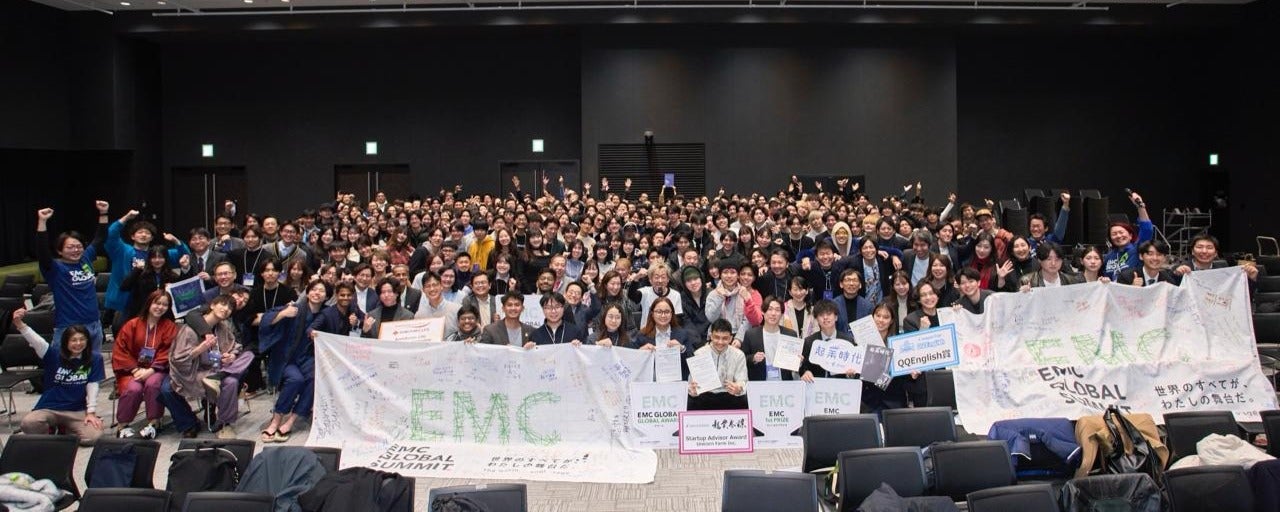
Ecovolt, founded by current NUS student Raphael Chew (Business Administration), and recent graduates Joseph Ho (Electrical Engineering, Second Major in Innovation & Design) from NUS Department of Electrical and Computer Engineering; as well as Eugene Chia (Computer Science), Glenn Quah (Information Systems) from NUS Computing; clinched the Sumitomo Life Insurance Award at the EMC Global Summit 2025.
Meanwhile, fellow NUS CDE startup and Innovation & Design Programme (iDP) project myVetBuddy won the Audience Award. myVetBuddy is an AI-powered veterinary assistant first initiated by Chakraborty Basudeb (Computer Engineering, Year 3), with teammates Chan Jia Min (Life Sciences, Year 3) and Singh Aryan (Electrical Engineering, Year 3).
Their wins at the Summit — a culmination of EMC Global’s entrepreneurship development programme and Musashino University’s programmes from its School of Entrepreneurship — send a strong signal of how the iDP programme helps student founders apply their knowledge and skills to solve problems, as well as design new products, services, and experiences.
By bringing together students from across NUS, the iDP programme — hosted by CDE’s Engineering Design and Innovation Centre (EDIC) — fosters the interdisciplinary collaboration needed to create high-impact solutions. To ensure these promising ideas become successful ventures, crucial post-project support is also provided through its Entrepreneur Fellowship—a programme that has propelled companies like Ecovolt forward.
More About the Teams
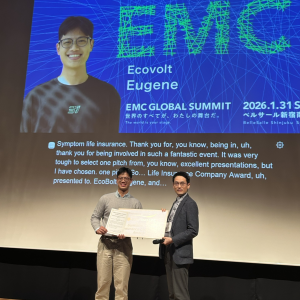
Ecovolt: Turning buildings into intelligent energy managers
By connecting sensors across electrical loads, air-conditioning, lighting, water usage, and indoor air quality, Ecovolt consolidates previously “invisible” consumption into a single dashboard that facility teams can act on.
Many buildings waste an estimated 15–20% of electricity through standby devices, cooling in empty spaces and disconnected systems. Across its client sites, Ecovolt has achieved close to 28% average energy reduction, helped prevent more than 100 tonnes of CO₂ in three months, and cut facilities-management man-hours by up to 70%.
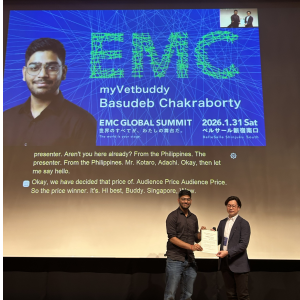
myVetBuddy: Cutting vet burnout and improving diagnostic accuracy
Cognitive fatigue and memory lapses contribute to an estimated 65% of pet misdiagnoses. myVetBuddy tackles this by automating notetaking, reminders, and prescription generation, while learning from past cases to offer real-time, research-backed diagnostic suggestions.
Built with veterinarians in mind, myVetBuddy aims to become Asia’s first agentic veterinary EHR, fitting into existing clinic workflows to boost clinical efficiency and patient outcomes.
Making the pitch resonate across cultures
One of the teams’ biggest hurdles was contextualising their pitches for a predominantly Japanese audience and understanding how things work on the ground. They addressed this by focusing less on technical detail and more on a human-centred narrative to help their ideas resonate across borders.
Basudeb from myVetBuddy expanded on the experience, saying, “The connections we made in Japan gave us firsthand insight into local business dynamics, veterinary workflows, and cultural expectations that no amount of desk research could replace. These relationships are what will help us localise myVetBuddy meaningfully when the time comes, rather than guessing from the outside.”
Feedback, humility — and a glimpse of Japan’s momentum
Beyond the win, the teams highlighted the quality of feedback from judges, describing it as mentorship-like and aimed at helping them think bigger. They also noted the humility among fellow winners. “We were struck by how the other award recipients responded,” Raphael from Ecovolt reflected. “There was real humility; winners downplayed their achievements, focused on the work ahead, and accepted the honour with a quiet resolve to do more. That ethos resonated with us deeply.”
Basudeb added, “There was a mutual respect that came from knowing everyone in the room was fighting their own version of the same uphill battle. We left with friendships that feel genuinely long-term, not built on exchanging business cards, but on shared values, shared struggles, and a shared drive to build something that matters.”
Scaling beyond Singapore
For myVetBuddy, the Summit was a step forward. The team is now deepening myVetBuddy into a full clinic operating system — iterating with clinics to refine workflow automation, building integration pathways to reduce adoption friction, and expanding beyond documentation to support the end-to-end clinic journey.
Connections forged in Japan are also expected to support myVetBuddy’s longer-term growth, laying the groundwork for future distribution in the Japanese market and opening up funding and partnership opportunities.
Similarly, the award has helped validate Ecovolt’s relevance beyond Singapore. Following the event, the startup secured meetings with Singlife and Japanese companies operating across Southeast Asia to explore how Ecovolt can support sustainability and operational efficiency goals.
Back home, Ecovolt continues to scale, with deployments across more than 20 organisations, including schools, corporate offices, industrial sites and hospitality venues. The team is expanding into more complex environments such as data centres and laboratories, and deepening collaboration with NUS on industry automation research across healthcare, agriculture and hospitality.
Raphael concluded, “We want Ecovolt to be the operating system for buildings, not just in Singapore, but across the region. Tokyo showed us that the appetite for that is real.”