

Research
NUS Cities Research aims to be an interdisciplinary and inclusive platform for researchers, academics and practitioners to solve complex urban challenges, and build capacity for the future.
The world is rapidly urbanising - almost 70% of its population are projected to live in cities by 2050. These cities face existential challenges, such as climate change, changing demographics and pandemics, which cannot be addressed by studying these issues within disciplinary silos, or by divorcing theory from real-world implementation.
NUS Cities Research thus aims to enhance our understanding of cities as complex adaptive systems. It will take an interdisciplinary and holistic approach, grounded by sound urban science alongside novel methods, commensurate to the multifaceted nature of the urban issues being investigated. It will leverage on a wealth of case studies on Singapore’s urban innovations to increase the depth of our understanding into real-world urban dynamics.
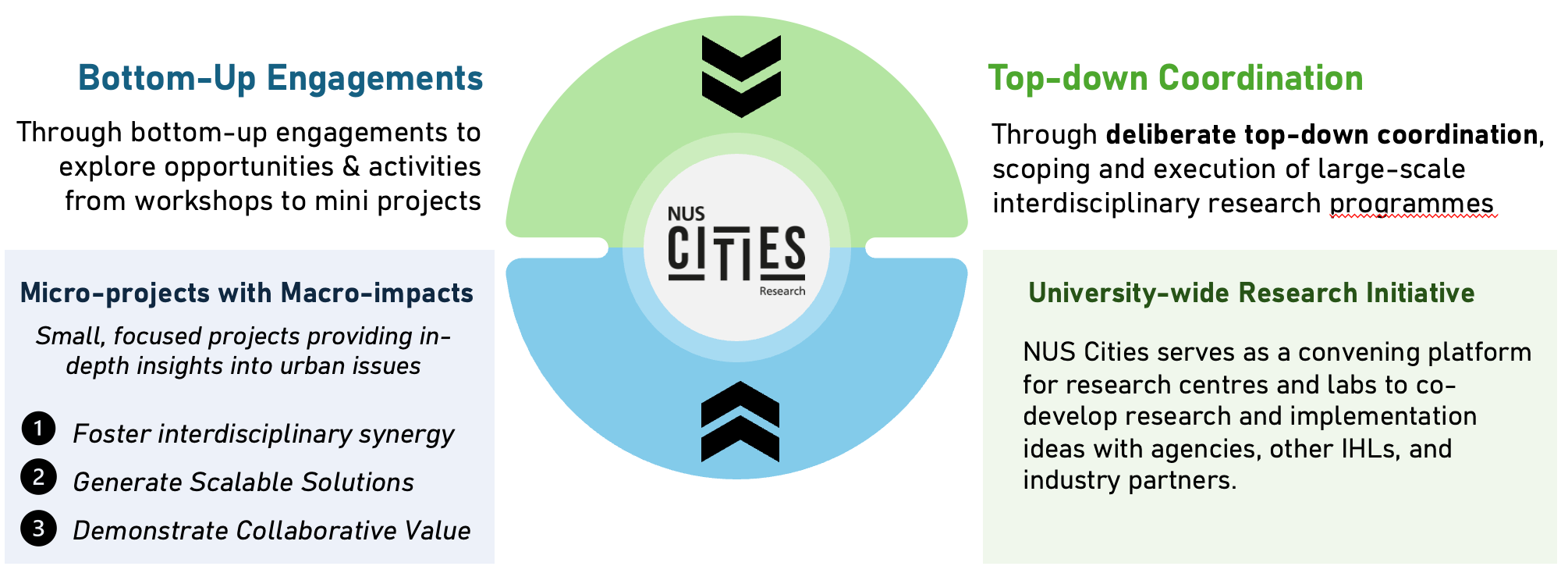
NUS Cities serves as a convening platform for built environment research across NUS, bringing together researchers, laboratories, and centres, including the Centre for Sustainable Asian Cities (CSAC); the Centre for Environment and Ageing Well (EngAGE); the Architectural & Urban Prototyping Lab; the Urban Climate Design Lab (UCDL); and the Urban Analytics Lab (UAL), among others, and facilitating the co-development of research and implementation ideas with agencies, other Institutes of Higher Learning (IHLs), and industry partners.
Through this, NUS Cities builds not just the theoretical and scientific understanding of cities, but also the capacity of governments and industry to solve complex urban challenges in order to achieve sustainability, resilience and liveability for our cities.
Research Strategy
Research Roadmap
Cities Foresight Lab
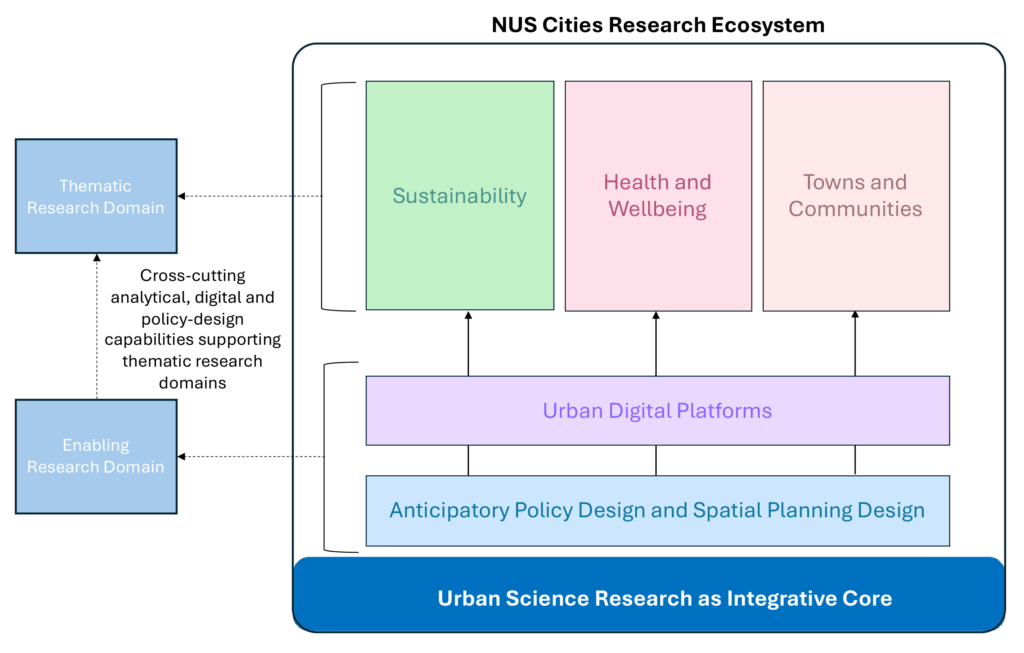
Research Areas
*Note that specific research projects and scopes are still under refinement.


Our Network
NUS Departments, Schools, Research Centres & Labs







Agencies












Institutes of Higher Learning (IHLs)