RESEARCH AT CDE
At CDE, we push boundaries to achieve world-class research excellence through the exploration and application of engineering, architecture, and design to solve complex problems. We pioneer unique models of interdisciplinary research that takes advantage of the natural synergies between these fields to advance impactful, basic and translational research.
In addition to our ten departments, our cross-disciplinary research thrives through partnerships. Our researchers forge new frontiers through college-level centres, global research partnerships and industry collaborations, powered by state-of-the art research infrastructure and unique capabilities.
People are at the core of our pursuits. We are committed to empowering visionary talent poised to redefine the future of architecture, design, and engineering, anchored in diversity and interdisciplinary research.

NUS researchers reveal how stiffer ovarian tissue can impair egg development
Targeting a signalling pathway helped restore connections between eggs and the cells that nourish them, improving egg maturation in laboratory experiments.
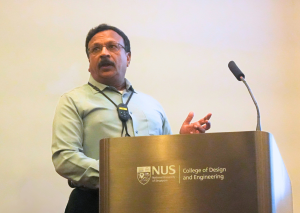
Start with the problem, not the discipline: Rethinking solutions to sustainability challenges
Recently named the inaugural NUS Keppel Professor in Sustainability Solutions, NUS CDE’s Prof Rajasekhar Balasubramanian reflects on three decades of tackling complex sustainability challenges and translating research into real-world solutions.
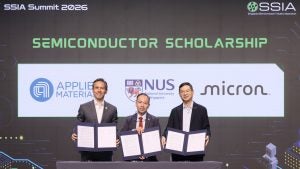
Building the next generation of semiconductor talent in collaboration with Applied Materials and Micron
New graduate scholarships awarded through CDE’s Master of Science in Semiconductor Technology & Operations (MSc STO) programme

NUS CDE researchers unlock dexterous soft-robot motion from a single artificial muscle
Taking inspiration from the octopus’s neural connections, NUS CDE researchers have developed a way to produce dexterous soft-robot motion from a single artificial muscle.
Teaching drones to hunt, rockets to land and lattices to absorb
At the NUS Energy Solutions Hub, researchers and partners are pooling expertise across disciplines to reimagine from the ground up how tropical cities can stay cool, connected and carbon-conscious.
Familiar ground: Ageing gracefully in places we know
At the NUS Energy Solutions Hub, researchers and partners are pooling expertise across disciplines to reimagine from the ground up how tropical cities can stay cool, connected and carbon-conscious.
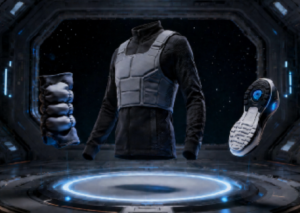
Defying gravity: The new threads of space flight and beyond
At the NUS Energy Solutions Hub, researchers and partners are pooling expertise across disciplines to reimagine from the ground up how tropical cities can stay cool, connected and carbon-conscious.

The art of letting go
At the NUS Energy Solutions Hub, researchers and partners are pooling expertise across disciplines to reimagine from the ground up how tropical cities can stay cool, connected and carbon-conscious.