NUS CDE is taking a major step toward shaping the future of semiconductor innovation through artificial intelligence, with dual initiatives spanning research and talent development.
On the research front, a Memorandum of Understanding was signed on 10 June 2026, strengthening CDE’s collaboration with Applied Materials through the Applied Materials-NUS Advanced Materials Corporate Lab, where efforts will focus on using AI to accelerate semiconductor process development.
On the talent development side, CDE will launch a new Applied AI for Materials and Process Engineering specialisation under the Master of Science in Semiconductor Technology and Operations (MSc STO). Starting in August 2026, the new specialisation will prepare students to apply AI and computational tools to industrial challenges in semiconductors, materials engineering and advanced manufacturing.
Together, both initiatives reinforce the College’s role in translating research into industry impact while preparing engineers for an increasingly AI-enabled semiconductor sector.
Collaboration with Applied Materials
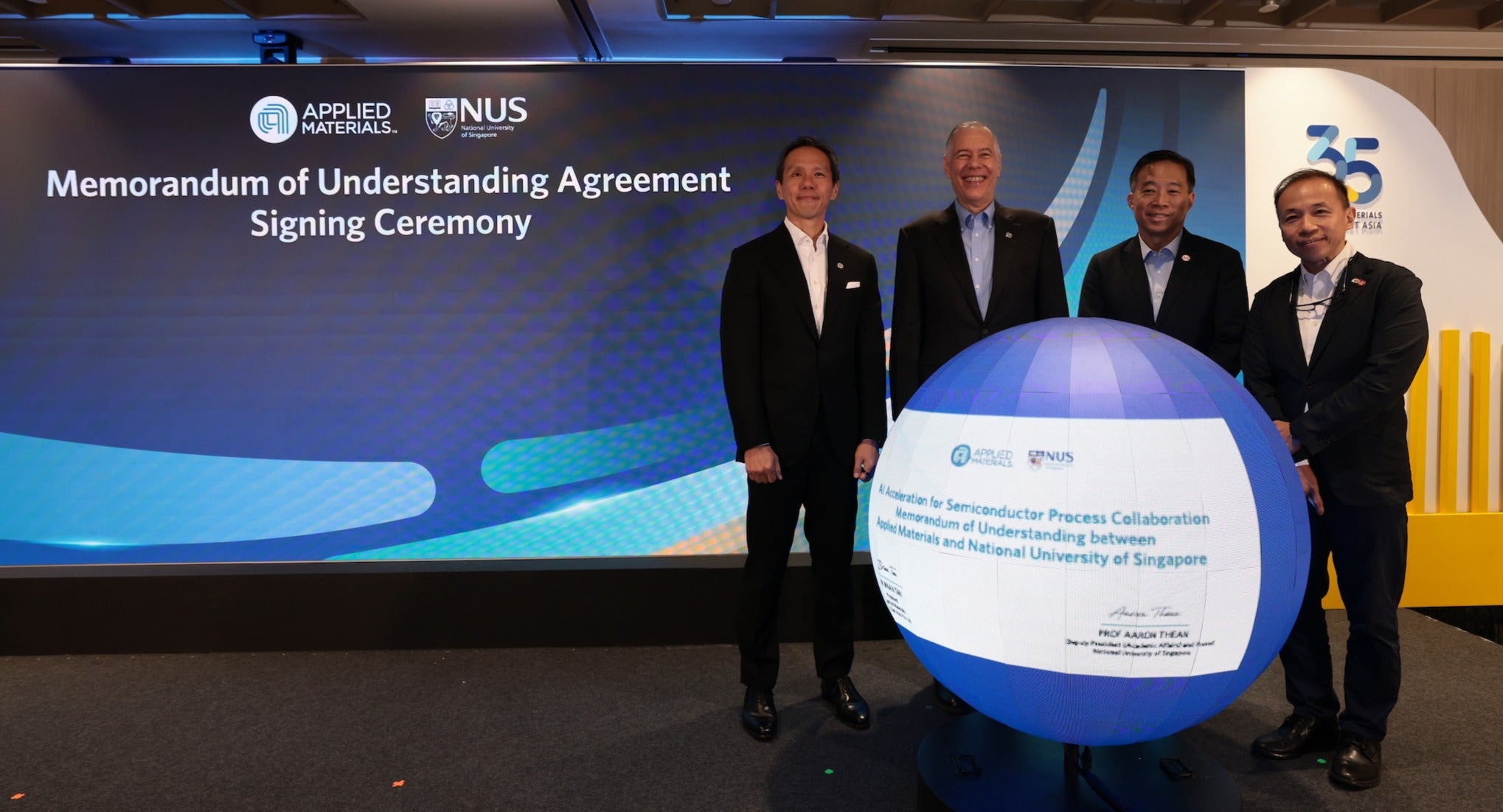
Marking the latest phase in research collaboration with Applied Materials, the MOU was signed by Professor Aaron Thean, NUS Deputy President (Academic Affairs) and Provost, and Mr Brian Tan, Regional President (South East Asia), Applied Materials, at the opening of the Applied Materials Tampines Campus. The signing ceremony was witnessed by Mr Gary Dickerson, President and CEO of Applied Materials, and Mr Png Cheong Boon, Chairman of the Singapore Economic Development Board.
Prof Thean said: “Deepening our collaboration with Applied Materials, together with our new AI specialisation in semiconductor engineering education, reflects how NUS is advancing this sector on both fronts, through research that forges new frontiers and education that nurtures the talent to apply it.”
Strengthening CDE’s impact through industry-linked innovation
Launched in 2018 and expanded in 2024, the Applied Materials-NUS Advanced Materials Corporate Lab provides a strong platform for applied research across chemistry, materials science and semiconductor process engineering. The Corporate Lab is led by three Co-Directors: Professor Silvija Gradečak-Garaj, CDE Vice Dean (Research and Technology); Professor Richard Wong from the NUS Faculty of Science; and Dr John Sudijono, Director of Engineering from Applied Materials.
Across CDE, researchers are strengthening the use of AI and data-driven methods to accelerate materials discovery and semiconductor innovation. Their work focuses on developing machine learning models, generative AI tools and advanced computational platforms to predict material properties, guide the design of new functional materials and support faster, more efficient research in areas including advanced semiconductors, energy materials and electronic devices.
By combining the College’s strengths in materials science, engineering, and computational expertise from both CDE and the NUS Faculty of Science, with Applied Materials’ semiconductor equipment capabilities, the collaboration aims to reduce costly trial-and-error cycles, identify the most promising experiments more quickly, and speed the translation of research from lab to fab.
The work also addresses key barriers to AI adoption in semiconductor manufacturing, including complex process parameters, fragmented data and the challenge of linking material changes to device performance.
Building AI-ready semiconductor talent
Complementing this research push is CDE’s new Applied AI for Materials and Process Engineering specialisation within the MSc STO programme.
Designed for STEM graduates and early- to mid-career professionals, students on the specialisation will gain hands-on exposure to technologies such as machine learning, generative AI, computer vision and digital twins, with applications including defect detection, predictive maintenance, yield optimisation and materials characterisation.
Industry placements will further allow students to work on real-world projects, helping them build interdisciplinary and practice-oriented expertise that is directly relevant to emerging technology sectors.
Advancing research, education and industry relevance
As AI becomes increasingly important to semiconductor manufacturing, these dual initiatives will further strengthen CDE’s position in shaping both the technologies and the people needed to support this transformation.
“By bringing together deep technical expertise from across NUS, strong industry partnerships through the NUS-Applied Materials Corporate Lab, and a commitment to applied learning within CDE, we are advancing fundamental and applied research for tangible economic and societal impact”, stated Prof Gradečak-Garaj.