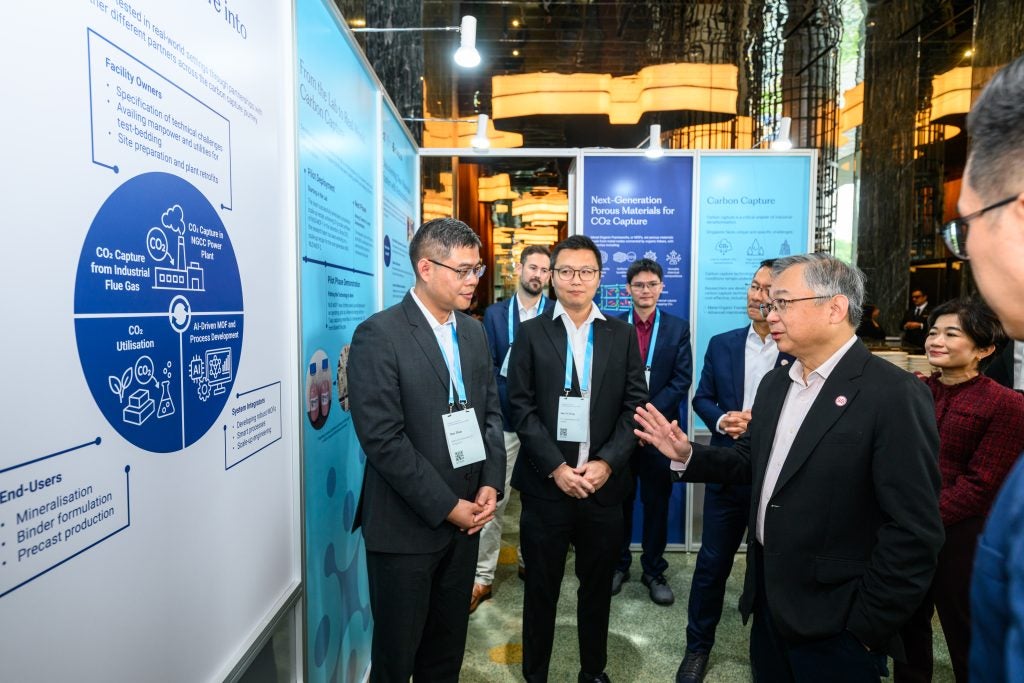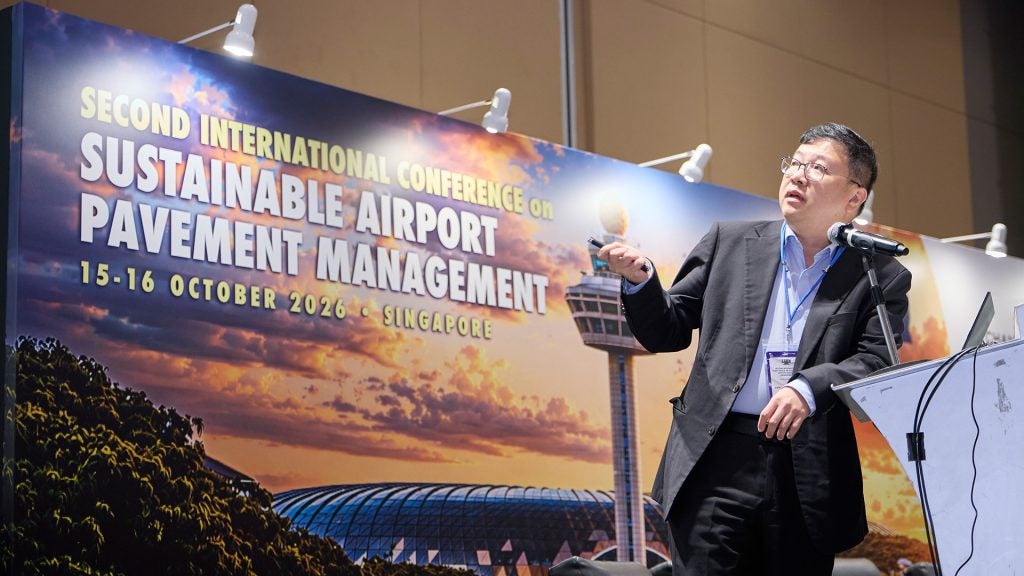
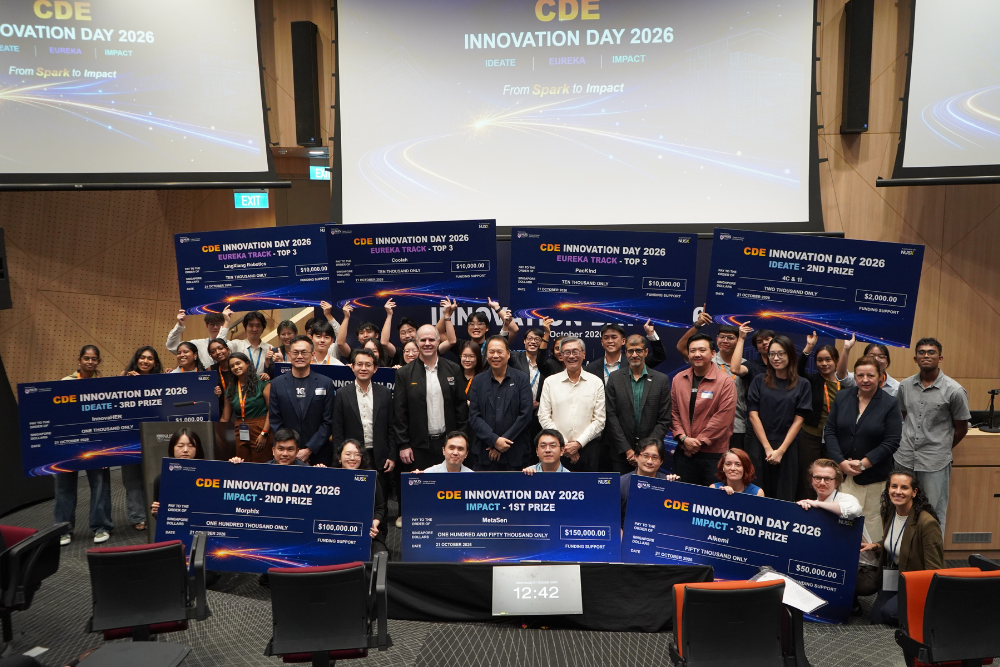
Innovative ideas spanning healthcare, assistive technology, robotics, sustainable energy and advanced manufacturing took centre stage at CDE Innovation Day 2026, as students and researchers from across NUS competed for funding to advance their projects.
Held on 21 October, the event brought together participants ranging from first-year undergraduates to graduate students and researchers, highlighting the breadth of innovation and entrepreneurial ambition within the NUS community.
Under this year's theme, “From Spark to Impact”, teams presented their projects across three competition tracks, each designed to support innovations at different stages of development. The IDEATE competition focused on early-stage ideas, EUREKA supported proof-of-concept development, while IMPACT centred on research translation and venture creation. This year's competition attracted a significant increase in applications across all three tracks, with enhanced funding support available to help winning teams take their ideas further.
IMPACT Track winners
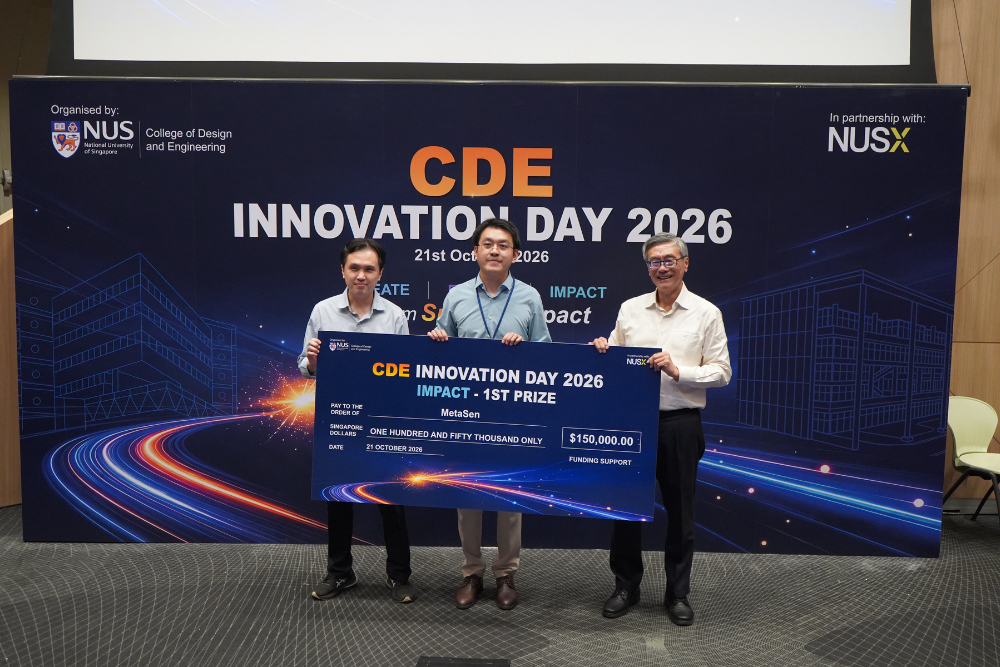
IMPACT Winner: MetaSen
$150,000 Funding Support
Developed by research fellow Zhang Jinyun (Biomedical Engineering), MetaSen addresses a major bottleneck in biomanufacturing: the engineering of high-performing enzymes and microbial strains.
Conventional microbial screening relies on analytical methods such as HPLC and LC-MS, which are costly, labour-intensive and limited in their ability to generate sufficient data for AI-driven engineering.
MetaSen's proprietary genetic biosensor-enabled platform addresses this challenge by converting intracellular metabolite production into fluorescent signals. Validated across multiple small-molecule targets, the platform has achieved up to 98% agreement with gold-standard analytical measurements.
This enables ultra-high-throughput screening of millions of microbial variants while generating high-quality sequence–function data for machine learning-guided optimisation. Compared with conventional methods, the platform can reduce development time by up to tenfold and screening costs by more than 90%.
The innovation has potential applications across biopharmaceuticals, sustainable chemicals, biomaterials, food ingredients and precision fermentation, with biotechnology and pharmaceutical companies, microbial developers, contract research organisations and synthetic biology researchers among its target users.
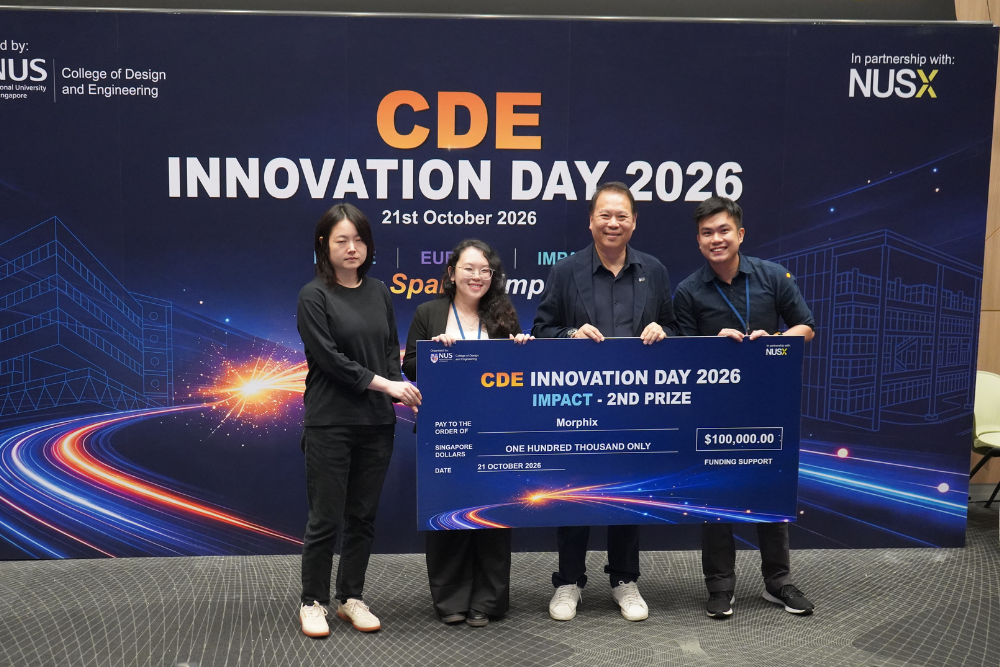
IMPACT 2nd Prize: Morphix
$100,000 Funding Support
Team members: Stella Ng Sze Yue (Chemical and Biomolecular Engineering), Lee Yi Wei (Chemical and Biomolecular Engineering), and research engineer Xie Jiaxun
Crystallisation is a critical process in pharmaceutical manufacturing, where even slight variations in crystal size, shape and structure can affect the quality of the final medicine.
However, existing technologies offer limited visibility into these changes, making it difficult for manufacturers to collect actionable data and optimise production processes. This often results in costly trial-and-error approaches that increase research and development costs.
To address this challenge, the Morphix team developed an AI-powered crystal imaging platform that provides detailed insights into crystallisation processes. Combining artificial intelligence with proprietary polychromatic polarisation imaging, the platform can rapidly characterise more than 500 crystals in a single measurement and autonomously identify the crystal structure of each one. This capability enables manufacturers to generate detailed crystal property data to inform decisions and improve process efficiency.
The technology has been validated using pharmaceutical model compounds in collaboration with Pfizer, with the findings published in a peer-reviewed journal. It has also secured an additional S$600,000 in funding from Pfizer for an ongoing development project at NUS Chemical and Biomolecular Engineering.
The platform targets pharmaceutical and chemical manufacturers seeking to accelerate product development and reduce production costs.
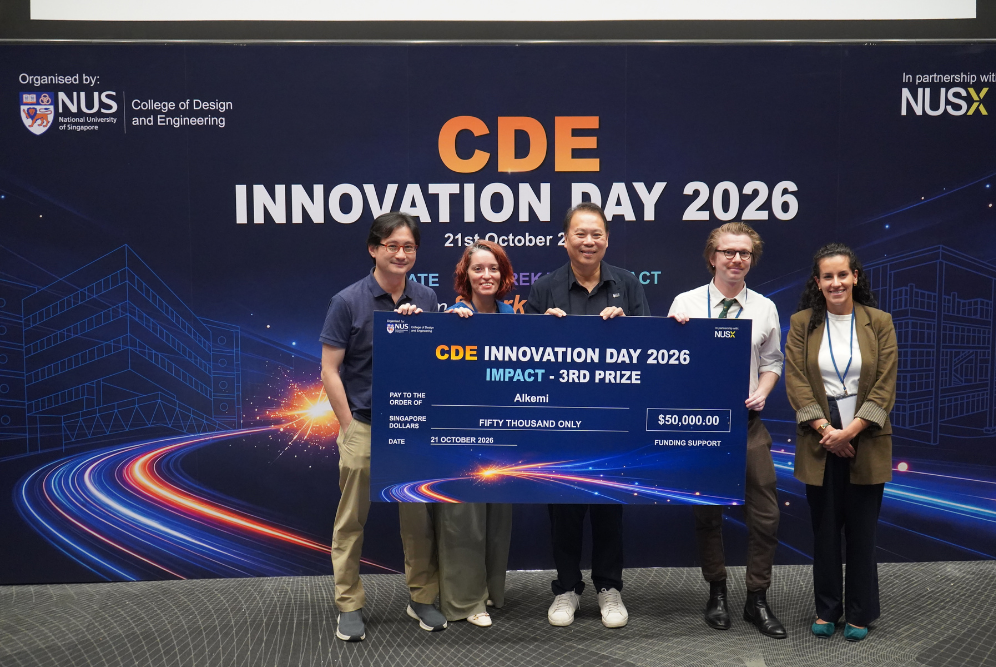
IMPACT 3rd Prize: Alkemi
$50,000 Funding Support
Team members: Beatriz Ferraz (Chemistry), Sara Aguiar (Chemistry), Hippolyte Astier (Materials Science and Engineering)
As semiconductor technology advances towards sub-2nm nodes, continued miniaturisation presents increasingly complex manufacturing challenges. Conventional copper interconnects face scaling limitations as electron surface scattering increases resistivity, while diffusion barriers occupy a growing proportion of shrinking semiconductor features. Molybdenum (Mo) has emerged as a promising alternative due to its short electron mean free path and compatibility with suitable dielectric materials.
The Alkemi team has developed a halide- and oxygen-free organometallic liquid molybdenum precursor for Atomic Layer Deposition (ALD), offering a potentially more convenient and efficient approach to semiconductor fabrication.
Unlike conventional solid precursors, the material remains liquid at room temperature, eliminating sublimation challenges and enabling stable, consistent vapour delivery. Its compatibility with conventional ALD processes also supports integration into existing semiconductor manufacturing workflows while enabling high-purity film growth.
Technical feasibility has been validated using commercial ALD equipment through the AMAT-NUS Advanced Materials Corporate Lab, demonstrating proof of concept for metallic molybdenum interconnects. The team is also exploring applications of its liquid precursor platform in depositing other molybdenum-containing materials, including MoS₂, for next-generation transistors.
By addressing critical precursor and manufacturing bottlenecks, the technology has the potential to support the development of smaller, faster electronic devices.
EUREKA Top 3 Winners
$10,000 funding support each:
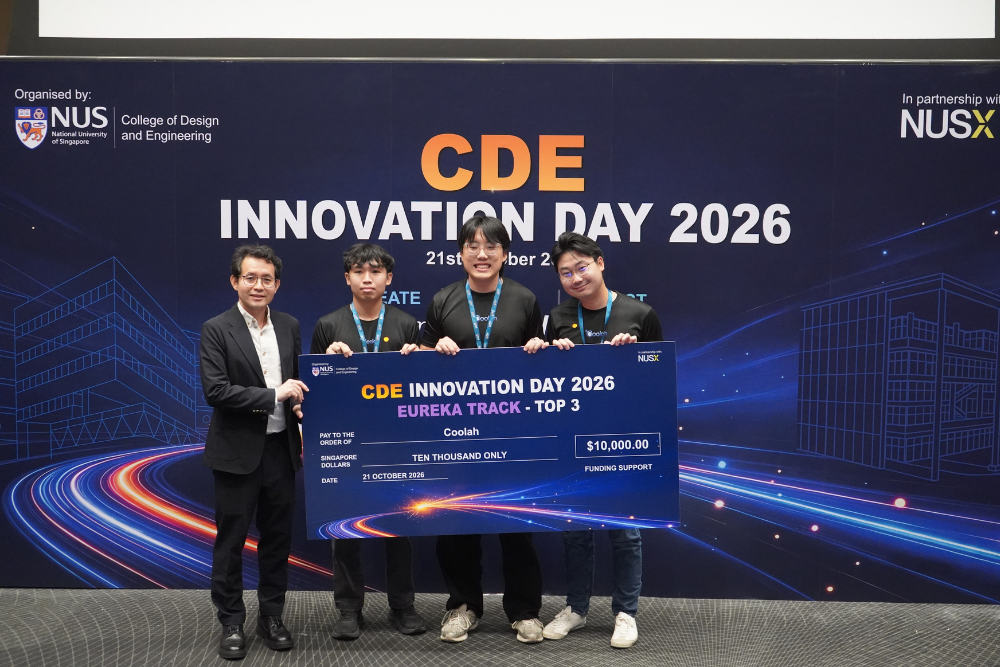
Coolah
Team members: Wilson Yeo (Materials Science and Engineering), Jethro Tan (Mechanical Engineering), Chuan Zhe (Mechanical Engineering)
Coolah is developing affordable wearable cooling solutions to protect outdoor workers from heat stress, particularly those working in Singapore's hot and humid conditions. With more than 480,000 outdoor construction workers in Singapore, many of whom are migrant workers, prolonged exposure to heat can contribute to exhaustion, illness and reduced concentration, increasing the risk of workplace accidents.
Existing cooling solutions often face limitations in tropical environments. Fan-based vests may circulate warm air, evaporative cooling vests can remain damp and cause discomfort, while ice-based solutions may lose their effectiveness quickly. Coolah addresses these challenges by incorporating cooling technology into personal protective equipment that workers already use.
Its CoolVest integrates long-lasting phase change materials into a standard safety vest, while its CoolHelmet Attachment clips onto most hard hats to provide targeted cooling around the neck. Both solutions are designed to remain effective for hours, offer a lower-cost alternative to premium cooling devices and require minimal changes to workers' existing routines.
The team has conducted controlled trials demonstrating that its vest sustains skin cooling for significantly longer than ice-based alternatives, while its helmet attachment effectively reduces neck temperature. Comfort and usability have also been evaluated with migrant construction workers through an NGO partner, providing insights to guide further development.
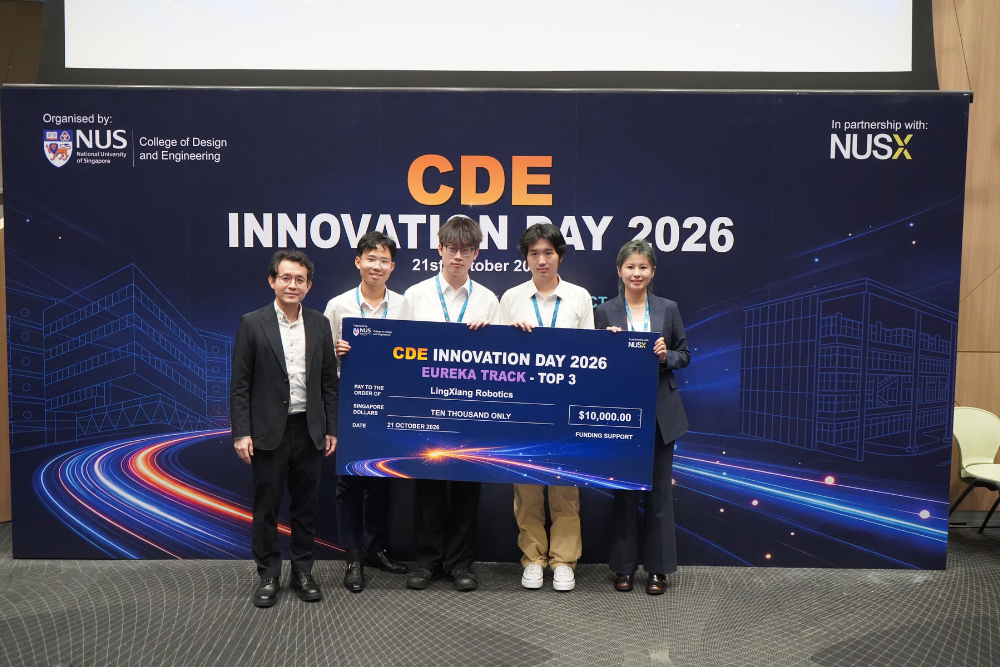
LingXiang Robotics
Team members: Huang Huishi, Wang Haozhe, Ying Fengkang, Yang HongXi, Jin Junyu (Mechanical Engineering)
LingXiang Robotics is developing an autonomous delivery robot designed to address the final stage of parcel delivery in Singapore's high-rise residential estates. While existing delivery robots can transport parcels to building lobbies, navigating lifts and corridors before physically handing packages to residents remains a significant technological challenge.
To overcome this limitation, the team developed an autonomous delivery system equipped with SpiraArm, a bio-inspired, cable-driven soft robotic trunk that mimics the grasping capabilities of an elephant's trunk. The flexible manipulator can handle payloads ranging from 10g to 10kg, adapting to different parcel shapes without requiring mechanical adjustments. Its soft structure also makes it inherently safer for human interaction.
By combining doorstep-level navigation with a flexible robotic manipulator, the solution aims to support more efficient parcel delivery while improving accessibility for elderly residents and individuals with mobility challenges.The underlying robotic trunk technology was published in npj Robotics in 2025, with nine grasping strategies demonstrated using a physical prototype.
The team's augmented reality teleoperation system also achieved a 3% real-to-simulation shape error and received the Best Poster Award at IEEE RoboSoft 2026.
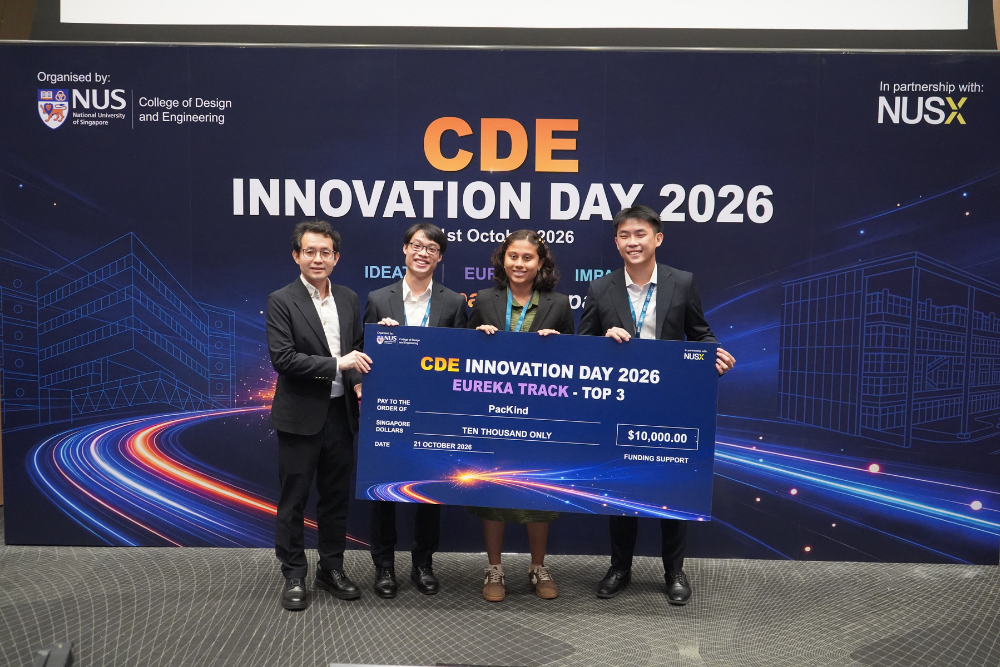
PacKind
Team members: Koh Jye Sheng, Zenson (Materials Science and Engineering), Evan Lim Shouwang (Biomedical Engineering), Manashree Krishnan (Economics)
PacKind is developing a more recyclable beverage carton by redesigning the adhesive layer that bonds its different materials together.
Conventional beverage cartons are difficult to recycle because their plastic and aluminium layers form a tightly bonded composite that is challenging to separate. As a result, many cartons are incinerated or sent to landfills despite containing valuable recoverable materials. Rather than focusing on downstream recycling technologies or replacing existing packaging materials, PacKind addresses the problem at its source through a separable adhesive system.
The innovation allows beverage cartons to retain their existing functionality while enabling easier separation and recovery of materials at the end of their lifecycle. Designed to be compatible with existing manufacturing processes, the solution could allow packaging manufacturers to adopt more sustainable materials without significantly modifying their production lines. It also has the potential to improve material recovery for recyclers and support broader circular economy objectives.
The team has validated the technology through prototype fabrication and experimental testing, including adhesion, material separation and recovery, mechanical strength, transport durability, barrier performance and leaching assessments.
IDEATE Track winners
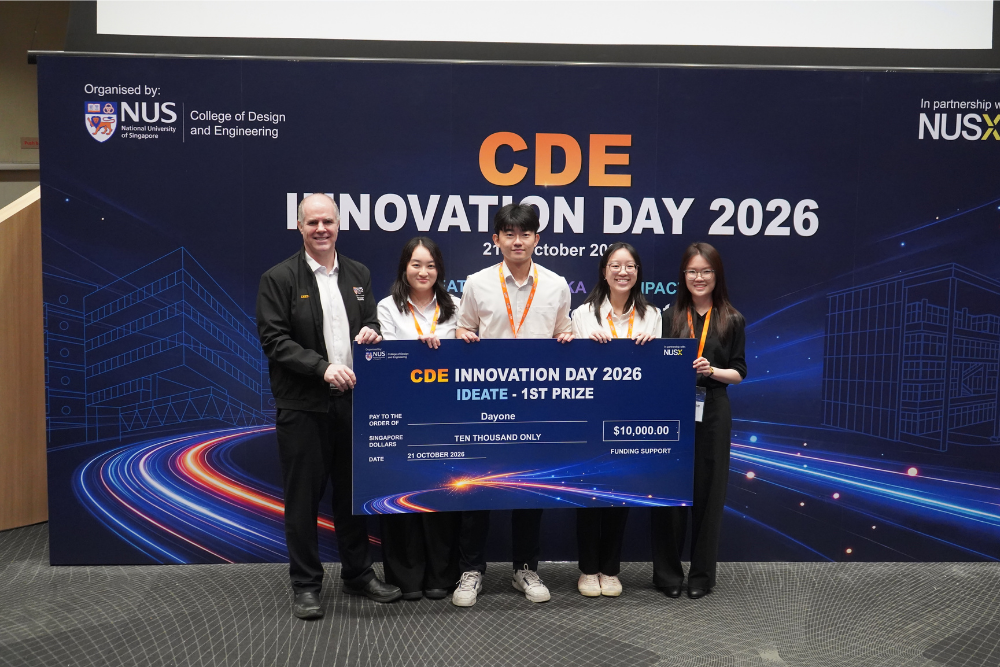
IDEATE Winner: dayone
$10,000 Funding Support
Team members: Tiffany Heng (Computer Engineering), Ong Miao Ying Clara (Mechanical Engineering), Liew Zhi Ren (Computer Engineering), Louisa Chung Yu (Computer Engineering)
Team dayone won the IDEATE track with WaveCare, a smart bed overlay designed to help prevent pressure injuries, commonly known as bedsores, among bedridden patients. As more patients in Singapore receive care at home, family members and caregivers face the physically demanding task of regularly repositioning patients to prevent prolonged pressure on vulnerable areas of the body.
WaveCare addresses this challenge through a pressure-mapping system that identifies areas experiencing sustained pressure and automatically adjusts individual air cells to relieve it. The overlay also features moisture sensors and a caregiver interface that provides real-time pressure maps, moisture alerts and overnight summaries.
Designed to fit onto existing beds, the solution aims to reduce the burden on caregivers while enabling more consistent, proactive care for bedridden patients.
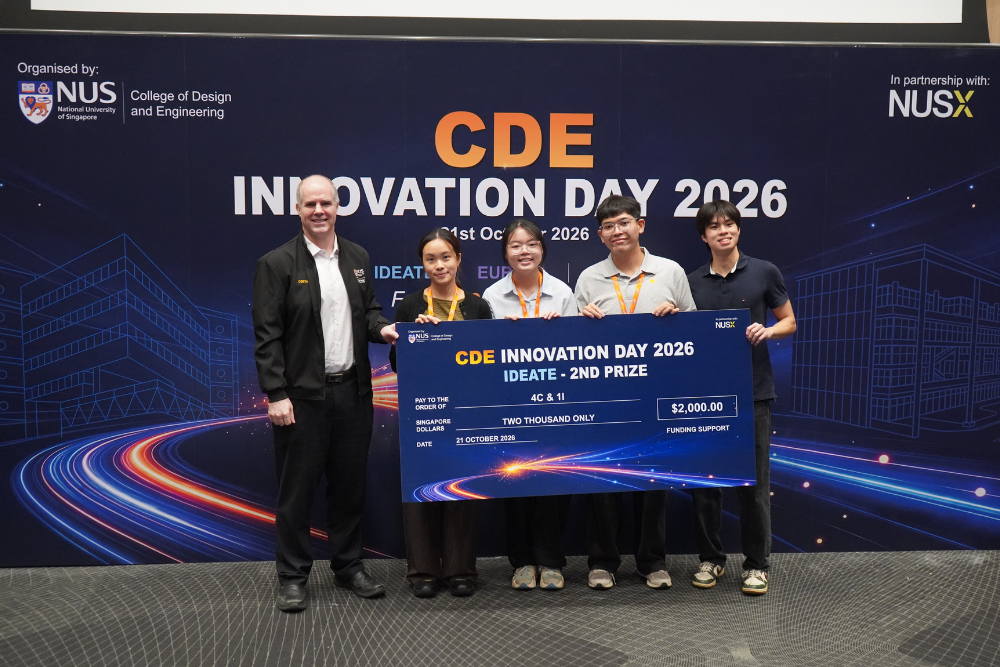
IDEATE 2nd Prize: 4C & 1I
$2,000 Funding Support
Team members: Rajkumar Sanjay (Computer Engineering), Mohamed Zaffrul Bin Mohamed Zahren (Mechanical Engineering), Loh Huey Xin (Materials Science and Engineering), Lai Hsien Hao (Mathematics), Lee Tian Hui Grace (Electrical Engineering)
With approximately 300,000 lives lost to drowning worldwide each year, improving the speed and effectiveness of emergency response remains an important challenge. Although many drowning incidents occur in the absence of lifeguards, even trained personnel can face limitations arising from visibility, fatigue and reaction times.
To address this challenge, team 4C & 1I developed the Aquatic Emergency Guard & Inference System (AEGIS), an autonomous lifesaving system that uses computer vision to detect early signs of drowning distress in real time.
Upon detecting a potential emergency, the system deploys a smart lifebuoy equipped with sensors that can autonomously navigate towards the person in distress. By reducing the time needed to initiate a rescue response, AEGIS aims to improve safety in aquatic environments.
The system is designed to complement lifeguards in supervised settings while offering an additional layer of emergency response support in locations without dedicated lifeguard personnel.
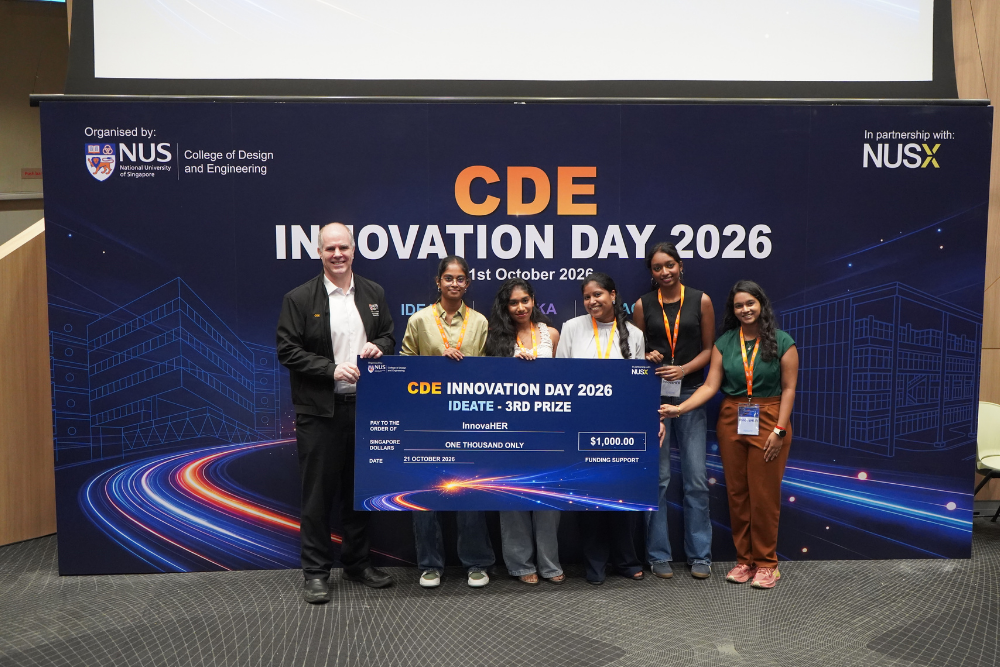
IDEATE 3RD Prize: InnovaHER
$1,000 Funding Support
Team members: Kubendhiran Savita Sri (Biomedical Engineering), Jayakumar Deshna (Mechanical Engineering), Chandramohan Harshini (Chemical and Biomolecular Engineering), Siri Neela (Biomedical Engineering), Neha Saravanan (Biomedical Engineering)
InnovaHER developed SteadiLAH, a lightweight wearable system designed to support individuals experiencing upper-limb tremors that can make everyday activities such as eating, writing and using a phone challenging.
Rather than simply monitoring tremors, SteadiLAH combines real-time motion sensing with active mechanical assistance to help reduce involuntary movement. Inertial sensors track wrist and arm movements, while an ESP32 microcontroller processes the data to identify motion patterns associated with tremors.
The system then uses a compact gyroscopic stabilisation mechanism to generate counteracting motion, with the aim of reducing unwanted movement while preserving voluntary movement. A companion app provides insights into tremor intensity and trends, with the potential to notify caregivers during sustained episodes of elevated tremor activity.
Designed as a modular wrist and forearm system, SteadiLAH demonstrates how sensing technologies, robotics and accessible wearable design can be combined to develop practical assistive solutions for everyday use.
Supporting innovation beyond the competition
In his opening address, CDE Dean Professor Teo Kie Leong highlighted how Innovation Day supports the journey from an initial idea to a solution capable of making a meaningful difference.
“There is no single path to innovation. Some ideas begin with a problem that needs a solution. Others begin with a wish to improve what already exists. Still others begin with a simple question: what if?”
He emphasised that innovation rarely follows a straightforward path, and that collaboration and the right support are essential to turning promising ideas into practical solutions. The potential for these innovations to progress beyond the competition is reflected in the achievements of previous participants.
IncyTech, whose Thermal Floater innovation won the 2024 CDE Impact Accelerator, has since secured a 100-unit pilot with the Defence Science and Technology Agency (DSTA), an S$800,000 SMART MIT Innovation 2.0 grant and S$1.2 million in contracts with energy utilities across Southeast Asia. The team's progress illustrates how early-stage support can help promising innovations advance towards deployment and commercialisation.
This year's enhanced funding support builds on that objective, providing winning teams with additional resources to develop their projects and explore opportunities for real-world application.
Lessons from entrepreneurs who have navigated the journey
Beyond the competition, participants heard from two entrepreneurs who shared insights into the challenges of turning promising ideas into successful businesses.
CDE alumnus Lim Wai Mun (Mechanical Engineering ’07), Founder and CEO of Doctor Anywhere, reflected on his journey from launching a four-person telehealth startup in 2017 to building a healthcare company serving millions across Southeast Asia. He emphasised the importance of identifying genuine market needs, adapting to setbacks and making consistent progress.
“If today is just 0.1% better than yesterday, you're doing enough,” he said, highlighting how small improvements can compound into meaningful achievements over time.
Roy Ang (Engineering Design & Innovation), Co-founder and CEO of Stryv and a current MSc student in Engineering Design and Innovation, shared lessons from navigating eight business pivots before finding success in the consumer products market. His experiences highlighted the importance of validating ideas, understanding market dynamics and recognising when to change direction.
“Standing still can be better than going the wrong way,” he said, underscoring the value of testing assumptions before committing resources to a business idea.
Together, their experiences reinforced the importance of resilience, adaptability and a clear understanding of market needs in bringing innovations from concept to commercial reality.
From promising ideas to meaningful impact
CDE Innovation Day forms part of the College's broader efforts to nurture innovation and entrepreneurship by connecting students and researchers with the expertise, resources and networks needed to develop their ideas.
With support from partners, the initiative provides opportunities for innovators at different stages of their journey, from exploring an initial concept to developing technologies with commercial potential.
For this year's winning teams, the recognition and funding represent an opportunity to build on the work they have already undertaken, refine their solutions and explore the next stages of development.
As CDE continues to strengthen its innovation ecosystem, initiatives such as Innovation Day aim to ensure that promising ideas are given the support and opportunities needed to progress from their first spark towards meaningful, real-world impact.