Three researchers from CDE have been awarded funding under a national research programme to accelerate the development of low-carbon technologies, supporting efforts to bring innovations in carbon capture and hydrogen production closer to industrial deployment.
Professor Zhao Dan, Associate Professor Sibudjing Kawi and Associate Professor Zhang Sui are leading three of five projects receiving a combined S$65 million under the Low Carbon Energy Research (LCER) Scale-Up Grant, announced at the Singapore Industry Decarbonisation Forum on 23 October 2026.
The projects were selected following promising results under earlier LCER research programmes. The new funding will support their progression towards larger-scale demonstrations, enabling researchers to validate the technologies under real-world industrial conditions and assess their potential for wider deployment.
Working with industry partners, the CDE teams aim to address some of the key technological challenges involved in reducing carbon emissions from energy generation and industrial processes.
Scaling up carbon capture for industrial applications
PI: Professor Zhao Dan (Department of Chemical and Biomolecular Engineering)
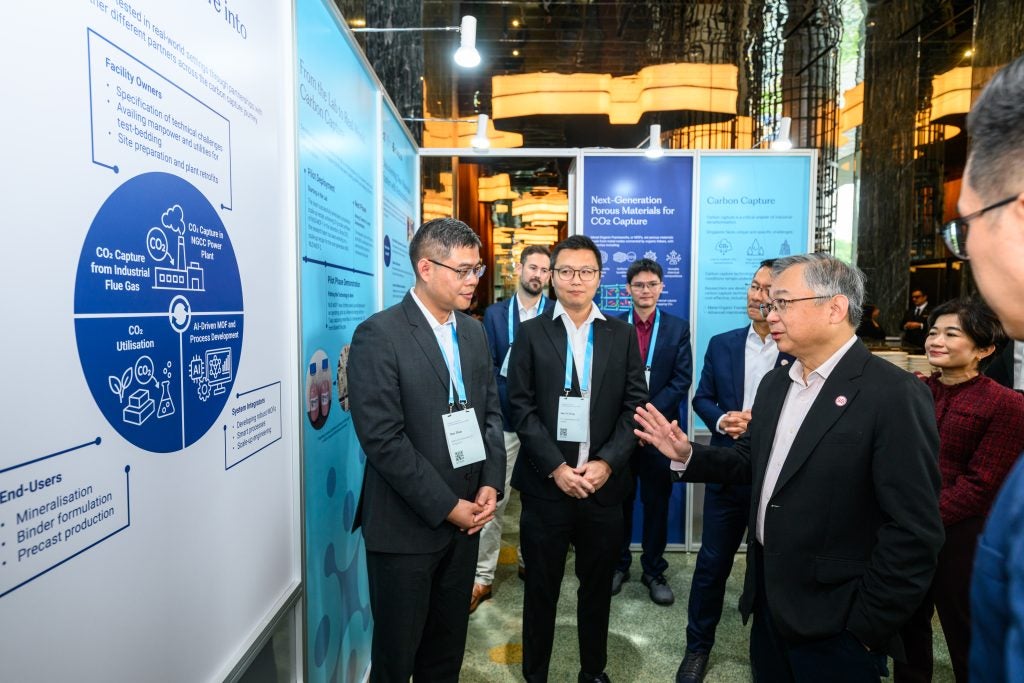
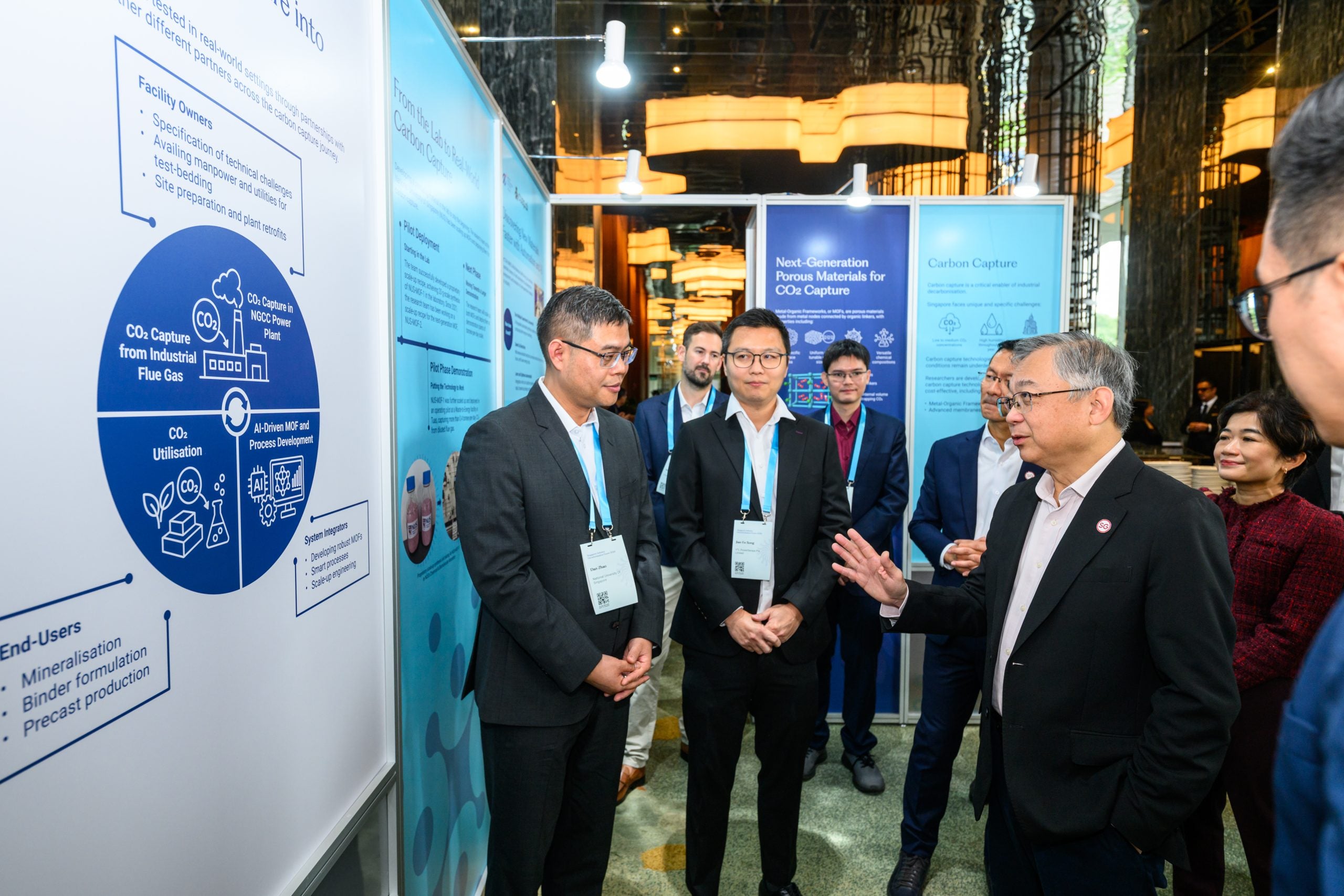
Prof Zhao's project uses advanced porous materials, including metal-organic frameworks (MOFs), to capture CO₂ from industrial emissions, with the potential to put the captured gas to productive use.
In earlier trials using real flue gas at a waste-to-energy facility, the team achieved close to 100% CO₂ recovery, capturing approximately 400 kg per day.
The new funding will support larger-scale demonstrations under different industrial conditions, including a five-tonne-per-day system for higher-concentration flue gas and a two-tonne-per-day pilot at YTL PowerSeraya's natural gas combined-cycle power plant. The project will also explore using captured CO₂ in concrete production through mineralisation.
Separately, a collaboration with Chevron will evaluate advanced carbon capture materials and processes for industrial applications.
Producing hydrogen with valuable carbon by-products
PI: Associate Professor Sibudjing Kawi (Department of Chemical and Biomolecular Engineering)
Assoc Prof Kawi's project aims to produce hydrogen from methane, the main component of natural gas, using a catalytic membrane reactor that breaks down methane into hydrogen and solid carbon.
The process also produces carbon nanotubes, a potentially valuable material with applications in advanced manufacturing.
In earlier laboratory trials, the team developed a catalytic membrane reactor operating at relatively low temperatures of 500 to 600°C, demonstrating the production of one kilogramme of hydrogen and three kilogrammes of carbon nanotubes per day.
The new funding will support a pilot-scale demonstration at PacificLight Power's 830 MW gas-fired power plant, using existing natural gas infrastructure. The system aims to produce 100 kg of hydrogen and 300 kg of carbon nanotubes daily, with the hydrogen intended for electricity generation.
Developing advanced membranes for carbon capture
PI: Associate Professor Zhang Sui (Department of Chemical and Biomolecular Engineering)
Assoc Prof Zhang's project focuses on advanced hollow-fibre membranes that selectively separate CO₂ from industrial emissions, offering a modular approach to carbon capture.
In the earlier phase of the LCER programme, the team developed next-generation hollow-fibre membranes that achieved a combination of CO₂ permeance and selectivity described in the project summary as the first to reach an industrially attractive performance range.
The membranes were subsequently scaled up into one-inch and four-inch modules, with the smaller modules tested at a waste-to-energy facility.
The new funding will support the development of a modular pilot system capable of capturing 0.1 tonnes of CO₂ per day, operating at up to 60°C.
The project will also assess the membranes' durability and performance under realistic industrial conditions, including exposure to contaminants in flue gas.
From research to industrial application
Together, the three projects highlight different approaches to reducing carbon emissions, from capturing and utilising CO₂ to producing hydrogen through methane pyrolysis.
Building on earlier research and pilot demonstrations, the teams will work with industry partners to test their technologies at larger scales and assess their potential for industrial application.
The LCER Scale-Up Grant awards were announced alongside a new S$143 million Industry Decarbonisation Funding Initiative, aimed at accelerating the development and commercialisation of low-carbon technologies for Singapore's industries.
Both initiatives form part of Singapore's broader efforts to advance industrial decarbonisation research and bring promising technologies closer to deployment.