As AI reshapes the way engineers and designers work, it is also raising fundamental questions about how they should be taught.
For universities, this means rethinking how students learn, what skills they need to develop, and how emerging technologies can support deeper understanding, creativity and independent thinking.
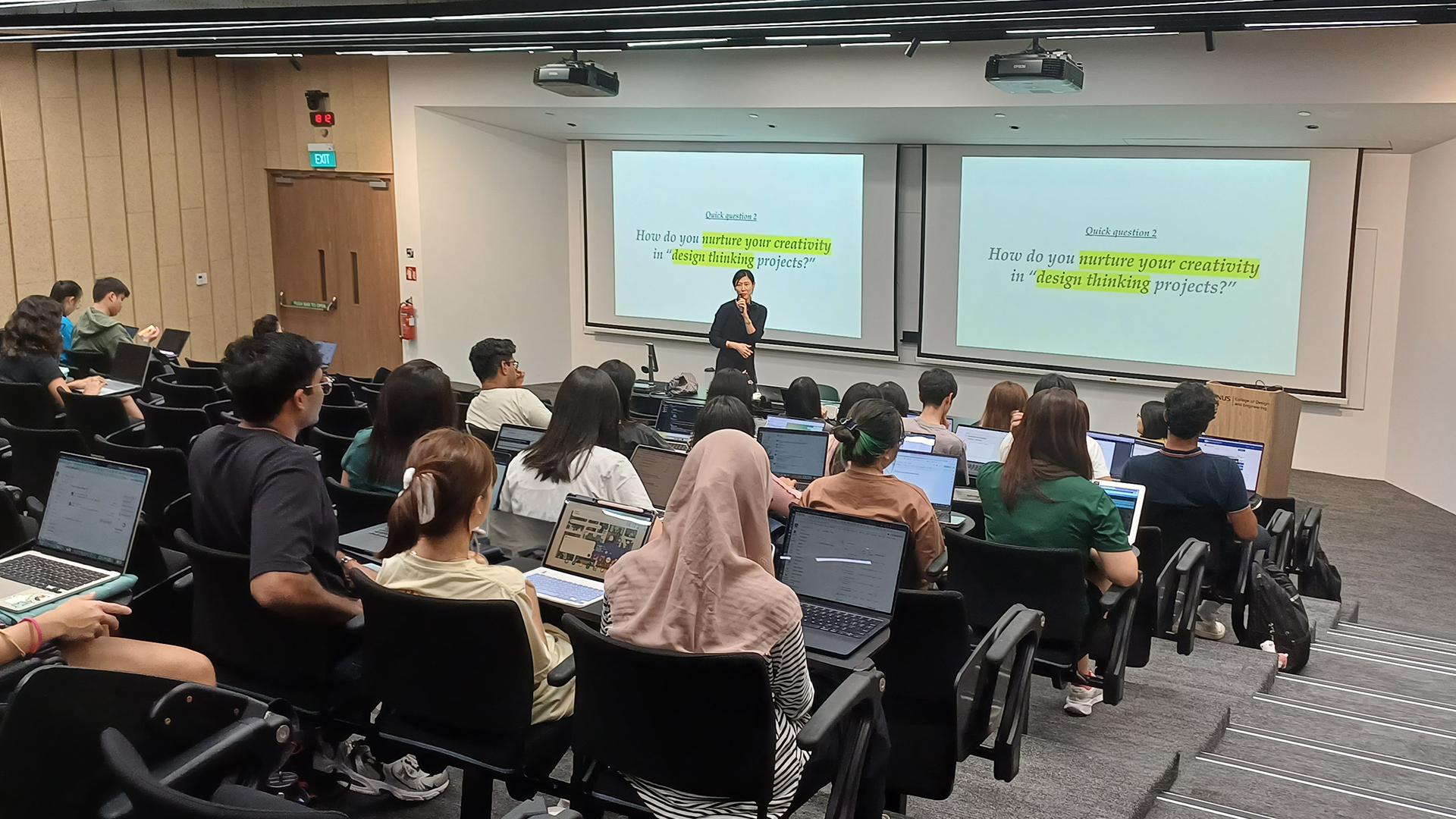
At CDE, the Teaching Transformation Grant (TTG) has helped academics respond to these challenges by providing funding to develop and test innovative, AI-enhanced approaches to teaching aimed at improving student engagement and learning outcomes.
Four projects supported by the TTG illustrate how these ambitions are being put into practice.
-
Helping student entrepreneurs make their pitch

For aspiring entrepreneurs, delivering a convincing startup pitch takes practice. But opportunities to rehearse in front of experienced mentors and receive detailed feedback can be limited.
Associate Professor Khoo Eng Tat (Engineering Design and Innovation Centre) has developed an AI-powered pitch evaluator that allows students to practise independently and receive detailed feedback on both their business ideas and presentation skills.
Supported by the TTG programme, the system is used in CDE4301A Ideas to Startup, a two-semester course for final-year undergraduates. It assesses pitches against eight criteria, checks business claims against current market information, and analyses aspects of speech such as pronunciation, intonation and fluency.
In one example, a student team received a score of just three out of 10 for its competitive positioning during an initial mock pitch. After receiving AI feedback identifying weaknesses in its analysis of competitors, the team revised its presentation and doubled that score to six in the final round a week later.
“Pitching is nerve-wracking, but it's a skill you learn by doing," said Assoc Prof Khoo. "Students can now rehearse on their own time, as often as they want, getting instant feedback, before engaging customers and investors."
He emphasised that the system complements rather than replaces feedback from human judges, allowing students to work independently on specific weaknesses while leaving judges free to focus on areas requiring human judgement.
"Presenting is a very human skill, and AI can't replace it. What AI can do is help students practise," said Assoc Prof Khoo.
-
Teaching students to think beyond AI-generated designs

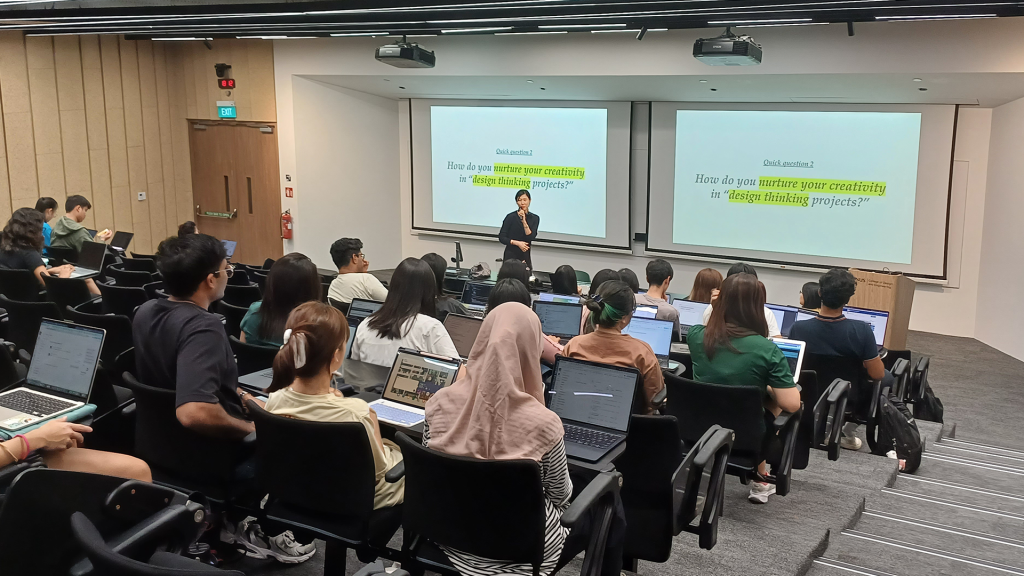
"We are in a fascinating era: everyone can be a designer, but not everyone can be a good designer," said Dr Kate Sangwon Lee (Engineering Design and Innovation Centre).
Generative AI can now produce polished design concepts in seconds, but creating something visually impressive is not necessarily the same as solving a real problem. For Dr Lee, this distinction is central to how design education needs to evolve.
"What I’ve learned is that the value of design education now lies less in teaching tools or skills but more in cultivating timeless perspectives and thinking processes," she said.
Through her TTG project, Dr Lee has introduced approaches that encourage students to use AI throughout the design process while retaining responsibility for the decisions they make.
In one exercise, students generate AI-created profiles of potential users, including people with unusual or easily overlooked needs. They then reflect on how these profiles challenge their assumptions and which details must be verified through research with real people.
Students also use a "Keep–Modify–Discard" framework to assess AI-generated suggestions, deciding which ideas are useful, which need adapting and which should be rejected.
The aim, Dr Lee said, is to ensure that AI accelerates the creative process without replacing the human judgement, empathy and critical thinking needed to develop meaningful designs.
-
Making fluid mechanics visible

In the study of fluid mechanics, students may learn to calculate how water moves through a pipe without fully understanding what is happening inside it.
Assistant Professor Gary Lei (Department of Civil and Environmental Engineering) is addressing this through interactive simulations and AI coaching, allowing students to experiment with fluid behaviour and receive immediate feedback.
In one activity, students can change the width of a virtual pipe and observe how narrowing it causes water to flow faster while reducing its pressure. They can test their predictions and ask an AI coach to explain the underlying principles.
"Students can often perform the calculations but find it harder to connect the equations with what the fluid is physically doing," said Asst Prof Lei. "Our aim is to achieve what I call 'phygital' experiential learning: combining physical demonstrations with interactive digital platforms that make abstract relationships visible and allow students to explore them for themselves."
Early evaluations involving 109 students have shown encouraging results, including increased confidence among some learners and evidence of students using AI feedback to revisit their calculations.
Asst Prof Lei is now developing an interactive virtual water tank that students can manipulate using hand gestures captured by their computer cameras. The cloud-based platform can be accessed without downloading software, allowing students to experiment with water flows and the effects of obstacles both in class and independently. The first prototype has already been demonstrated in a lecture, with further development planned.
-
Bringing structural engineering concepts to life

Dr Cui Yue (Department of Civil and Environmental Engineering) is using AI to bring complex structural engineering concepts to life through interactive visualisations that make principles traditionally taught through equations and static diagrams easier to understand.
In his Structural Stability course, for example, students explore the behaviour of a ball resting on a curved surface to understand different types of equilibrium. By adjusting parameters and observing how the ball responds, they can connect intuitive physical behaviour with the mathematical principles governing structural stability and buckling.
The demonstrations are created using an AI-enhanced platform developed by Dr Cui, which allows educators to generate animations, scientific visualisations and interactive simulations without extensive programming expertise.
"One noticeable change is that students become more engaged and curious when they can interact with engineering concepts rather than passively observe them," said Dr Cui. "Interactive visualisations encourage students to ask 'what if' questions, experiment with different conditions, and develop their own understanding of the underlying principles."
Students can also use the platform to generate scientific figures for assignments, allowing them to spend less time creating graphs and more time interpreting and critically evaluating their results.
Feedback has been encouraging, with students in the Structural Stability course rating the enhancement of their thinking ability at 4.8 out of 5.
The platform is now being adopted by other educators, opening up opportunities to develop customised teaching resources across a wider range of engineering and science disciplines.
Supporting innovation across the College
While these projects take different approaches, they share a common goal: using AI to help students learn through practice, experimentation and critical thinking.
Together, they show how the TTG is supporting new approaches to AI-enhanced teaching, with the potential for successful innovations to be adopted more widely across CDE.