
From a programme with 10 academic staff to a department that has educated more than 3,000 alumni, the Department of Materials Science and Engineering (MSE) at NUS has come a long way over the past three decades.
“Our story began in 1992, with the Materials Science Programme in the Faculty of Science. In 1996, the Department of Materials Science was officially established, with just 10 academic staff. In 2005, we moved to the Faculty of Engineering and became the Department of Materials Science and Engineering.”
Recounting these milestones at MSE’s 30th anniversary gala dinner on 6 November 2026, Professor Xue Junmin, Head of Department, reflected on the people and achievements that have shaped its journey.
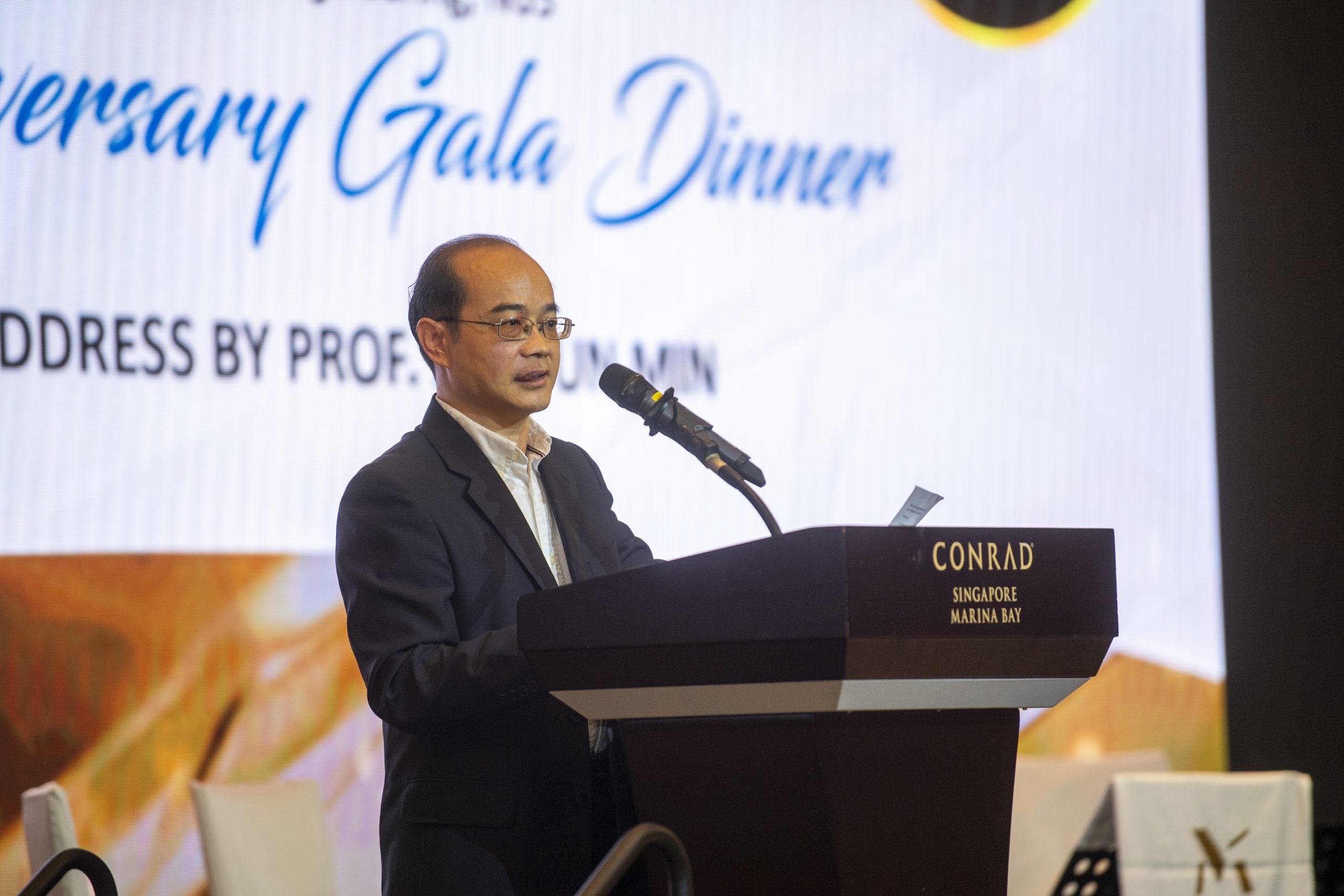
Among the department’s many accomplishments, Prof Xue highlighted one of its greatest sources of pride: it’s more than 3,000 alumni, many of whom are making significant contributions in Singapore and beyond. One of them is Professor Lee Pooi See, MSE PhD Alumni Guest Speaker, now counted amongst the world’s leading scientists in intelligent material systems.
The celebrations brought together faculty, alumni, students, donors and partners to recognise the department's achievements and look towards its future. Speaking at the event, Professor Teo Kie Leong, CDE Dean, highlighted the importance of interdisciplinary collaboration in advancing materials research.
“Materials science is a natural bridge across disciplines, connecting advances in materials with applications in fields ranging from electronics and energy to healthcare. By bringing together diverse expertise, we can open new avenues of research and tackle pressing challenges that no single discipline can address alone.”


That spirit of research excellence and collaboration was also reflected in the recognition of emerging researchers at the gala dinner.
Prizes were presented to outstanding postdoctoral and PhD researchers who had presented at MatterX 2026, the MSE Annual Research Congress jointly organised by the department and the Materials Research Society Singapore (MRS-S).
Their research reflects the breadth of materials science and its potential applications, spanning AI-assisted development of tougher polymer composites, atom-by-atom engineering of two-dimensional materials, advanced semiconductors and optoelectronics, hydrogen production, sustainable energy storage and conversion, and next-generation membranes for gas separation. Together, these projects demonstrate how advances in materials science can contribute to developments across industries, addressing diverse challenges in energy, sustainability and technology.
As MSE marks its 30th anniversary, the occasion was both a celebration of the people who have built the department and a recognition of those who will shape its next chapter.
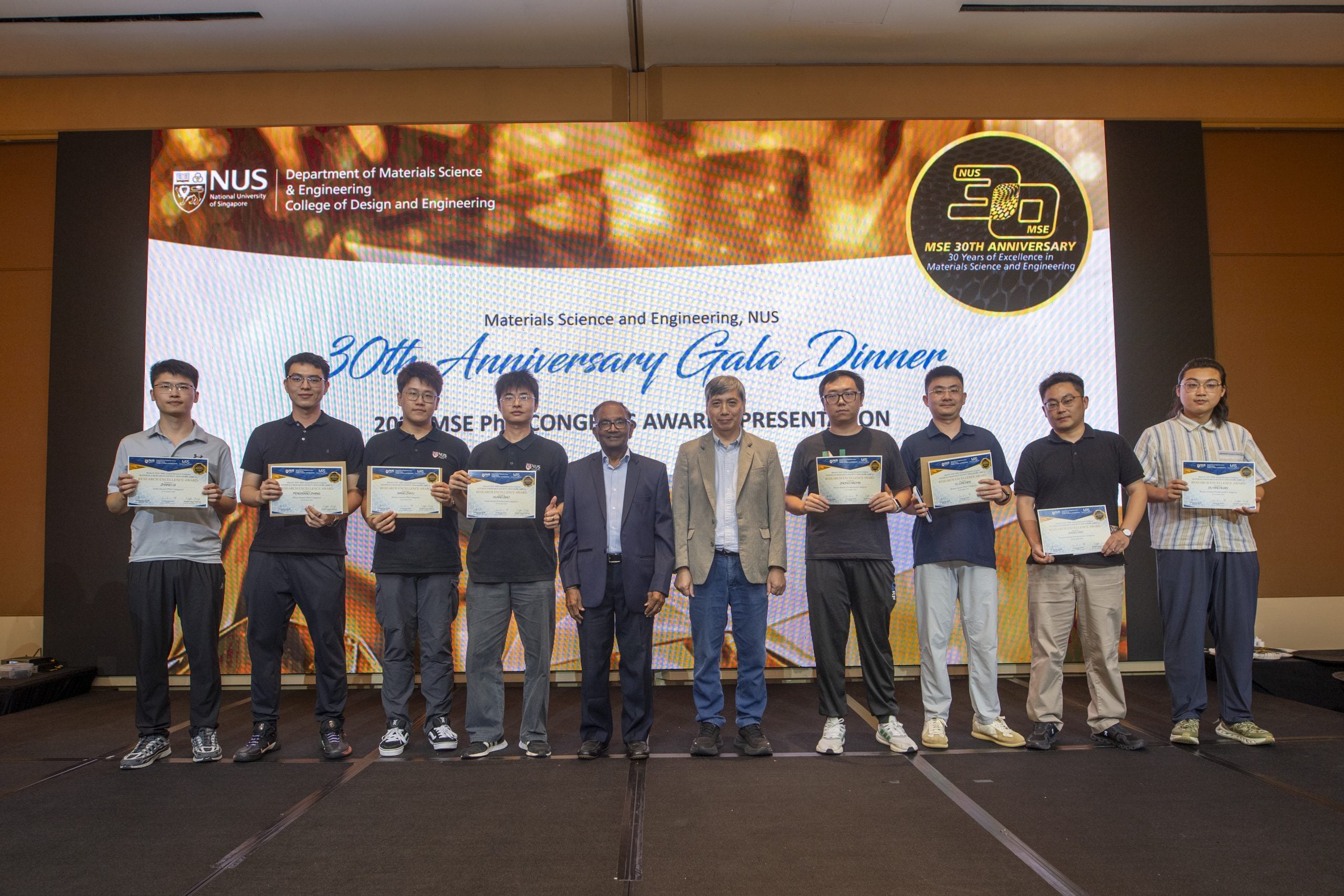
Award presenters: Prof B.V.R. Chowdari and Prof He Chaobin
Award recipients and their winning research (names listed in no particular order):
Bronze Award (Postdoc)
- Dr Du Xinchuan: Developing electrically tunable strain engineering in 2D semiconductors for reconfigurable optoelectronic devices.
- Dr Wang Hao: Using AI to develop tougher polymer composites.
Silver Award (Postdoc)
- Dr Zhong Haoyin: Advancing green hydrogen production by studying how oxygen-evolution catalysts function under operating conditions to improve the efficiency and durability of water electrolysis.
- Dr Huang Biao: Designing high-entropy alloys and unconventional-phase nanomaterials to advance electrocatalysis for sustainable energy conversion.
Bronze Award (PhD)
- Mr Yu Junchen: Developing strategies to improve the efficiency and durability of water electrolysis by addressing instability in oxygen-redox reactions.
- Mr Wang Zhiyu: Advancing sustainable energy storage and conversion through aqueous redox-mediated electrochemical technologies.
Silver Award (PhD)
- Mr Zhang Pengxiang: Developing crumpled graphene oxide membranes for faster and more selective hydrogen separation from carbon dioxide.
- Mr Zhang Qi: Engineering atomically thin 2D materials to precisely control their electronic and magnetic properties.