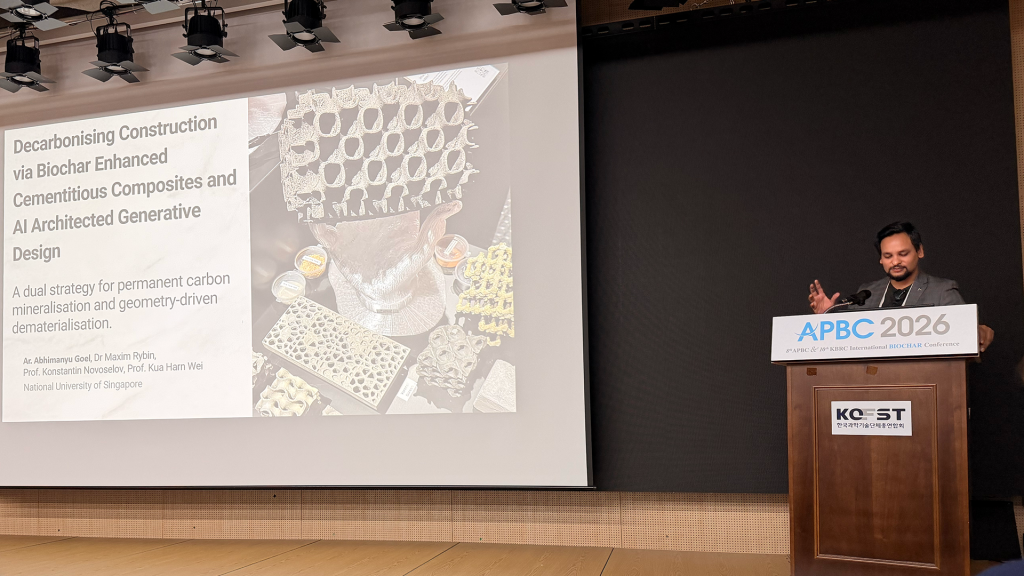


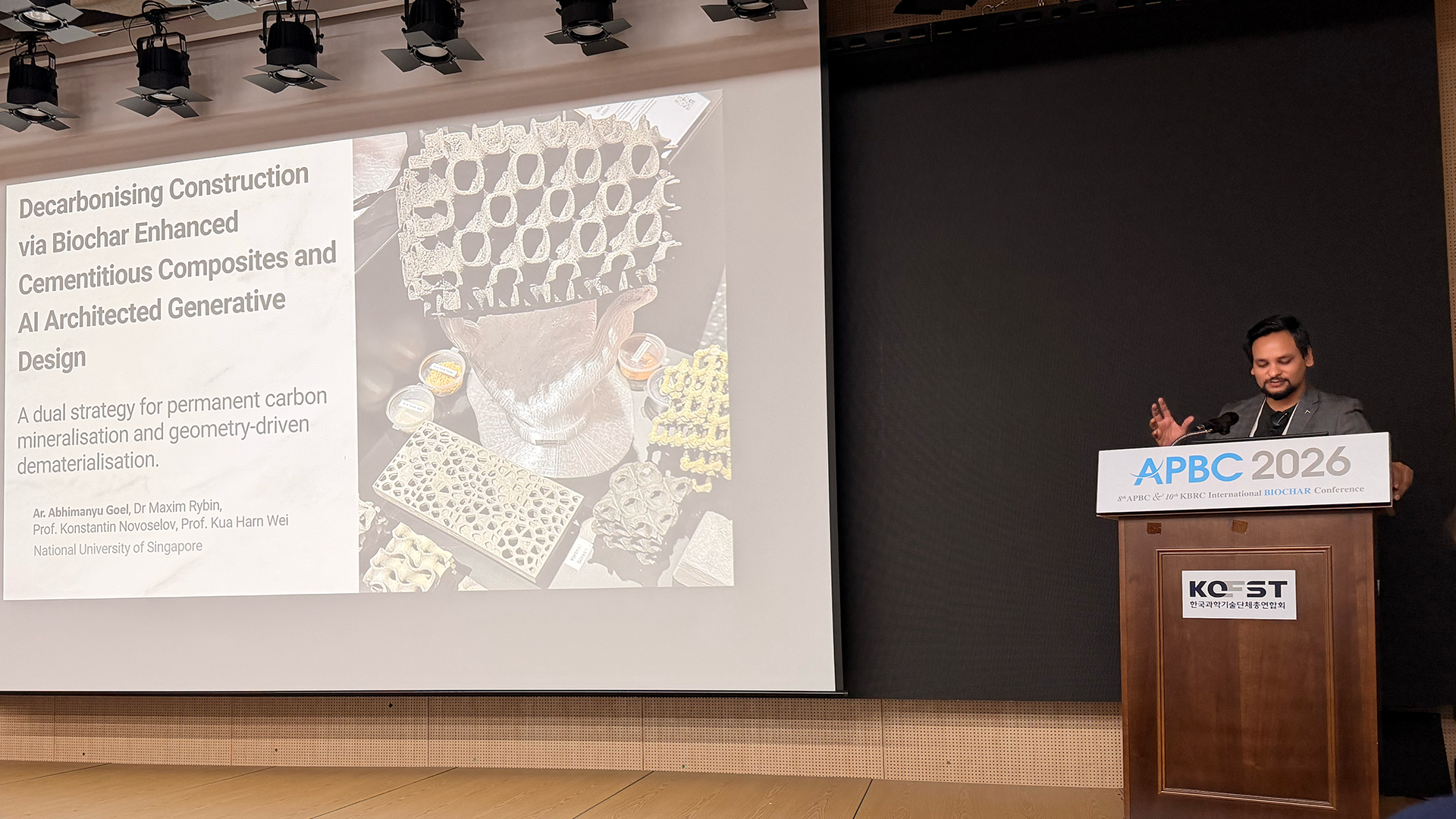
Senior Research Associate Abhimanyu Goel (Department of the Built Environment) has received the Outstanding Early Career Scientist Award at the 8th Asia Pacific Biochar Conference (APBC 2026), recognising his research into innovative approaches to reducing the carbon footprint of construction.
The award was presented for his research presentation, “Decarbonising Construction via Biochar Enhanced Cementitious Composites and AI Architected Geometric Design”, at the conference held in Seoul, South Korea, from 13 to 15 October 2026.
The Outstanding Early Career Scientist Award recognises excellence in scientific contribution, research design, results and interpretation, as well as the structure and delivery of research presentations.
Reflecting on the recognition, Mr Goel expressed his gratitude to Professor Michael Chew (Head, Department of the Built Environment), Professor Konstantin Novoselov (Department of Materials Science and Engineering) and Associate Professor Kua Harn Wei (Department of the Built Environment) for their mentorship and support.
“Their guidance has been invaluable in achieving this recognition,” he said. “This award serves as a powerful motivation to continue working even harder towards advancing biochar applications for sustainability and the circular economy.
Tackling construction emissions
Mr Goel's research explores how advances in materials science and artificial intelligence (AI) could work together to reduce the environmental impact of construction.
Working with Prof Novoselov, Assoc Prof Kua and Dr Maxim Rybin (NUS Institute for Functional Intelligent Materials), he has been investigating a two-pronged approach that combines lower-carbon cement materials with AI-generated structural designs that use less concrete.
The first approach involves incorporating biochar, a carbon-rich material made by heating organic waste in an environment with little or no oxygen, into cement. Using biochar produced from rice husks, the researchers are exploring how agricultural waste can replace some conventional cement ingredients while helping the resulting material capture and store carbon dioxide.
The second approach uses AI to optimise the internal structures of 3D-printed construction components, reducing the amount of material needed while maintaining their overall dimensions. The researchers have demonstrated designs that could reduce material volume by approximately 25 to 30 per cent.
Together, the two approaches offer a potential pathway towards construction materials and components that both store carbon and require fewer resources to produce.