CELEBRATING INCLUSIVE DESIGN: M.ARCH ALUMNA VICTORIA LIEW HONOURED WITH GOH CHOK TONG ENABLE AWARD
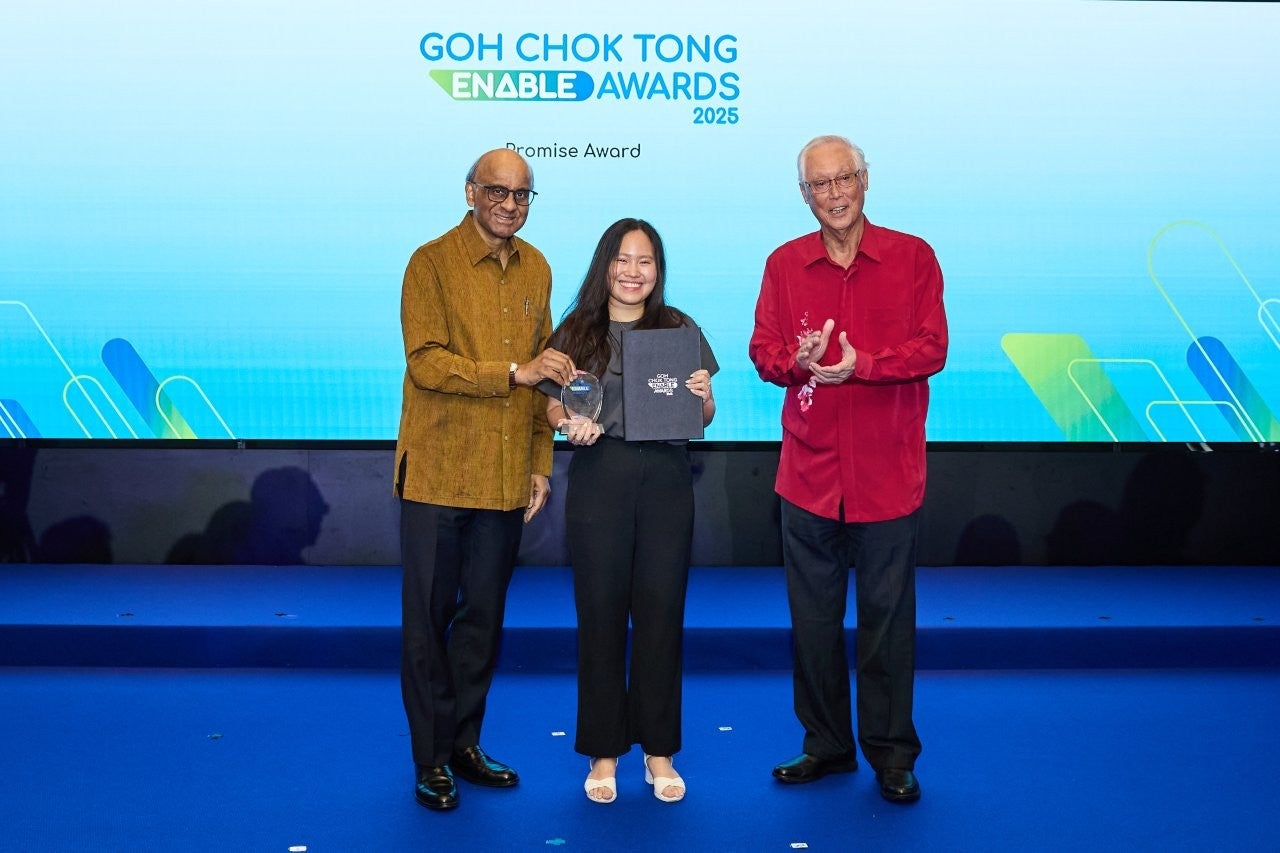
We are pleased to share that alumna Victoria Liew Yi Xuan (M.Arch, Class of 2025) has been honoured with the Goh Chok Tong Enable Awards 2025, a national accolade that celebrates the achievements of persons with disabilities and encourages those with promise to pursue their aspirations.
Born with a hearing impairment, Victoria has long observed how architectural spaces can be under- or over-stimulating for deaf and hard-of-hearing individuals. Growing up, she often struggled to integrate into communities as a “typical” person due to her hearing disability. With her parents’ strong encouragement for early intervention, she was able to focus on developing key skills such as verbal communication from a young age.
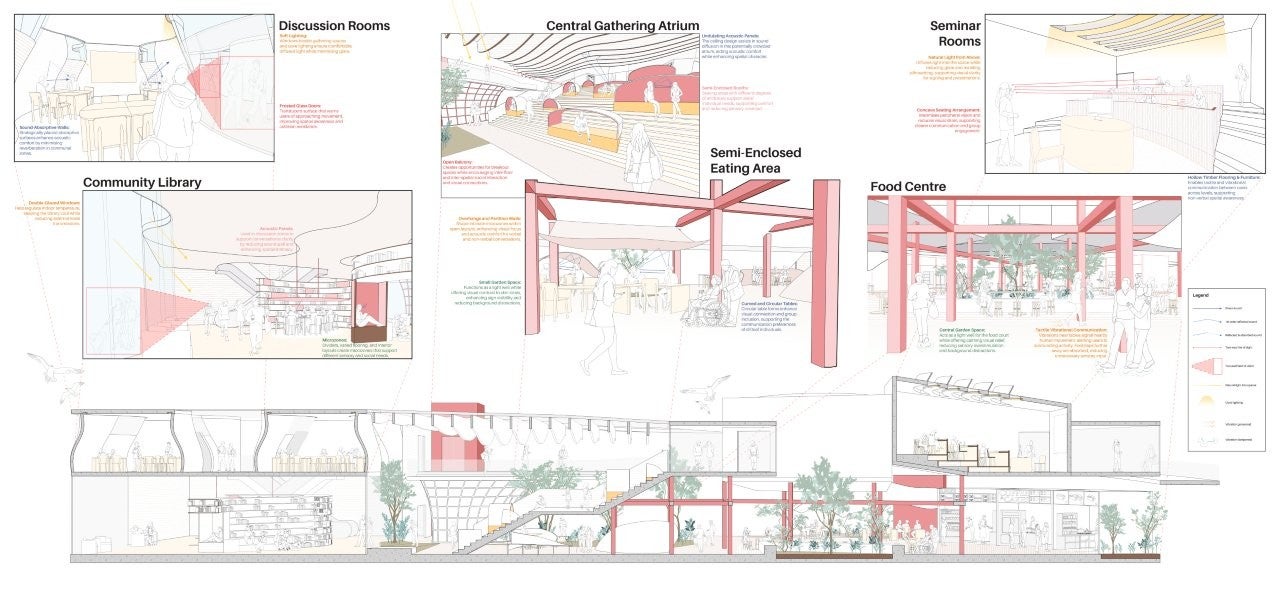 SECTIONAL PERSPECTIVE DRAWING FROM VICTORIA’S THESIS
Unfortunately, many people with hearing disabilities continue to face significant challenges in competitive, individualistic environments. This prompted her to examine how the built environment can unintentionally exclude the d/Deaf community, and how architecture might become more thoughtful, accommodating, and empowering. As part of her M.Arch thesis, she developed an Inclusive Design Toolkit for the d/Deaf community, advancing accessible innovation and collaboration to improve public space accessibility. Her thesis, “Aural-clusivity: Designing for the d/Deaf Community in Singapore’s Urban Landscape,” addresses the central question: How can architecture better serve invisible disability communities as cities champion inclusive and Universal Design (UD)?
“Over the course of my thesis, I learned to embrace my identity as a d/Deaf individual more fully. Engaging closely with other d/Deaf individuals through interviews, workshops, and community work—particularly via CAPT-in-Silence at the College of Alice & Peter Tan—helped me appreciate the diversity of lived experiences within the community. These engagements also deepened my understanding of inclusive and universal design, especially the challenges of balancing different, and sometimes competing, multisensory needs within shared spaces,” Victoria shared.
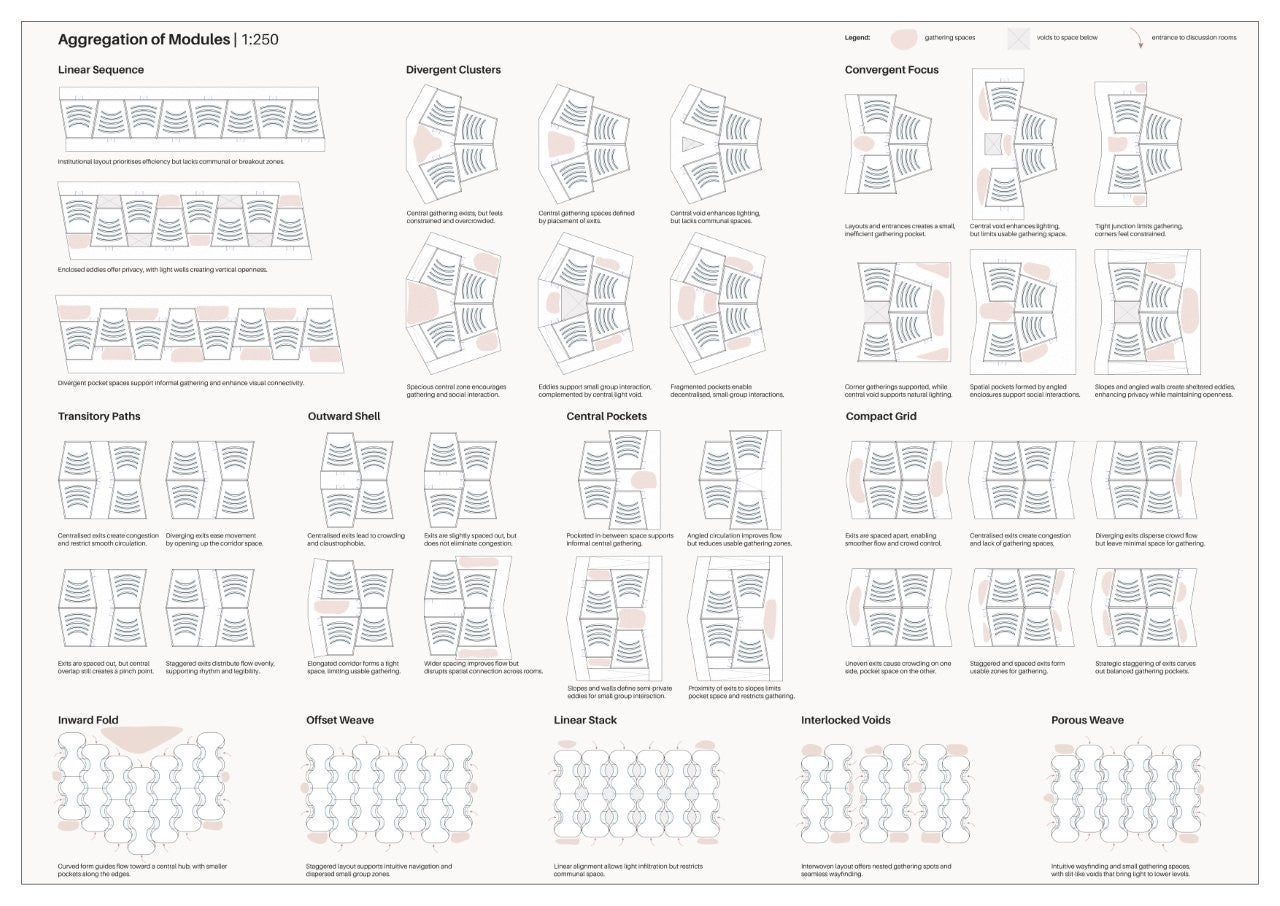 AGGREGATION OF MODULES COMPILED FROM HER RESEARCH
Through a participatory methodology and community-centric lens, her thesis engages the d/Deaf community to surface lived experiences. It investigates navigational, communicational, and environmental challenges, identifying architectural barriers that hinder participation in public spaces. The work proposes a set of design principles that foster spatial inclusivity through tactile cues, lighting strategies, and spatial configurations. These principles are tested in the design of a mid-sized community centre serving both d/Deaf users and the wider public, and applied to everyday settings such as dining, educational, and event spaces.
By foregrounding multisensory, user-driven design, the thesis seeks to expand the discourse on inclusive architecture—redefining spatial inclusivity and exploring the potential of a built environment that embraces the nuanced needs of diverse communities. This achievement has reaffirmed her commitment and plans to refine the design toolkit and to collaborate with relevant government agencies and organisations to explore opportunities for publishing and implementation. Her goal is to advance a more ground-up, community-driven approach to inclusive design that benefits the d/Deaf community and other groups with invisible disabilities. Rather than viewing the thesis as a completed project, she sees it as the beginning of a longer-term inquiry into how architecture can respond more sensitively to invisible disabilities and multisensory needs.
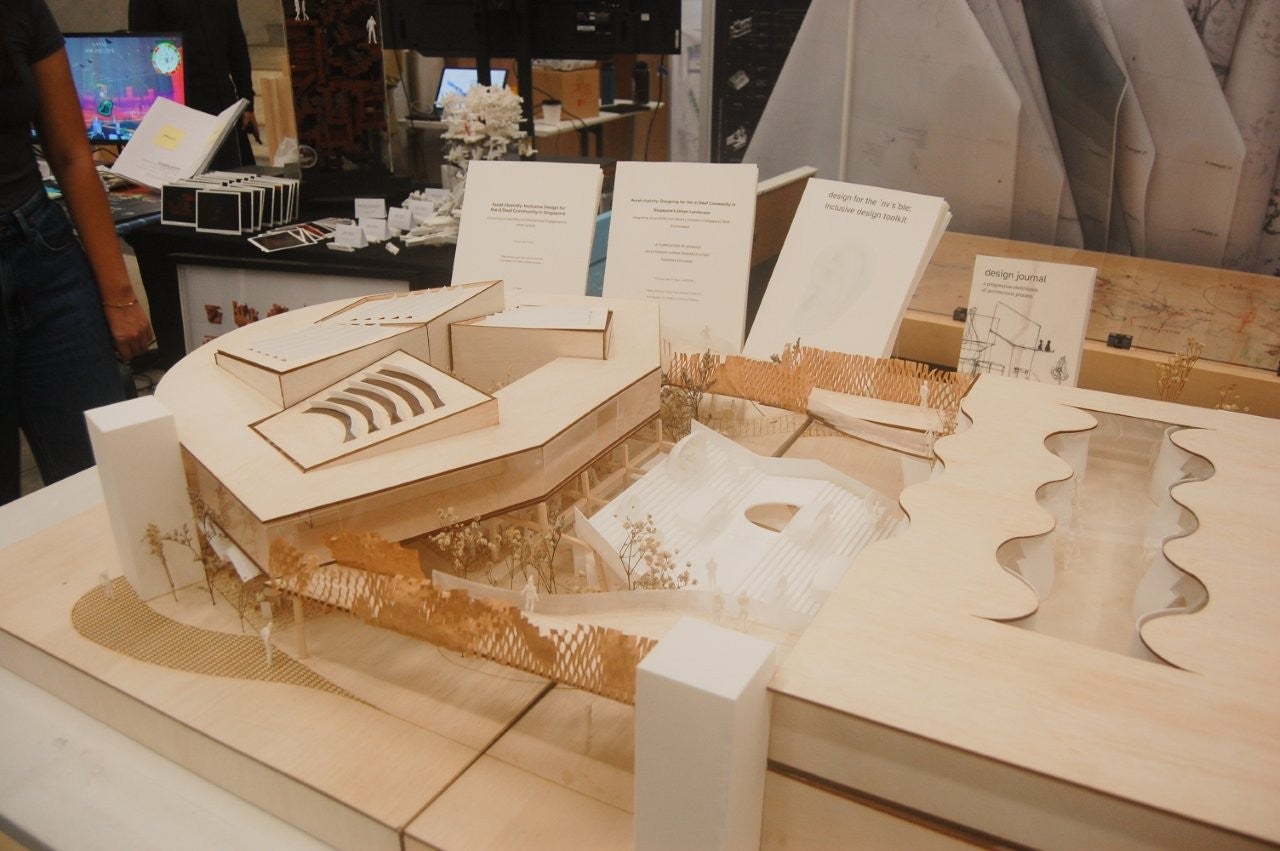
HER MODEL DISPLAYED ALONGSIDE HER DESIGN TOOLKIT DURING THE FINAL REVIEW PRESENTATION
“I am deeply grateful to my supervisor, Assistant Prof Joshua Comaroff, for his guidance, expertise in inclusive design, and encouragement to adopt a participatory, community-based approach. The groundwork established through this process shaped not only the design outcome but also my growth as a designer. I hope this research can serve as a foundation for further exploration and development in inclusive architectural practice. This recognition has given me the confidence and motivation to keep going—especially in advocating for inclusive design that goes beyond compliance and centres lived, recounted experiences. I am truly thankful for this opportunity and recognition; it has strengthened my belief that this work can make a meaningful difference,” Victoria reflected.
The Goh Chok Tong (GCT) Enable Awards
The Goh Chok Tong (GCT) Enable Awards, an initiative of the Goh Chok Tong Enable Fund (GCTEF), were launched on 15 January 2019. Inspired by Emeritus Senior Minister Goh Chok Tong, Patron of GCTEF, the Awards recognise the achievements of persons with disabilities and encourage those with promise and potential to pursue their endeavours.
View the full list of awardees: https://www.gctenablefund.sg/goh-chok-tong-enable-awards/awardees/