Spectropolis: The Enchantment of Capital in Singapore
Name of Event/Lecture
Spectropolis: The Enchantment of Capital in Singapore
Name of Speaker
Joshua Comaroff
Location
SDE 4, Level 5, Forum
You are cordially invited to the following event:
Book Launch
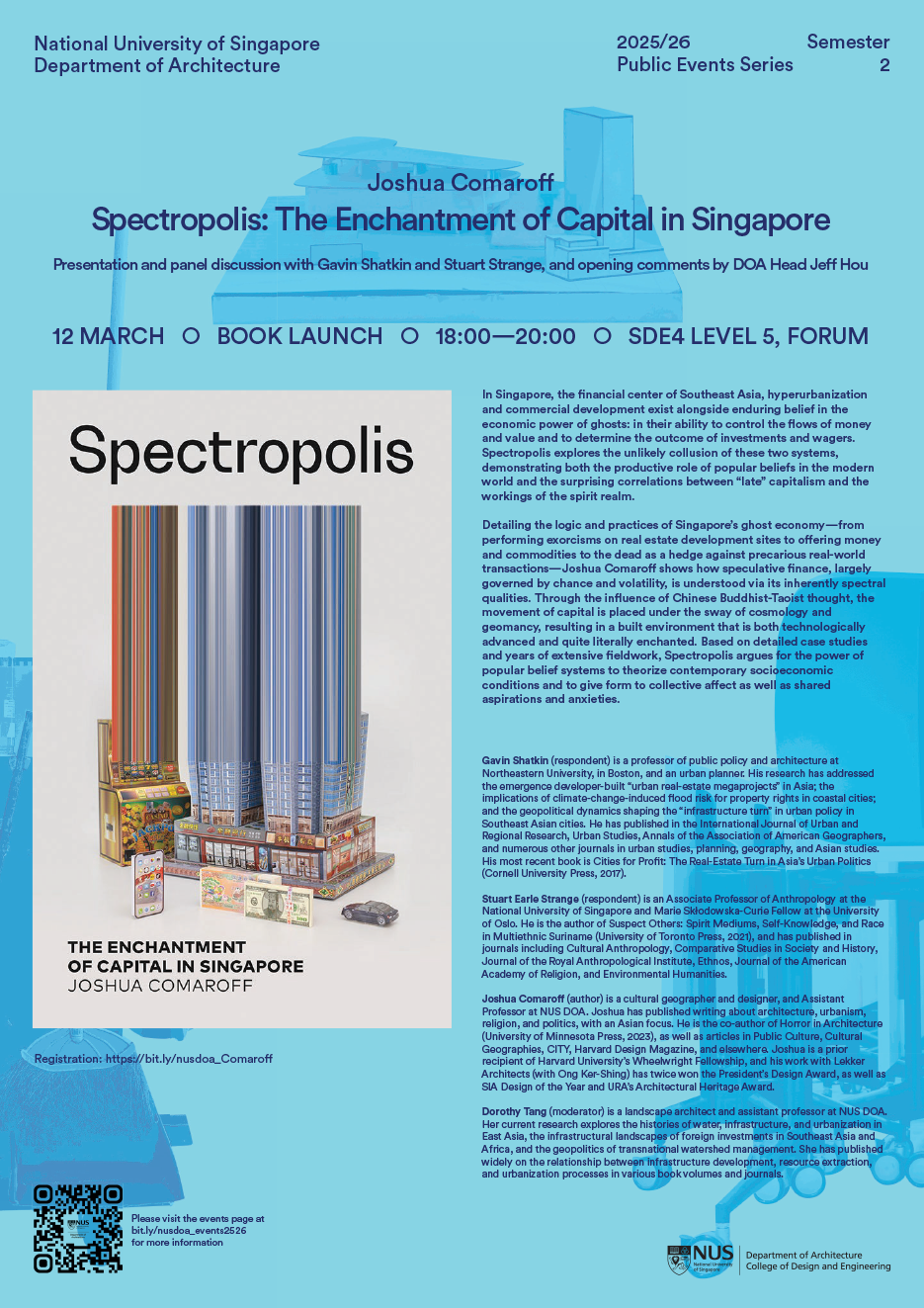
Spectropolis: The Enchantment of Capital in Singapore
By Joshua Comaroff
Presentation and panel discussion with Gavin Shatkin and Stuart Strange, and opening comments by DOA Head Jeff Hou.
March 12, 6:00-8:00pm
SDE4 Level 5, Forum
RSVP here: https://bit.ly/nusdoa_Comaroff
In Singapore, the financial center of Southeast Asia, hyperurbanization and commercial development exist alongside enduring belief in the economic power of ghosts: in their ability to control the flows of money and value and to determine the outcome of investments and wagers. Spectropolis explores the unlikely collusion of these two systems, demonstrating both the productive role of popular beliefs in the modern world and the surprising correlations between “late” capitalism and the workings of the spirit realm.
Detailing the logic and practices of Singapore’s ghost economy—from performing exorcisms on real estate development sites to offering money and commodities to the dead as a hedge against precarious real-world transactions—Joshua Comaroff shows how speculative finance, largely governed by chance and volatility, is understood via its inherently spectral qualities. Through the influence of Chinese Buddhist-Taoist thought, the movement of capital is placed under the sway of cosmology and geomancy, resulting in a built environment that is both technologically advanced and quite literally enchanted. Based on detailed case studies and years of extensive fieldwork, Spectropolis argues for the power of popular belief systems to theorize contemporary socioeconomic conditions and to give form to collective affect as well as shared aspirations and anxieties.
Gavin Shatkin (respondent) is a professor of public policy and architecture at Northeastern University, in Boston, and an urban planner. His research has addressed the emergence developer-built “urban real-estate megaprojects” in Asia; the implications of climate-change-induced flood risk for property rights in coastal cities; and the geopolitical dynamics shaping the “infrastructure turn” in urban policy in Southeast Asian cities. He has published in the International Journal of Urban and Regional Research, Urban Studies, Annals of the Association of American Geographers, and numerous other journals in urban studies, planning, geography, and Asian studies. His most recent book is Cities for Profit: The Real-Estate Turn in Asia’s Urban Politics (Cornell University Press, 2017).
Stuart Earle Strange (respondent) is an Associate Professor of Anthropology at the National University of Singapore and Marie Skłodowska-Curie Fellow at the University of Oslo. He is the author of Suspect Others: Spirit Mediums, Self-Knowledge, and Race in Multiethnic Suriname (University of Toronto Press, 2021), and has published in journals including Cultural Anthropology, Comparative Studies in Society and History, Journal of the Royal Anthropological Institute, Ethnos, Journal of the American Academy of Religion, and Environmental Humanities.
Joshua Comaroff (author) is a cultural geographer and designer, and Assistant Professor at NUS DOA. Joshua has published writing about architecture, urbanism, religion, and politics, with an Asian focus. He is the co-author of Horror in Architecture (University of Minnesota Press, 2023), as well as articles in Public Culture, Cultural Geographies, CITY, Harvard Design Magazine, and elsewhere. Joshua is a prior recipient of Harvard University’s Wheelwright Fellowship, and his work with Lekker Architects (with Ong Ker-Shing) has twice won the President’s Design Award, as well as SIA Design of the Year and URA’s Architectural Heritage Award.
Dorothy Tang (moderator) is a landscape architect and assistant professor at NUS DOA. Her current research explores the histories of water, infrastructure, and urbanization in East Asia, the infrastructural landscapes of foreign investments in Southeast Asia and Africa, and the geopolitics of transnational watershed management. She has published widely on the relationship between infrastructure development, resource extraction, and urbanization processes in various book volumes and journals.