NUS logo
menu

Department of Architecture

  • About
    About
    • Mission & Values
    • History
    • Contact
    People
    • Staff
    • Ong Siew May (OSM) Professorship
    • Alumni
    • The Architecture Society (TAS)
    Facilities
    • SDE1 Building
    • SDE3 Building
    • SDE4 Building
    • Design Fabrication Workshop
    Gallery
  • Study
    PROGRAMMES
    • BACHELOR OF ARTS IN ARCHITECTURE
    • BACHELOR OF LANDSCAPE ARCHITECTURE
    • Master of Architecture
    • Master of Landscape Architecture
    • MASTER OF ARTS IN ARCHITECTURAL CONSERVATION
    • Master of Science, Integrated Sustainable Design
    • Master of Arts in Urban Design
    • Master of Urban Planning
    • DOCTOR OF PHILOSOPHY and MASTER OF ARTS By RESEARCH (Architecture)
    RESOURCES FOR PROSPECTIVE STUDENTS
    • Study at DoA
    • Awards, Scholarships and Grants
    • DOA Graduate Futures Fellowship
    RESOURCES FOR CURRENT STUDENTS
    • Academic Matters
    • Student Works and Programme Brochures
  • Research
    Research Clusters
    • Design Education Research
    • Research by Design
    • History, Theory, Criticism
    • Technologies
    • Urbanism
    • Landscape Studies
    • Work and Publications
    • News + Events
    Tun Tan Cheng Lock Centre
    • About
    • History
    • Restoration and Conservation Projects
    • Conservation Works Team
    • Donor and Scholarship
    • News + Events
    Campus Design Innovations Group
    • About
    • SDE 1
    • SDE 3
    • SDE 4
    • Yusof Ishak House
    • CDE +
    Centre for Advanced Studies in Architecture
    • Graduate Research Symposium 2025
    • Graduate Research Symposium 2024
    • Graduate Research Symposium 2023
    • NUS-SUTD PhD Symposium in Architecture 2022
    Centre for Environment and Ageing Well (ENgAGE)
    Research Labs
    • Critical Landscapes Design Lab
    • Urban Climate Design Lab (UCDL)
    • Urban Analytics Lab
    • Urban Ecology Lab
    • SkyTimber™: Tropical Renewable Architecture Design Lab
    • Civic Resilience Lab
    • Urban Transitions Lab
    • Urban Wild Lab
    • Architectural Conservation Laboratory (ArCLab)
    Research Networks
    • Architecture Design Education and Research in ASEAN (AUN-ADERA)
    • International Network for Tropical Architecture (iNTA)
    Designing Resilience in Asia International Research Progamme (DRIA)
  • News + Events
    News + Events
    Newsletter
  • Careers
    Overview
  • Admissions
    BACHELOR OF ARTS IN ARCHITECTURE
    BACHELOR OF LANDSCAPE ARCHITECTURE
    MASTER OF ARCHITECTURE
    MASTER OF LANDSCAPE ARCHITECTURE
    MASTER OF ARTS IN ARCHITECTURAL CONSERVATION
    MASTER OF SCIENCE, INTEGRATED SUSTAINABLE DESIGN
    MASTER OF ARTS IN URBAN DESIGN
    MASTER OF URBAN PLANNING
    DOCTOR OF PHILOSOPHY AND MASTER OF ARTS IN ARCHITECTURE BY RESEARCH
logo logo
< BACK TO Gallery

Producing the Gir Lionscape: Redesigning Boundaries, Settlement Edges, and Tourist Encounters witin Manufactured Wilderness
PROGRAMME

Master of Landscape Architecture

STUDENT

Yang Xiaoyang

YEAR

2

ADVISOR/TUTOR

Dorothy Tang

This thesis reconsiders the Gir Landscape of Gujarat, India, by shifting attention from the Asiatic lion as a protected species to the broader socio-ecological systems through which it is produced, governed, and experienced. Rather than viewing conservation as the protection of a fixed habitat, the project examines how ecological processes, pastoral livelihoods, tourism, and political governance collectively shape the landscape beyond the boundaries of Gir National Park.
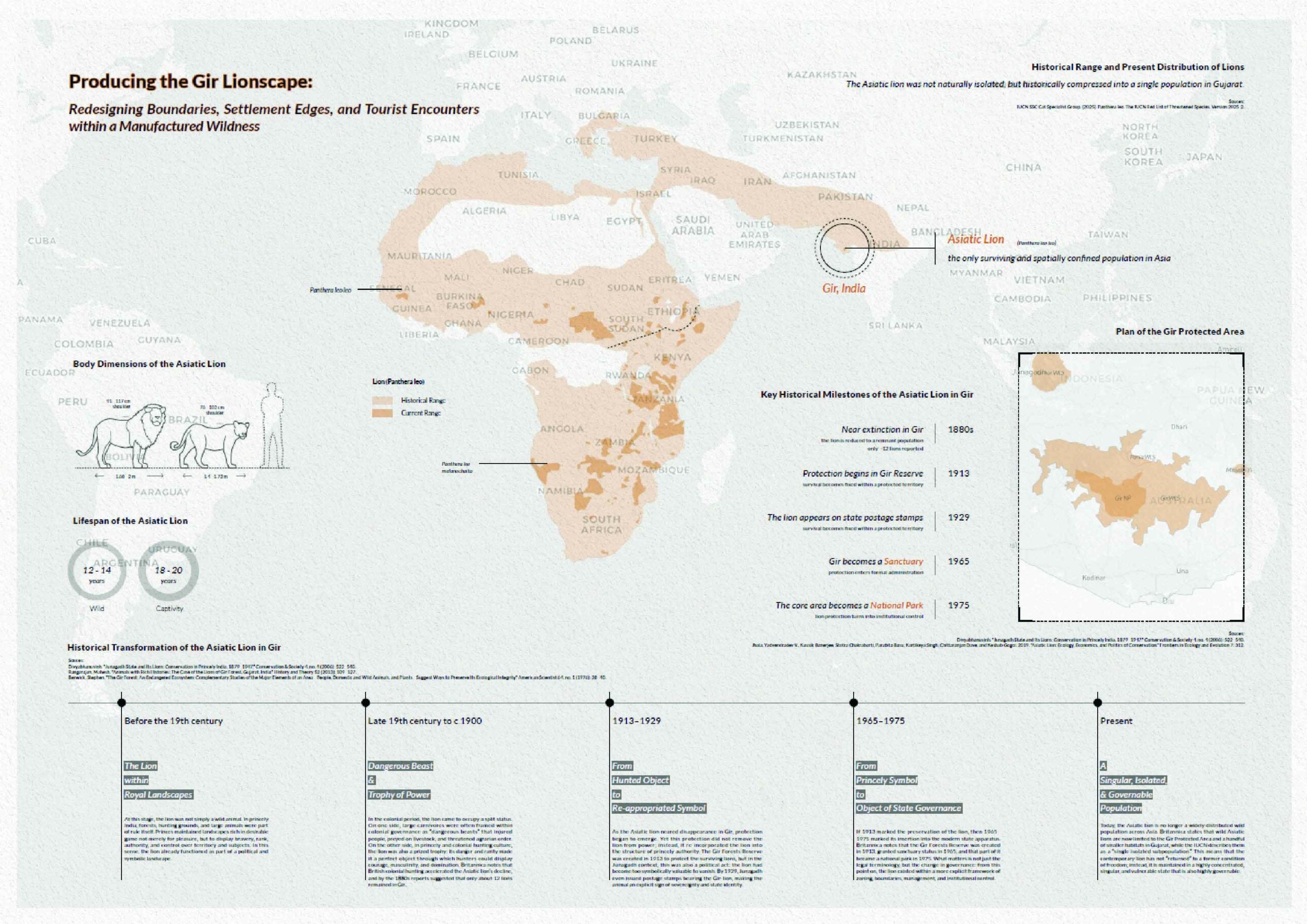
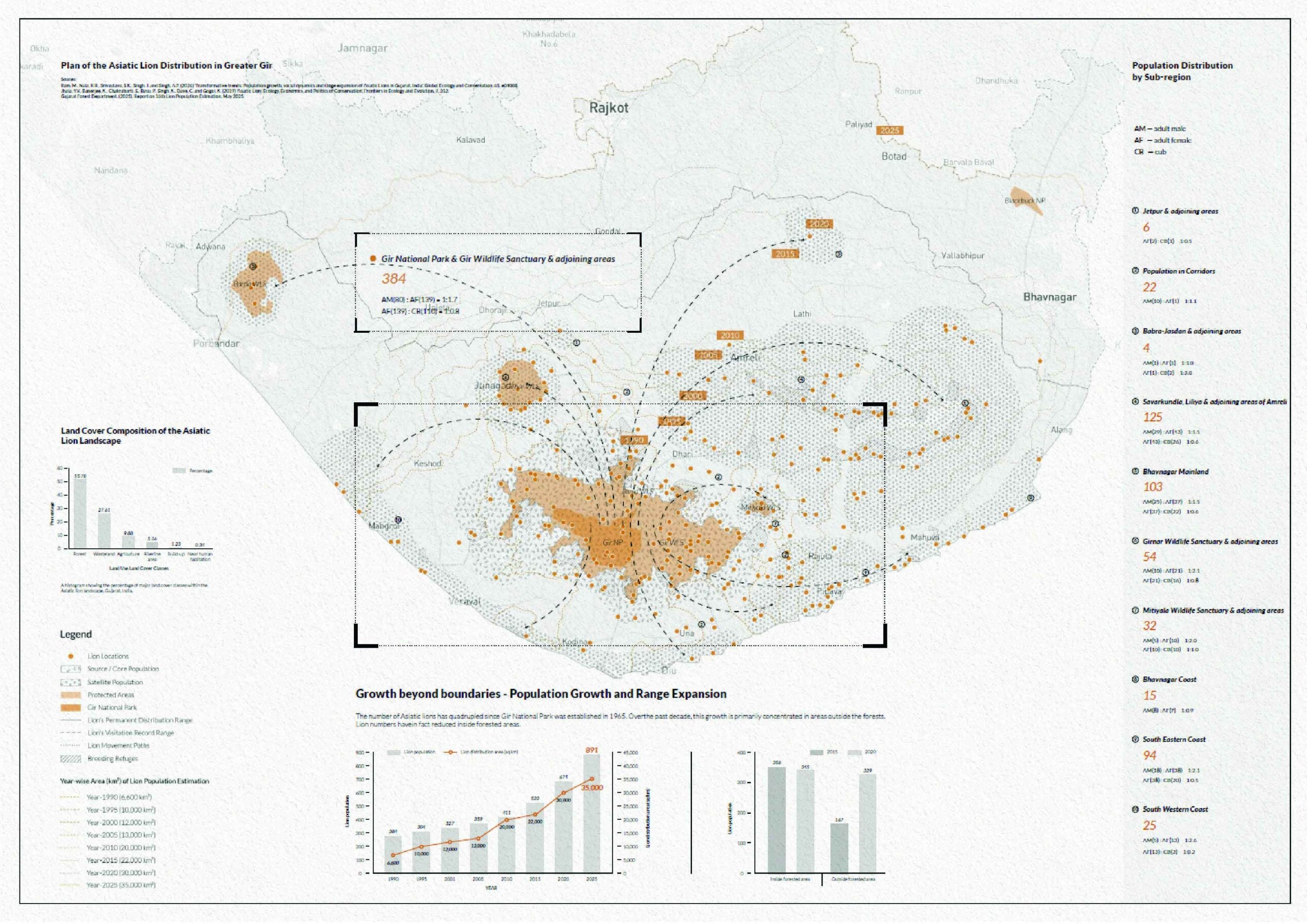
The research traces the historical contraction of the Asiatic lion’s range and identifies four interconnected systems that organise the contemporary landscape: the expansion of lion territories beyond protected areas, tourism centred on wildlife viewing, compensation mechanisms responding to livestock predation, and governance structures that negotiate competing ecological and political interests. Together, these systems reveal a landscape where conservation is continuously shaped by movement, conflict, and human intervention.
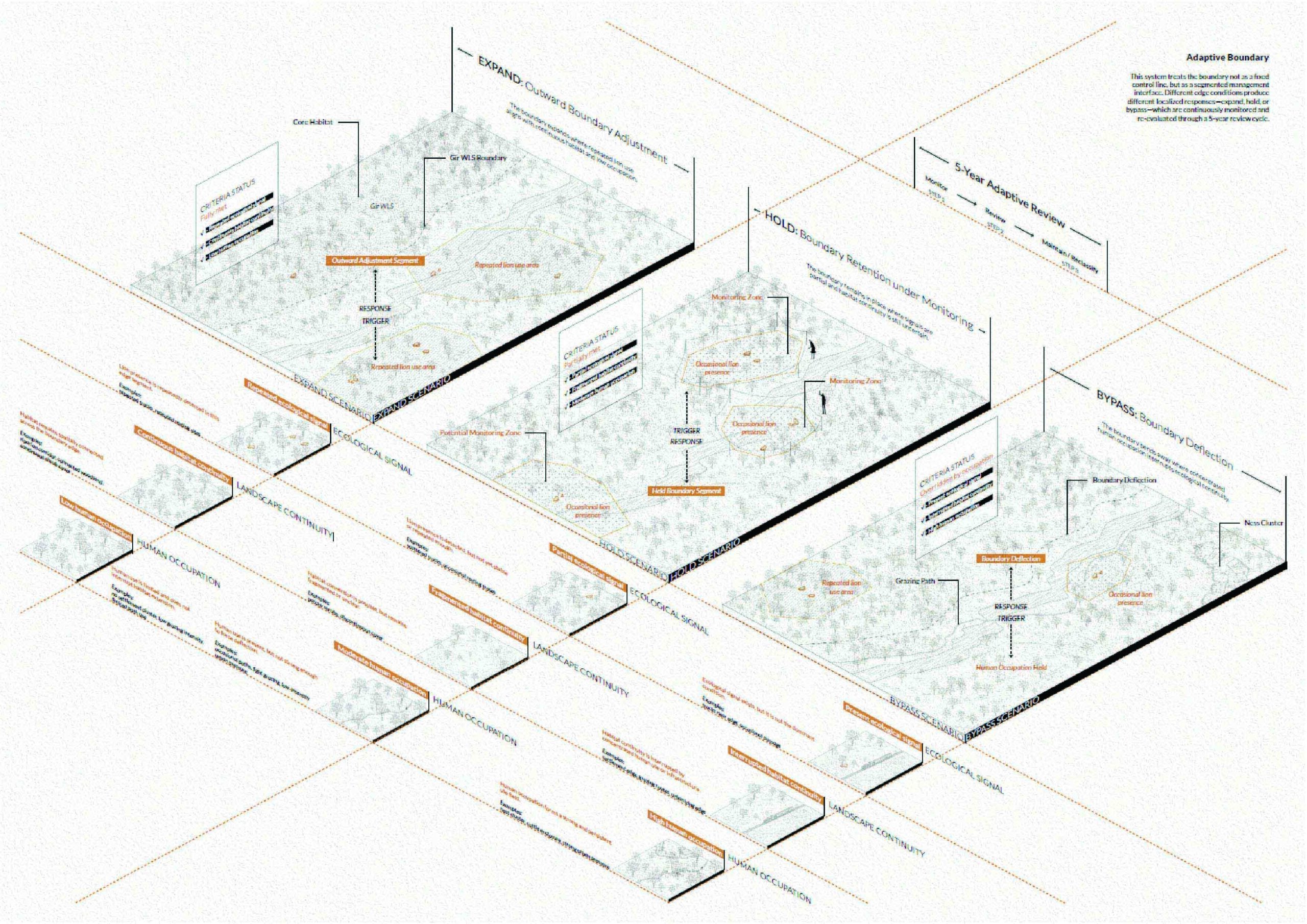
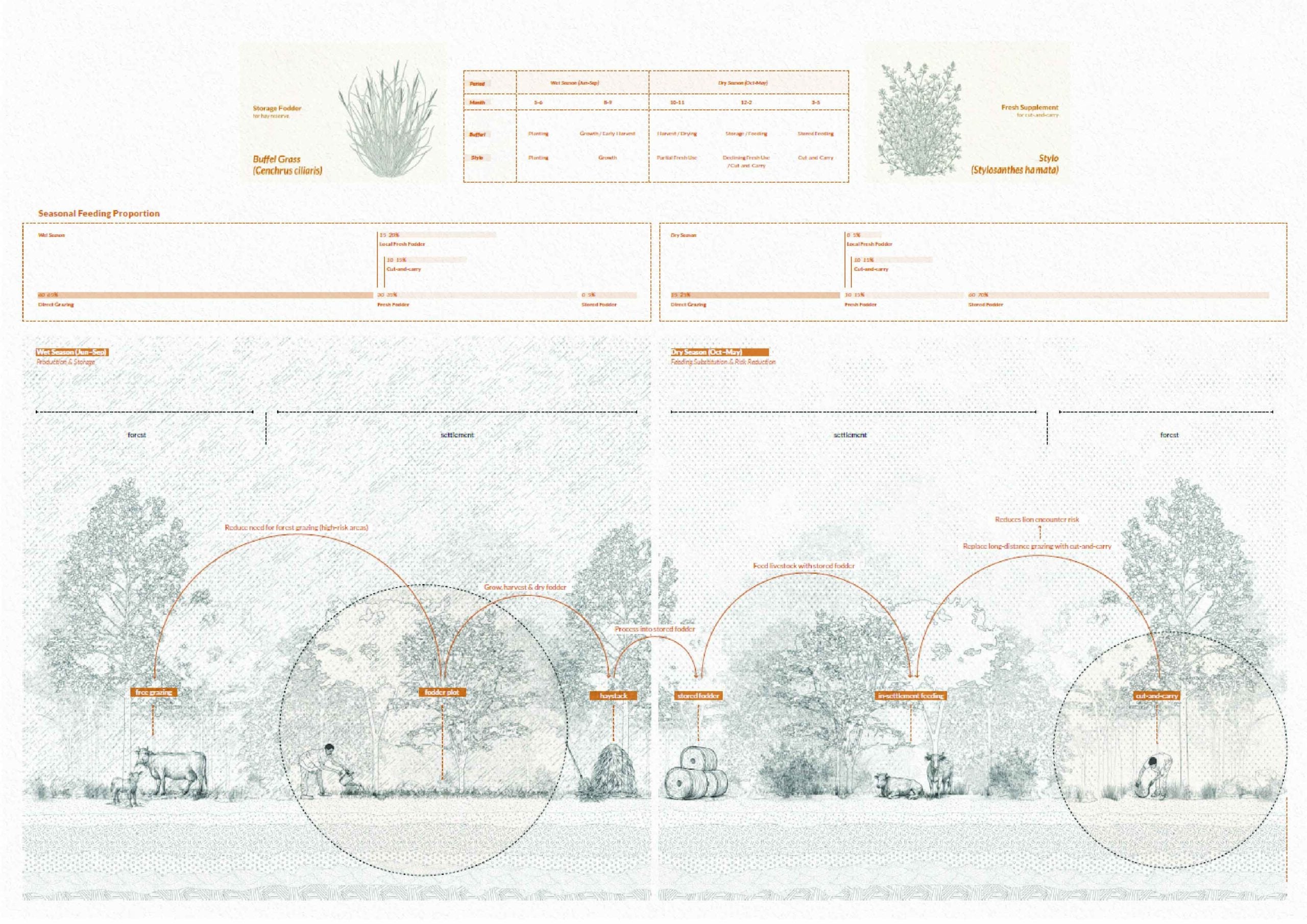
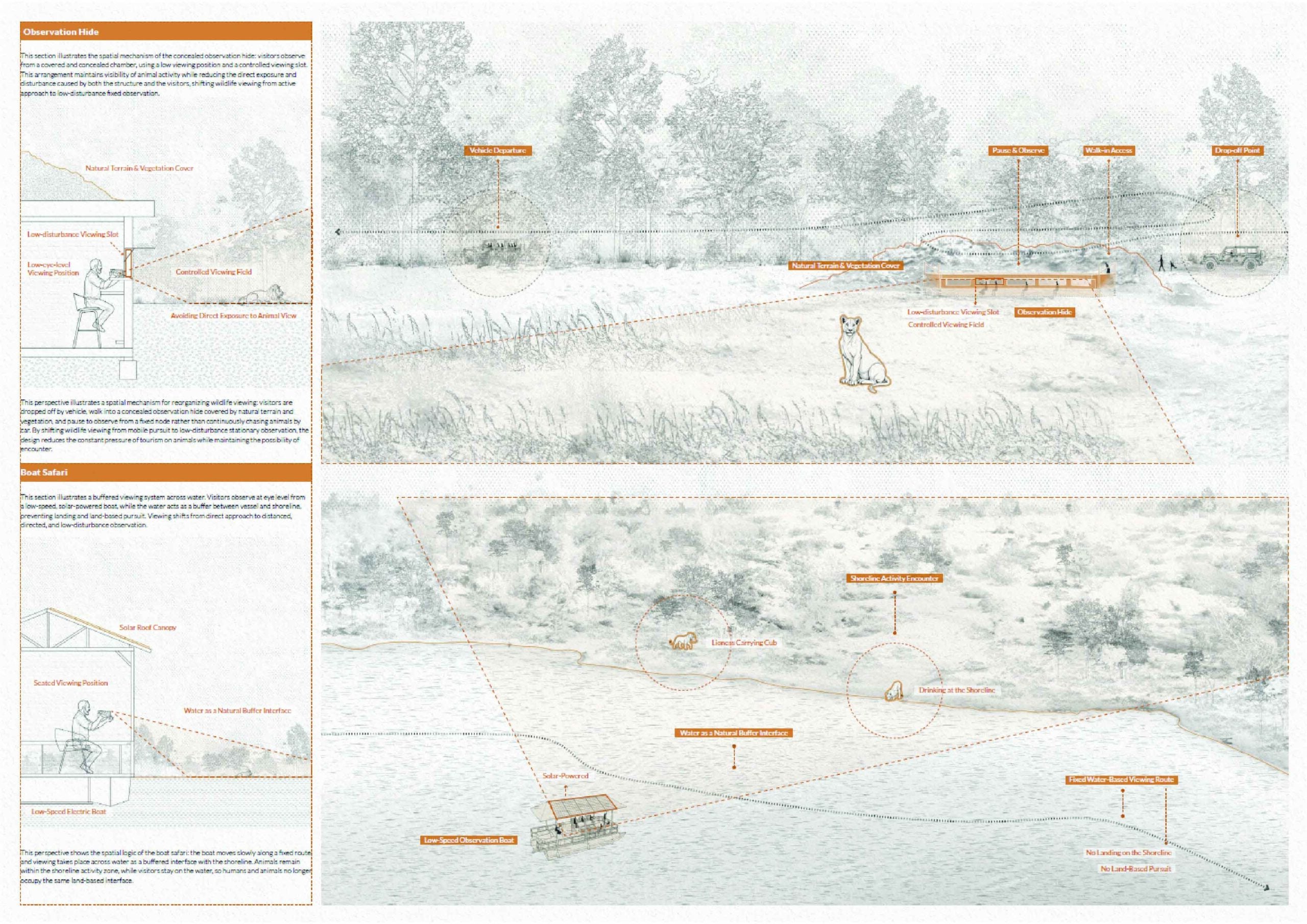
In response, the project proposes a series of spatial strategies that reorganise relationships between wildlife, people, and governance. Ecological corridors and adaptive boundaries accommodate the lion’s expanding range, while settlement-scale fodder support systems reduce livestock movement into high-risk grazing areas and strengthen local pastoral livelihoods. Tourism is restructured through dispersed observation hides and river-based wildlife viewing, shifting encounters from vehicle-based spectacle to slower, habitat-oriented experiences that reduce pressure on protected areas while maintaining opportunities for observation.
Rather than separating conservation from everyday life, the proposal positions Gir as a relational landscape where ecological resilience depends on the continuous negotiation of boundaries, livelihoods, and mobility. By integrating ecological design with regional governance and community practices, the project presents a landscape framework that supports coexistence between wildlife and people while adapting to the evolving dynamics of conservation.
  • About
    About
    • Mission & Values
    • History
    • Contact
    People
    • Staff
    • Ong Siew May (OSM) Professorship
    • Alumni
    • The Architecture Society (TAS)
    Facilities
    • SDE1 Building
    • SDE3 Building
    • SDE4 Building
    • Design Fabrication Workshop
    Gallery
  • Study
    PROGRAMMES
    • BACHELOR OF ARTS IN ARCHITECTURE
    • BACHELOR OF LANDSCAPE ARCHITECTURE
    • Master of Architecture
    • Master of Landscape Architecture
    • MASTER OF ARTS IN ARCHITECTURAL CONSERVATION
    • Master of Science, Integrated Sustainable Design
    • Master of Arts in Urban Design
    • Master of Urban Planning
    • DOCTOR OF PHILOSOPHY and MASTER OF ARTS By RESEARCH (Architecture)
    RESOURCES FOR PROSPECTIVE STUDENTS
    • Study at DoA
    • Awards, Scholarships and Grants
    • DOA Graduate Futures Fellowship
    RESOURCES FOR CURRENT STUDENTS
    • Academic Matters
    • Student Works and Programme Brochures
  • Research
    Research Clusters
    • Design Education Research
    • Research by Design
    • History, Theory, Criticism
    • Technologies
    • Urbanism
    • Landscape Studies
    • Work and Publications
    • News + Events
    Tun Tan Cheng Lock Centre
    • About
    • History
    • Restoration and Conservation Projects
    • Conservation Works Team
    • Donor and Scholarship
    • News + Events
    Campus Design Innovations Group
    • About
    • SDE 1
    • SDE 3
    • SDE 4
    • Yusof Ishak House
    • CDE +
    Centre for Advanced Studies in Architecture
    • Graduate Research Symposium 2025
    • Graduate Research Symposium 2024
    • Graduate Research Symposium 2023
    • NUS-SUTD PhD Symposium in Architecture 2022
    Centre for Environment and Ageing Well (ENgAGE)
    Research Labs
    • Critical Landscapes Design Lab
    • Urban Climate Design Lab (UCDL)
    • Urban Analytics Lab
    • Urban Ecology Lab
    • SkyTimber™: Tropical Renewable Architecture Design Lab
    • Civic Resilience Lab
    • Urban Transitions Lab
    • Urban Wild Lab
    • Architectural Conservation Laboratory (ArCLab)
    Research Networks
    • Architecture Design Education and Research in ASEAN (AUN-ADERA)
    • International Network for Tropical Architecture (iNTA)
    Designing Resilience in Asia International Research Progamme (DRIA)
  • News + Events
    News + Events
    Newsletter
  • Careers
    Overview
  • Admissions
    BACHELOR OF ARTS IN ARCHITECTURE
    BACHELOR OF LANDSCAPE ARCHITECTURE
    MASTER OF ARCHITECTURE
    MASTER OF LANDSCAPE ARCHITECTURE
    MASTER OF ARTS IN ARCHITECTURAL CONSERVATION
    MASTER OF SCIENCE, INTEGRATED SUSTAINABLE DESIGN
    MASTER OF ARTS IN URBAN DESIGN
    MASTER OF URBAN PLANNING
    DOCTOR OF PHILOSOPHY AND MASTER OF ARTS IN ARCHITECTURE BY RESEARCH
Home
Department of Architecture
College of Design and Engineering
National University of Singapore
4 Architecture Drive
Singapore 117566
+65 6516 8736
© National University of Singapore.
All Rights Reserved.
Legal
Branding Guidelines