NUS logo
menu

Department of Architecture

  • About
    About
    • Mission & Values
    • History
    • Contact
    People
    • Staff
    • Ong Siew May (OSM) Professorship
    • Alumni
    • The Architecture Society (TAS)
    Facilities
    • SDE1 Building
    • SDE3 Building
    • SDE4 Building
    • Design Fabrication Workshop
    Gallery
  • Study
    PROGRAMMES
    • BACHELOR OF ARTS IN ARCHITECTURE
    • BACHELOR OF LANDSCAPE ARCHITECTURE
    • Master of Architecture
    • Master of Landscape Architecture
    • MASTER OF ARTS IN ARCHITECTURAL CONSERVATION
    • Master of Science, Integrated Sustainable Design
    • Master of Arts in Urban Design
    • Master of Urban Planning
    • DOCTOR OF PHILOSOPHY and MASTER OF ARTS By RESEARCH (Architecture)
    RESOURCES FOR PROSPECTIVE STUDENTS
    • Study at DoA
    • Awards, Scholarships and Grants
    • DOA Graduate Futures Fellowship
    RESOURCES FOR CURRENT STUDENTS
    • Academic Matters
    • Student Works and Programme Brochures
  • Research
    Research Clusters
    • Design Education Research
    • Research by Design
    • History, Theory, Criticism
    • Technologies
    • Urbanism
    • Landscape Studies
    • Work and Publications
    • News + Events
    Tun Tan Cheng Lock Centre
    • About
    • History
    • Restoration and Conservation Projects
    • Conservation Works Team
    • Donor and Scholarship
    • News + Events
    Campus Design Innovations Group
    • About
    • SDE 1
    • SDE 3
    • SDE 4
    • Yusof Ishak House
    • CDE +
    Centre for Advanced Studies in Architecture
    • Graduate Research Symposium 2025
    • Graduate Research Symposium 2024
    • Graduate Research Symposium 2023
    • NUS-SUTD PhD Symposium in Architecture 2022
    Centre for Environment and Ageing Well (ENgAGE)
    Research Labs
    • Urban Climate Design Lab (UCDL)
    • Urban Analytics Lab
    • Urban Ecology Lab
    • SkyTimber™: Tropical Renewable Architecture Design Lab
    • Civic Resilience Lab
    • Urban Transitions Lab
    • Urban Wild Lab
    • Architectural Conservation Laboratory (ArCLab)
    International Network for Tropical Architecture (iNTA)
    Designing Resilience in Asia International Research Progamme (DRIA)
  • News + Events
    News + Events
    Newsletter
  • Careers
    Overview
  • Admissions
    BACHELOR OF ARTS IN ARCHITECTURE
    BACHELOR OF LANDSCAPE ARCHITECTURE
    MASTER OF ARCHITECTURE
    MASTER OF LANDSCAPE ARCHITECTURE
    MASTER OF ARTS IN ARCHITECTURAL CONSERVATION
    MASTER OF SCIENCE, INTEGRATED SUSTAINABLE DESIGN
    MASTER OF ARTS IN URBAN DESIGN
    MASTER OF URBAN PLANNING
    DOCTOR OF PHILOSOPHY AND MASTER OF ARTS IN ARCHITECTURE BY RESEARCH
logo logo
< BACK TO Gallery

Spalding Landscapes: Exploring the politics of plant belonging through decay, fungal growth and mycelium network
PROGRAMME

Master of Landscape Architecture

STUDENT

Shruthakeerthi Karthikeyan

YEAR

2

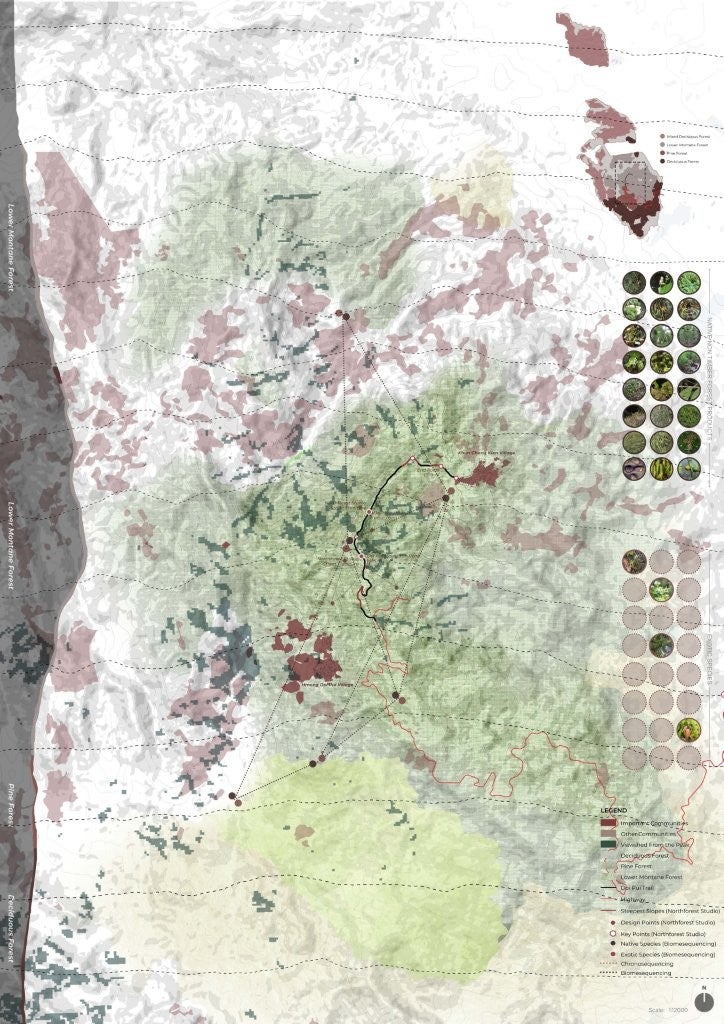
Spalding Landscapes is a landscape proposal situated along the Doi Pui Nature Trail within Doi Suthep-Pui National Park. The trail, one of seven educational routes in the park, connects the Hmong villages of Khun Chang Kien and Doi Pui while serving as a shared ground for ecological systems, local livelihoods, and scientific research. Currently undergoing upgrades, the site is poised to become a key tourism and education corridor, raising questions about how knowledge, conservation, and access are produced within a protected landscape.

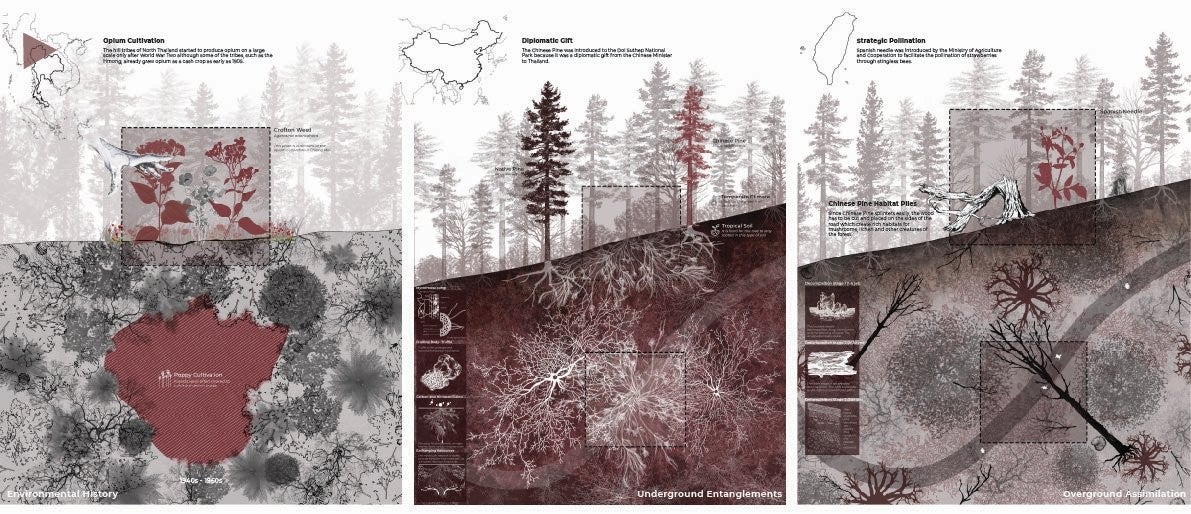
The project emerges from a critical observation: the politics of ‘belonging’ in nature are often defined through rigid distinctions between native and non-native species. Inspired by an encounter with a hybrid Spalding peafowl (valued yet confined due to its mixed lineage) the project interrogates how similar logics are imposed onto plant life. Within the Doi Pui trail, multiple non-native species, such as Crofton weed, Spanish needle, and Chinese pine, coexist with native ecologies, despite national park regulations that prohibit their presence.
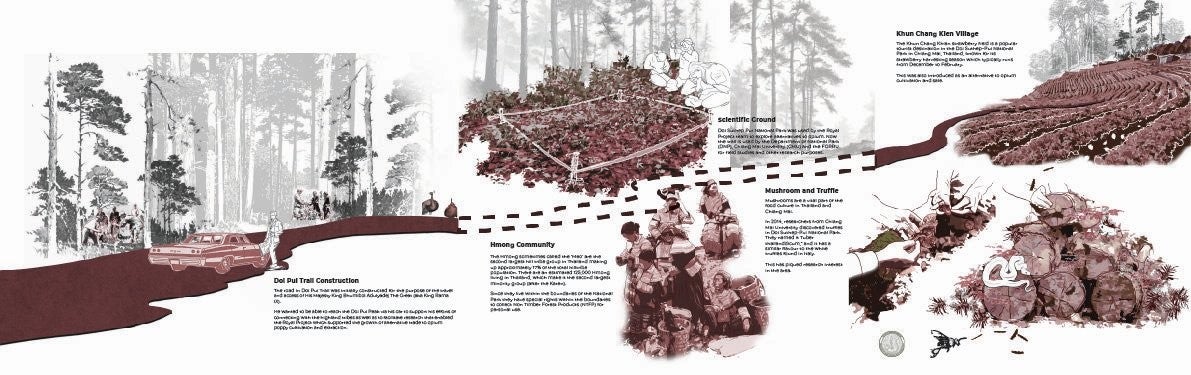
Historically, this condition is rooted in the region’s transformation during and after the opium economy of the mid-twentieth century. State-led interventions, particularly under King Bhumibol Adulyadej (King Rama IX), introduced alternative crops and research infrastructures through the Royal Project, reshaping both the ecological and socio-economic landscape. These interventions brought new plant species into the forest, many of which have since integrated into its ecological processes.
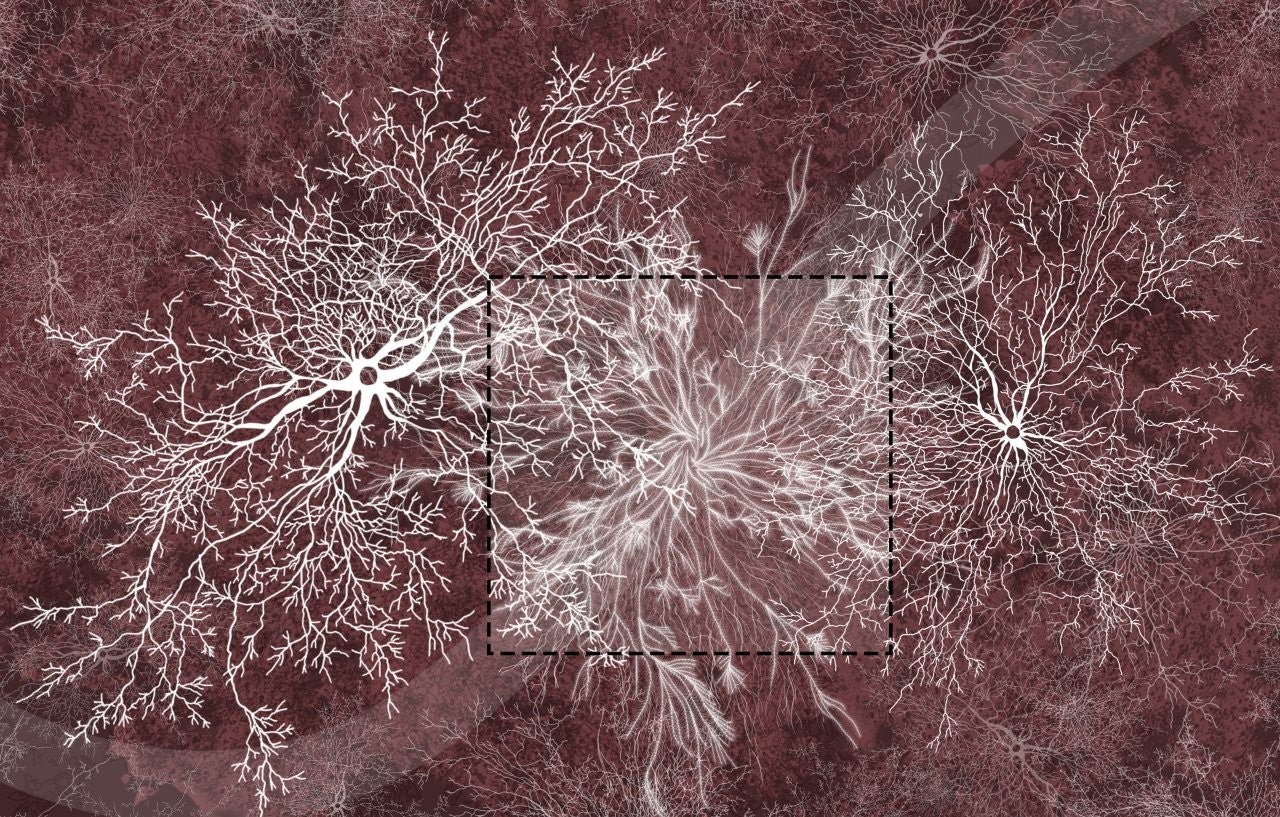
Rather than viewing these species as contaminants, Spalding Landscapes understands the forest as a metabolic system, where native and non-native species participate in cycles of growth, decay, and mutual dependence. Mycorrhizal networks, decomposing timber, and adaptive vegetation demonstrate how ecological relationships exceed imposed categories of purity.
The design responds by shifting attention from outward-facing tourism infrastructure to inward ecological processes. Central to the proposal is the slow removal of the existing asphalt road, originally built for royal access, over a five-month period. This gradual process allows for soil recovery, material reuse, and the observation of ecological succession. Fragments of asphalt are retained as markers of the site’s layered history, transforming infrastructure into a pedagogical tool.
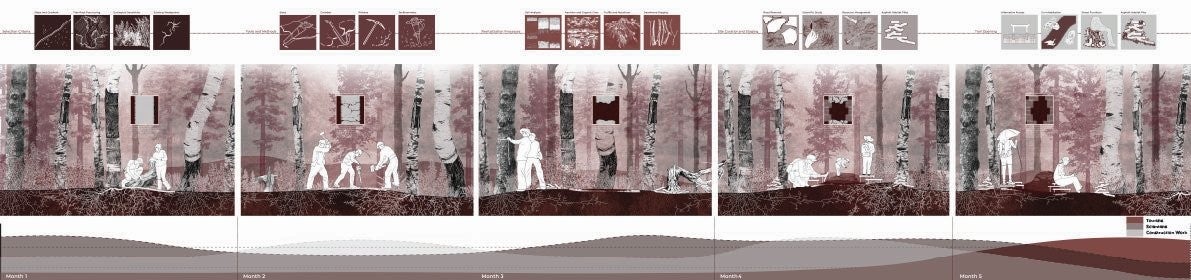
The resulting landscape is organised as a series of interpretive nodes that support interaction between visitors, researchers, and local communities. These spaces frame the trail as a living laboratory, where knowledge is produced through observation, participation, and dialogue.
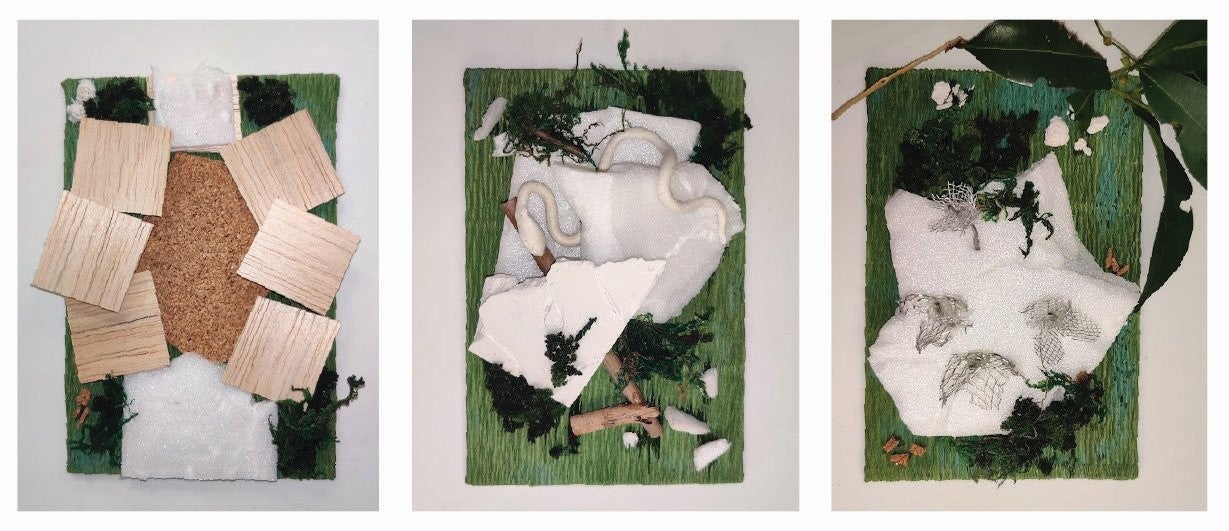
Ultimately, Spalding Landscapes reframes conservation as an ongoing negotiation rather than a fixed ideal. By embracing ecological hybridity and slowing down intervention, the project positions the Doi Pui trail as a living archive shaped by politics, science, community stewardship, and the entangled realities of a changing environment.

  • About
    About
    • Mission & Values
    • History
    • Contact
    People
    • Staff
    • Ong Siew May (OSM) Professorship
    • Alumni
    • The Architecture Society (TAS)
    Facilities
    • SDE1 Building
    • SDE3 Building
    • SDE4 Building
    • Design Fabrication Workshop
    Gallery
  • Study
    PROGRAMMES
    • BACHELOR OF ARTS IN ARCHITECTURE
    • BACHELOR OF LANDSCAPE ARCHITECTURE
    • Master of Architecture
    • Master of Landscape Architecture
    • MASTER OF ARTS IN ARCHITECTURAL CONSERVATION
    • Master of Science, Integrated Sustainable Design
    • Master of Arts in Urban Design
    • Master of Urban Planning
    • DOCTOR OF PHILOSOPHY and MASTER OF ARTS By RESEARCH (Architecture)
    RESOURCES FOR PROSPECTIVE STUDENTS
    • Study at DoA
    • Awards, Scholarships and Grants
    • DOA Graduate Futures Fellowship
    RESOURCES FOR CURRENT STUDENTS
    • Academic Matters
    • Student Works and Programme Brochures
  • Research
    Research Clusters
    • Design Education Research
    • Research by Design
    • History, Theory, Criticism
    • Technologies
    • Urbanism
    • Landscape Studies
    • Work and Publications
    • News + Events
    Tun Tan Cheng Lock Centre
    • About
    • History
    • Restoration and Conservation Projects
    • Conservation Works Team
    • Donor and Scholarship
    • News + Events
    Campus Design Innovations Group
    • About
    • SDE 1
    • SDE 3
    • SDE 4
    • Yusof Ishak House
    • CDE +
    Centre for Advanced Studies in Architecture
    • Graduate Research Symposium 2025
    • Graduate Research Symposium 2024
    • Graduate Research Symposium 2023
    • NUS-SUTD PhD Symposium in Architecture 2022
    Centre for Environment and Ageing Well (ENgAGE)
    Research Labs
    • Urban Climate Design Lab (UCDL)
    • Urban Analytics Lab
    • Urban Ecology Lab
    • SkyTimber™: Tropical Renewable Architecture Design Lab
    • Civic Resilience Lab
    • Urban Transitions Lab
    • Urban Wild Lab
    • Architectural Conservation Laboratory (ArCLab)
    International Network for Tropical Architecture (iNTA)
    Designing Resilience in Asia International Research Progamme (DRIA)
  • News + Events
    News + Events
    Newsletter
  • Careers
    Overview
  • Admissions
    BACHELOR OF ARTS IN ARCHITECTURE
    BACHELOR OF LANDSCAPE ARCHITECTURE
    MASTER OF ARCHITECTURE
    MASTER OF LANDSCAPE ARCHITECTURE
    MASTER OF ARTS IN ARCHITECTURAL CONSERVATION
    MASTER OF SCIENCE, INTEGRATED SUSTAINABLE DESIGN
    MASTER OF ARTS IN URBAN DESIGN
    MASTER OF URBAN PLANNING
    DOCTOR OF PHILOSOPHY AND MASTER OF ARTS IN ARCHITECTURE BY RESEARCH
Home
Department of Architecture
College of Design and Engineering
National University of Singapore
4 Architecture Drive
Singapore 117566
+65 6516 8736
© National University of Singapore.
All Rights Reserved.
Legal
Branding Guidelines