DoA Symposium: Building / Community in the Tropics and Beyond
Name of Event/Lecture
DoA Symposium: Building / Community in the Tropics and Beyond
Location
SDE3 Level 1-Exhibition Space, 4 Architecture Drive, National University of Singapore
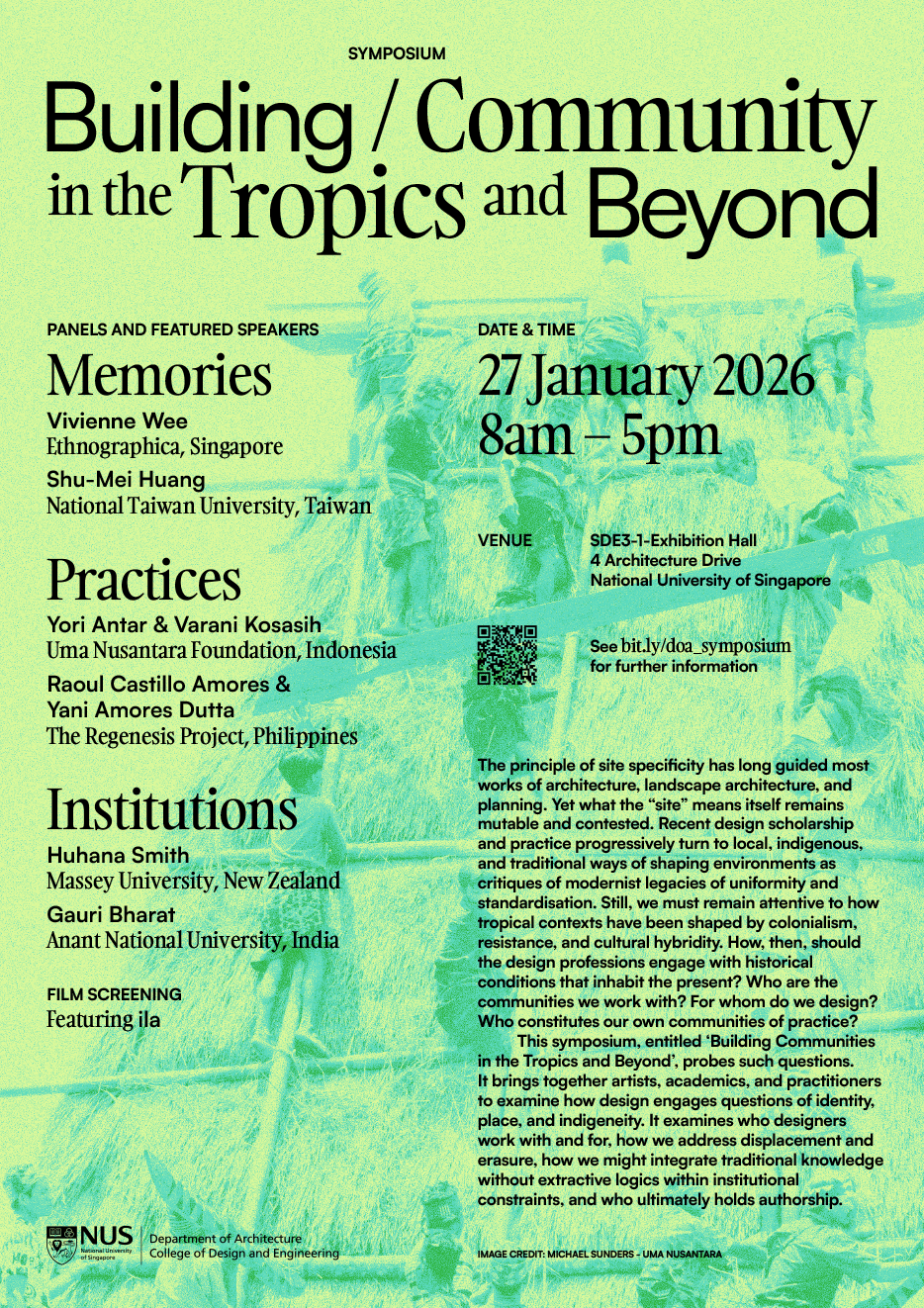
The principle of site specificity has long guided most works of architecture, landscape architecture, and planning. Yet what the “site” means itself remains mutable and contested. Recent design scholarship and practice progressively turn to local, indigenous, and traditional ways of shaping environments as critiques of modernist legacies of uniformity and standardisation. Still, we must remain attentive to how tropical contexts have been shaped by colonialism, resistance, and cultural hybridity. How, then, should the design professions engage with historical conditions that inhabit the present? Who are the communities we work with? For whom do we design? Who constitutes our own communities of practice?
This symposium, entitled ‘Building Communities in the Tropics and Beyond’, probes such questions. It brings together artists, academics, and practitioners to examine how design engages questions of identity, place, and indigeneity. It examines who designers work with and for, how we address displacement and erasure, how we might integrate traditional knowledge without extractive logics within institutional constraints, and who ultimately holds authorship.
Date: 27 January 2026
Time: 8:00 AM – 6:00 PM
Location:
SDE3 Level 1 Exhibition Space, 4 Architecture Drive, National University of Singapore
Please RSVP here.
Please click here for more details.
Schedule
08.00–08.30 Registration
08:30–08.50 Welcome
Jeff Hou, Provost’s Chair Professor & Head, Department of Architecture, NUS
Dorothy Tang, NUS
09.00–10.30 Memories
Vivienne Wee, Ethnographica, Singapore
Shu-Mei Huang, National Taiwan University, Taiwan
Moderated by Saptarshi Sanyal, NUS
11.00–12.30 Practices
Yori Antar & Varani Kosasih, Uma Nusantara Foundation, Indonesia
Raoul Castillo Amores & Yani Amores Dutta, The Regenesis Project, Philippines
Moderated by Florian Heinzelmann, NUS
13.30–15.00 Institutions
Huhana Smith, Massey University, New Zealand
Gauri Bharat, Anant National University, India
Moderated by Robin Hartanto Honggare, NUS
15.30–16.00 Film Screening of Animacies of Absence by ila
16.00–17.00 Roundtable Discussion