Towards Resilient Heritage: Nature, Culture, and Living Knowledge in Conservation Practice
Name of Event/Lecture
Towards Resilient Heritage: Nature, Culture, and Living Knowledge in Conservation Practice
Name of Speaker
Li Kuanghan
Location
SDE3 Level 4, LT425
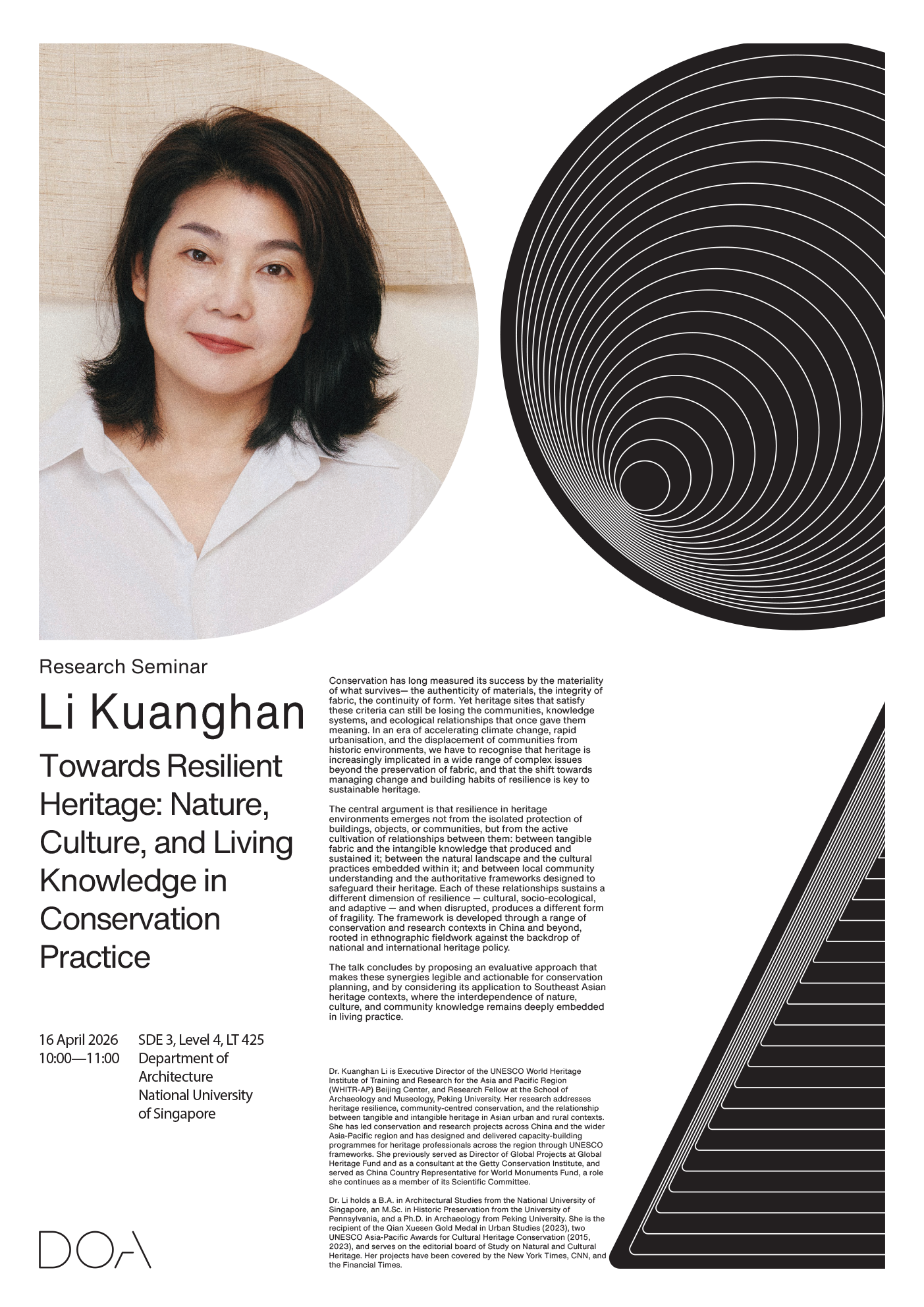
You are cordially invited to attend the research seminar by Li Kuanghan:
Date: 16 April 2026
Time: 10:00 – 11:00
Venue: SDE 3, Level 4, LT 425
Towards Resilient Heritage: Nature, Culture, and Living Knowledge in Conservation Practice
Conservation has long measured its success by the materiality of what survives— the authenticity of materials, the integrity of fabric, the continuity of form. Yet heritage sites that satisfy these criteria can still be losing the communities, knowledge systems, and ecological relationships that once gave them meaning. In an era of accelerating climate change, rapid urbanisation, and the displacement of communities from historic environments, we have to recognise that heritage is increasingly implicated in a wide range of complex issues beyond the preservation of fabric, and that the shift towards managing change and building habits of resilience is key to sustainable heritage.
The central argument is that resilience in heritage environments emerges not from the isolated protection of buildings, objects, or communities, but from the active cultivation of relationships between them: between tangible fabric and the intangible knowledge that produced and sustained it; between the natural landscape and the cultural practices embedded within it; and between local community understanding and the authoritative frameworks designed to safeguard their heritage. Each of these relationships sustains a different dimension of resilience — cultural, socio-ecological, and adaptive — and when disrupted, produces a different form of fragility. The framework is developed through a range of conservation and research contexts in China and beyond, rooted in ethnographic fieldwork against the backdrop of national and international heritage policy.
The talk concludes by proposing an evaluative approach that makes these synergies legible and actionable for conservation planning, and by considering its application to Southeast Asian heritage contexts, where the interdependence of nature, culture, and community knowledge remains deeply embedded in living practice.
Dr. Kuanghan Li is Executive Director of the UNESCO World Heritage Institute of Training and Research for the Asia and Pacific Region (WHITR-AP) Beijing Center, and Research Fellow at the School of Archaeology and Museology, Peking University. Her research addresses heritage resilience, community-centred conservation, and the relationship between tangible and intangible heritage in Asian urban and rural contexts. She has led conservation and research projects across China and the wider Asia-Pacific region and has designed and delivered capacity-building programmes for heritage professionals across the region through UNESCO frameworks. She previously served as Director of Global Projects at Global Heritage Fund and as a consultant at the Getty Conservation Institute, and served as China Country Representative for World Monuments Fund, a role she continues as a member of its Scientific Committee.
Dr. Li holds a B.A. in Architectural Studies from the National University of Singapore, an M.Sc. in Historic Preservation from the University of Pennsylvania, and a Ph.D. in Archaeology from Peking University. She is the recipient of the Qian Xuesen Gold Medal in Urban Studies (2023), two UNESCO Asia-Pacific Awards for Cultural Heritage Conservation (2015, 2023), and serves on the editorial board of Study on Natural and Cultural Heritage. Her projects have been covered by the New York Times, CNN, and the Financial Times.