Championing Community and Ecology: NUS Team Wins First Place at CERF 2025
An interdisciplinary team from the Architecture and Landscape Architecture programmes has clinched first place at the Coastal and Estuarine Research Federation (CERF) 2025 Student Design Competition with their project, “Cultivating Resilience.” Developed from May to November 2025 as part of an extracurricular design initiative, the project demonstrates innovative approaches to coastal and estuarine resilience.
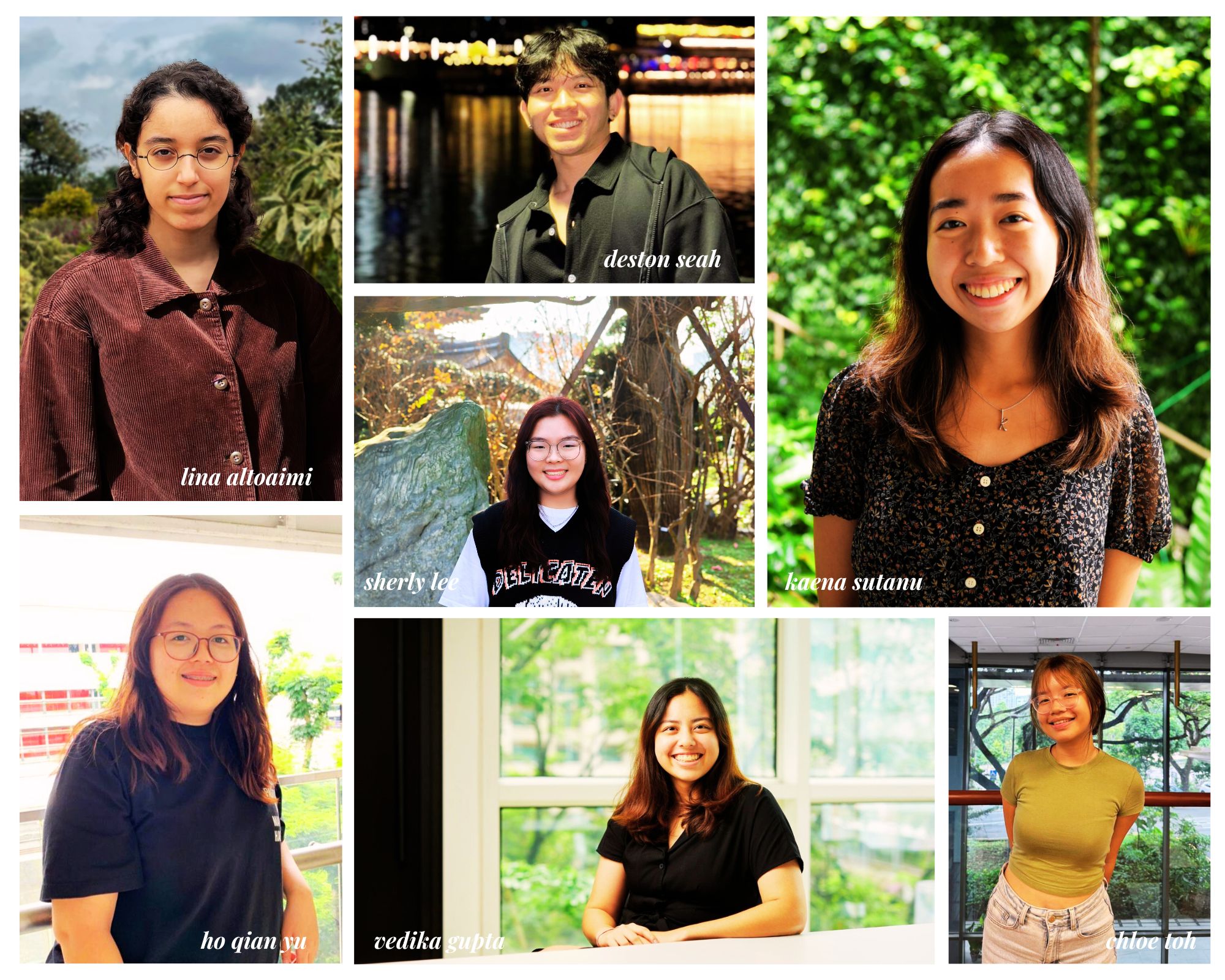
Congratulations to the team members:
– Lina Altoaimi (Team Lead), BLA Alumni, Class of 2025
– Vedika Gupta (Co-presenter), BA Arch + MUP, Year 4
– Kaena Sutanu (Co-presenter), BLA Alumni, Class of 2025
– Ho Qian Yu, BLA Alumni, Class of 2025
– Lee Wen Qi Sherly, BLA Alumni, Class of 2025
– Seah Yun Zhang Deston, BLA Alumni, Class of 2025
– Toh Tze Hwee Chloe, BLA Year 3
Their achievement underscores the power of interdisciplinary collaboration and a shared commitment to tackling urgent environmental challenges. Centred on Galesville, a low-lying coastal town in Maryland’s Chesapeake Bay region, the project addresses the impacts of tidal flooding, storm surges, and sea-level rise. Once a vibrant hub for maritime culture and boatbuilding, Galesville now faces the critical task of balancing heritage preservation with climate adaptation. Key stakeholders, including residents, waterfront owners, business operators, and municipal authorities, bring diverse priorities to the table, ranging from property protection to ecological sustainability. This complexity highlights the need for integrated strategies that strengthen both community and environmental resilience.
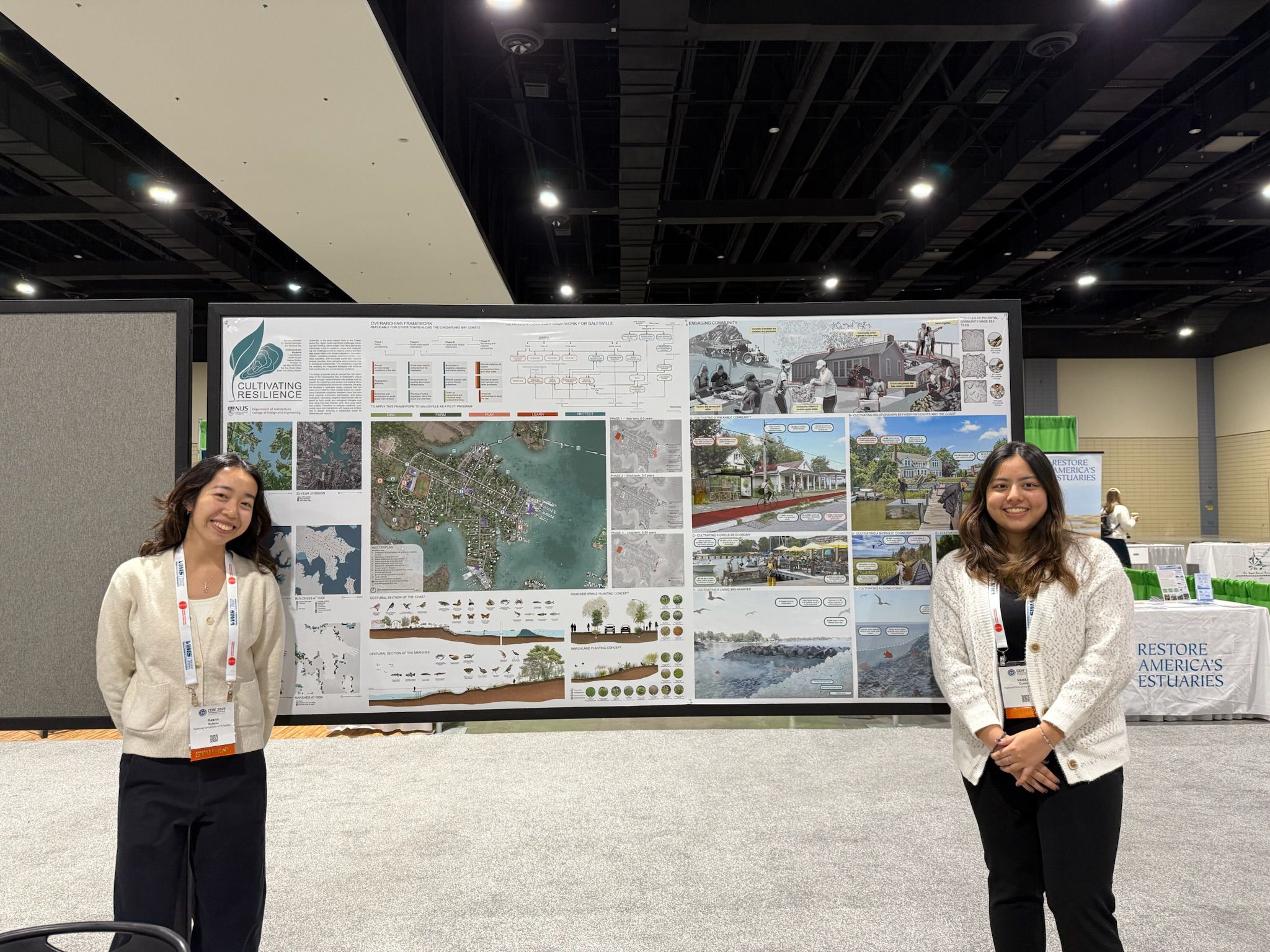 VEDIKA GUPTA AND KAENA SUTANU REPRESENTING THE TEAM AT CERF 2025
The design proposal connects the rich narratives of the Chesapeake Bay to Galesville’s unique context through rigorous site analysis and research. Drawing on case studies and established literature in ecological and community resilience, the team developed a replicable model that can inform adaptation efforts in other coastal towns. An overarching framework embeds feedback loops to sustain community participation and guide policy evaluation, enabling adaptive interventions that evolve with social and ecological change. Organised around five themes—dine, farm, play, learn, and protect—the proposal weaves community input and engagement with nature into the design, charting a path toward a sustainable future for Galesville and beyond.
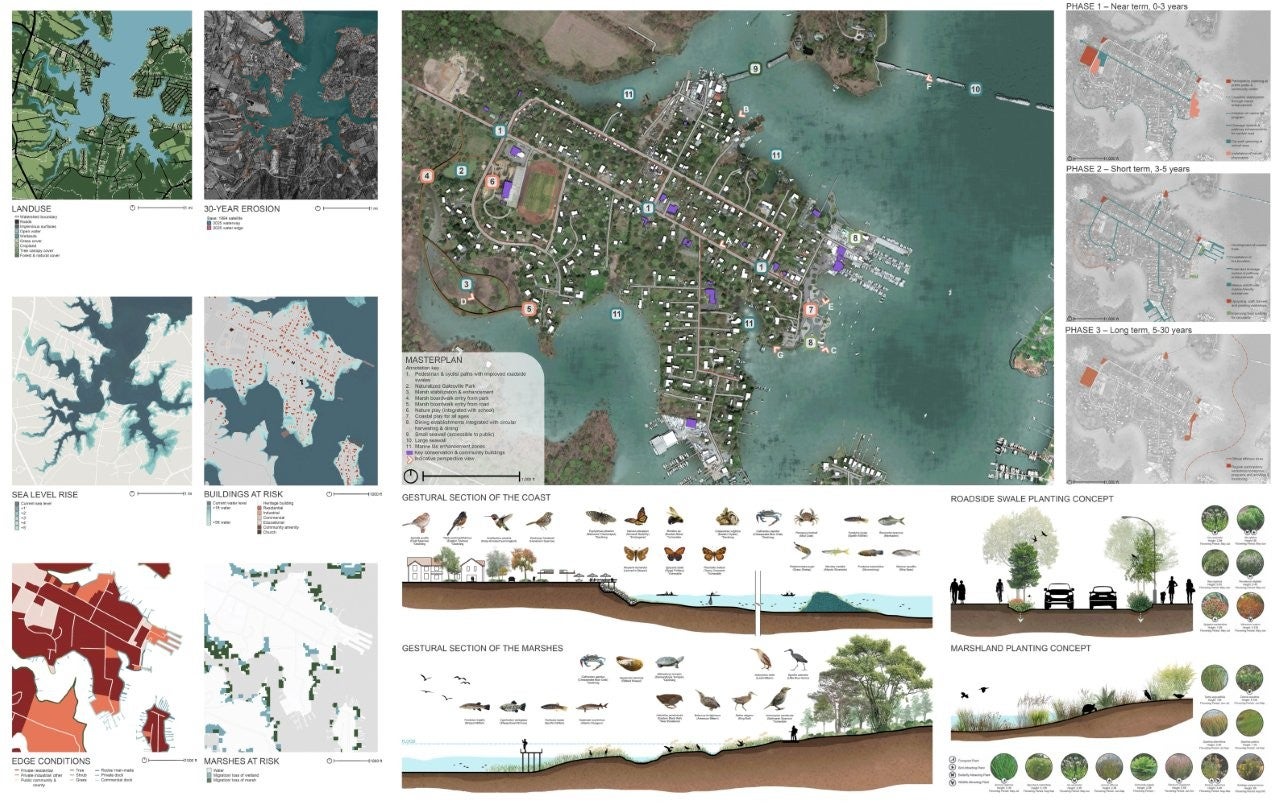
ONE OF THE DESIGN FRAMEWORKS DEVELOPED BY THE TEAM
The judging panel commended the project’s holistic, ground-up approach and strong emphasis on community-led design. They also highlighted the team’s high-quality visualisation and graphics, which effectively communicated complex ideas with clarity and impact.
“The team would like to thank Dr Rosita Samsudin and Dr Terrence Tan for their guidance and encouragement throughout the competition. We also extend our gratitude to the CERF 2025 committee and the Galesville community for fostering positive dialogue between the student designers and the town’s residents,” Lina Altoaimi, team lead, expressed.
Coastal and Estuarine Research Federation
The competition is an initiative inspiring students and faculty across disciplines to address community-based challenges of climate change. The aim of the competition is for university-based teams to propose research, design solutions, and innovative strategies to make our coastal environments more resilient in the face of climate change and other pressing challenges. The Student Coastal Design Competition focuses on critical issues such as coastal settlement, ecosystem restoration, flood protection, and economic development, while highlighting the capacity of faculty-led transdisciplinary teams to solve coastal problems and respond to climate change
For more information about the competition, visit:
https://conference.cerf.science/coastal-design-competition