Master of Science (MSc) in Chemical Engineering
The Master of Science in Chemical Engineering is an established programme that focuses on developing skills and knowledge in the field of chemical engineering. This programme is designed to develop adaptable and technically proficient engineers in an increasingly interdisciplinary and collaborative work environment.
We are focused on enhancing our student’s understanding of complex chemical engineering systems and equipping students with essential skills and the ability to learn about the latest technological advancement and tools to develop environmentally, economically, and socially sustainable processes in the following areas:
- Design and developing sustainable processes in the chemical, pharmaceutical, energy, and related sectors
- Development and application of advanced knowledge in research areas such as polymer, membrane, and electronic materials
The curriculum is taught by experienced faculty whose work directly contributes to cleaner water, food waste reduction, carbon capture, and renewable energy sectors. While grounded in the fundamentals of chemical engineering, students are nurtured to be versatile and apply advanced principles in research and the following professional industries:
- Pharmaceutical and Biopharmaceutical (e.g. GlaxoSmithKline, Pfizer, Merck)
- Advanced Research (e.g. A*STAR, CREATE)
- Sustainable and Renewable Technology (e.g. REC, Neste, PUB)
Degree Requirements
| Degree Requirements | To qualify for the MSc (Chemical Engineering) programme, a candidate must:
|
| Continuation and Graduation Requirements | Refer to the degree requirements for more details:
MSc (CHE) Degree Requirements (for cohorts from Sem 2 AY2023/2024 and onwards) MSc (CHE) Degree Requirements (for cohorts AY2020/2021 to Sem 1 AY2023/2024) * Refer to detailed course descriptions here. Listed graduate courses offered every semester or academic year are subject to programme curriculum changes and schedules of teaching staff. Candidates should note this in planning their study programme. All courses offered in the academic year can be found at NUSMods. |
Candidature
| Full-time | Minimum 1 year – maximum 2 years |
| Part-time | Minimum 2 years – maximum 4 years |
The academic study workload in a typical semester is as shown below:
| Recommended Workload per Semester | Part-time | Full-time |
| Maximum workload | 12 Units | 20 Units |
| Minimum workload | 4 Units | 12 Units |
Continuation and Graduation Guidelines
All graduate coursework programmes follow stipulated continuation and graduation guidelines established by the Office of the University Registrar (OUR) here.
| Eligibility | At least a Bachelor’s degree in Engineering or its equivalent.
The above-mentioned is a minimum requirement, which does not guarantee admission; selection is on a competitive basis. For more information on admission requirements, please refer to the CDE (Admission Requirements) website. |
| English Requirements | TOEFL (internet-based test) ≥ 85 or IELTS (academic) ≥ 6.0 is required if your first language is not English. You may be waived from this requirement if you have completed your degree programme taught entirely in English, situated in an English-speaking country/territory, for example (non-exhaustive list) Australia, Canada, Hong Kong, India, New Zealand, Pakistan, Philippines, Singapore, United Kingdom, USA.
The TOEFL/IELTS result is only valid for 2 years after the test and should be valid at the beginning of the application period. Other tests (including the TOEFL Institutional Test) and those that claim to be predictions, estimations, equivalents, simulations, etc. (e.g. MyBestscores) of the TOEFL or IELTS (e.g. Oneskill retake) are unacceptable. For more details, refer to CDE (Admission Requirements) website. |
| Application Requirements | Please refer to the CDE (Application) website for detailed instructions and documents that need to be submitted upon application.
We regret to inform you that your application may be deemed invalid if you do not upload all the required documents upon submission. |
Admission Intake
There are two (2) intakes per Academic Year. Candidates will be admitted at the beginning of each semester of the academic year either August or January depending on the application submitted.
| Intake | Application Period | Admission Outcome | Application Fee |
| August 2027 Intake | 1 October 2026 to 28 February 2027 | The admission outcome will be released in batches. Successful candidates will receive an email on their offer accordingly. | S$109 (9% GST) |
| January 2027 Intake | 27 July 2026 to 31 August 2026 |
Application Link
Useful information for students
Admission Requirements for Master of Science Programmes in Engineering
Application Guide to Graduate Admission System (GDA3)
Frequently Asked Questions for Master of Science by Coursework Programmes
Continuation and Graduation Requirements(CDE)
Programme Fees for students admitted in AY2027/2028 (August 2027 intake)
| Programme Fees | Total Payable (inclusive of GST) | Acceptance Fee (9% GST) |
1st Semester (9% GST) | 2nd Semester (9% GST) | 3rd Semester (9% GST) | 4th Semester (9% GST) |
| Full-Time Students | $52,000 | $5,450 | $23,275 | $23,275 | N.A. | N.A. |
| Part-Time Students | $52,000 | $5,450 | $11,637.50 | $11,637.50 | $11,637.50 | $11,637.50 |
- For AY2027/2028, Singapore Citizens, Singapore Permanent Residents and NUS Alumni* (regardless of citizenship) will receive a 40% fee rebate.
- Recipients of financial aid/scholarships/sponsorships from external (non-NUS) sources are not eligible for the 40% fee rebate.
- Information on the NUS Master’s by Coursework Enhanced Tuition Fee Rebate can be found here.
- All fees quoted here are in Singapore Dollars (S$) and inclusive of 9% Goods and Services Tax (GST).
- Fees are correct as at time of posting and are subject to changes without prior notice.
- A non-refundable and non-transferable Acceptance Fee of S$5,450 (9% GST) is payable upon acceptance of offer.
- The course fees are payable in instalments over regular semesters.
- Students need to additionally pay for Miscellaneous Student Fee (MSF) in every semester enrolled.
* You are an NUS alumnus if you have graduated from the National University of Singapore, or one of its five predecessor institutions i.e. King Edward VII College of Medicine, Raffles College, University of Malaya, Nanyang University and University of Singapore. All graduates awarded with an undergraduate or postgraduate degree, or graduate diploma are accorded alumni status.
Programme Fees for students admitted in AY2026/2027 (January 2027 intake)
| Programme Fees | Total Payable (inclusive of GST) | Acceptance Fee (9% GST) |
1st Semester (9% GST) | 2nd Semester (9% GST) | 3rd Semester (9% GST) | 4th Semester (9% GST) |
| Full-Time Students | $50,500 | $5,450 | $22,525 | $22,525 | N.A. | N.A. |
| Part-Time Students | $50,500 | $5,450 | $11,262.50 | $11,262.50 | $11,262.50 | $11,262.50 |
- For AY2026/2027, Singapore Citizens, Singapore Permanent Residents and NUS Alumni* (regardless of citizenship) will receive a 40% fee rebate.
- Recipients of financial aid/scholarships/sponsorships from external (non-NUS) sources are not eligible for the 40% fee rebate.
- Information on the NUS Master’s by Coursework Enhanced Tuition Fee Rebate can be found here.
- All fees quoted here are in Singapore Dollars (S$) and inclusive of 9% Goods and Services Tax (GST).
- Fees are correct as at time of posting and are subject to changes without prior notice.
- A non-refundable and non-transferable Acceptance Fee of S$5,450 (9% GST) is payable upon acceptance of offer.
- The course fees are payable in instalments over regular semesters.
- Students need to additionally pay for Miscellaneous Student Fee (MSF) in every semester enrolled.
* You are an NUS alumnus if you have graduated from the National University of Singapore, or one of its five predecessor institutions i.e. King Edward VII College of Medicine, Raffles College, University of Malaya, Nanyang University and University of Singapore. All graduates awarded with an undergraduate or postgraduate degree, or graduate diploma are accorded alumni status.
Current Students
For current students, please refer to your cohort's respective full programme fees here.
SkillsFuture Credit
Student Finance Matters
Details on payment modes, student loans, SkillsFuture credit and financial aid can be found here.
Three Programmes Come Together for First Combined Orientation
31 August 2026, 9am
Gardens by The Bay
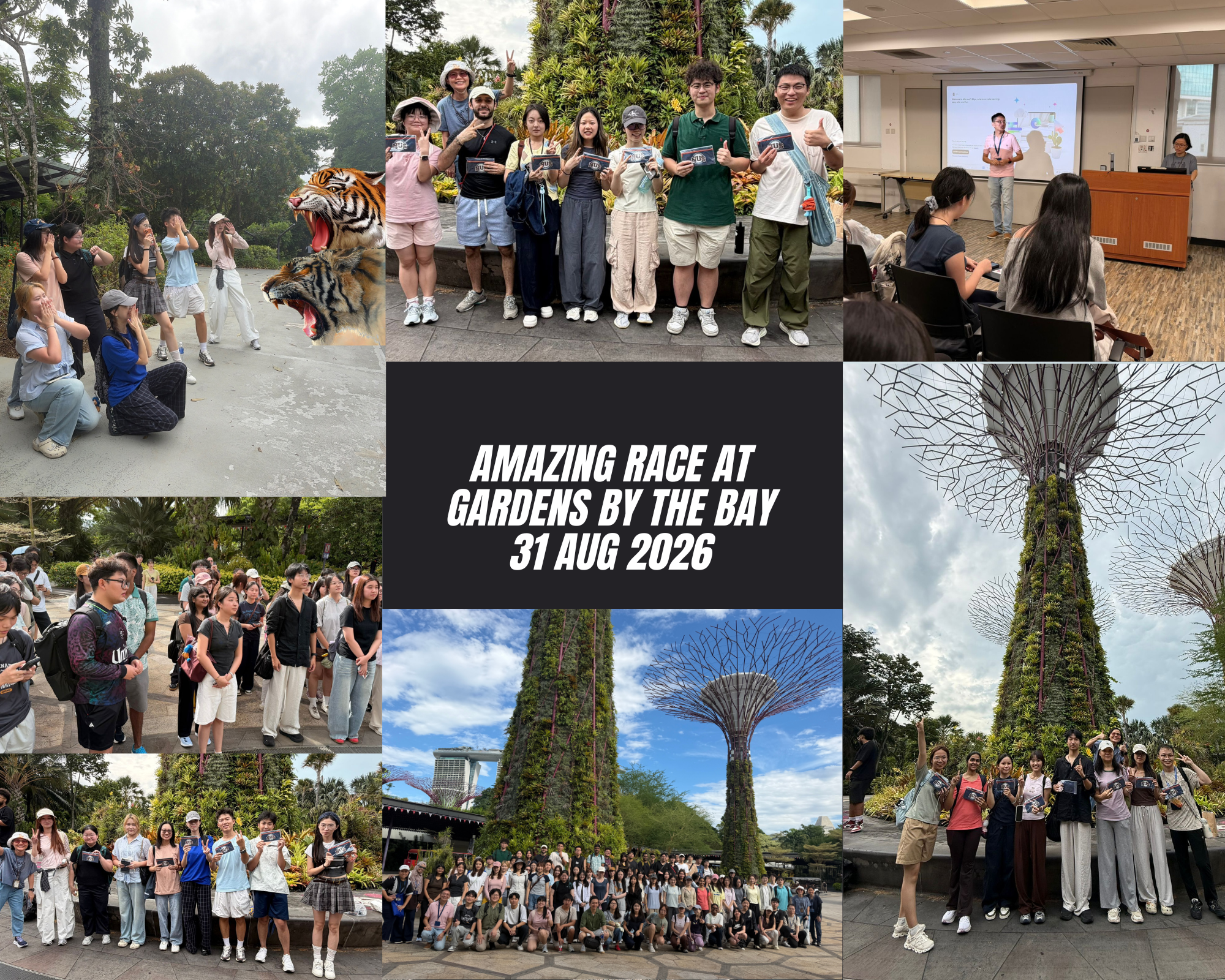
On 31 August 2026, students from the MSc in Chemical Engineering (CHE), MSc in Safety, Health and Environment (SHE) Technology, MSc in Energy System (ES) came together for their first combined orientation at Gardens by the Bay.
The orientation featured an Amazing Race-style team activity, with students placed in mixed groups and using an interactive app to complete challenges, explore the gardens and learn about local plant species.
The activity encouraged teamwork and interaction among students from different programmes. For the predominantly international cohort, it also provided a fun and informal opportunity to familiarise themselves with Singapore and practise using English in everyday interactions.
More importantly, bringing the three programmes together helped foster a shared sense of collective identity and belonging within the Department of Chemical and Biomolecular Engineering (ChBE), providing a positive start to the new academic year and strengthening the wider student community.

A Very Warm Welcome Tea
5 August 2026, 11am
E-Cubes Foyer
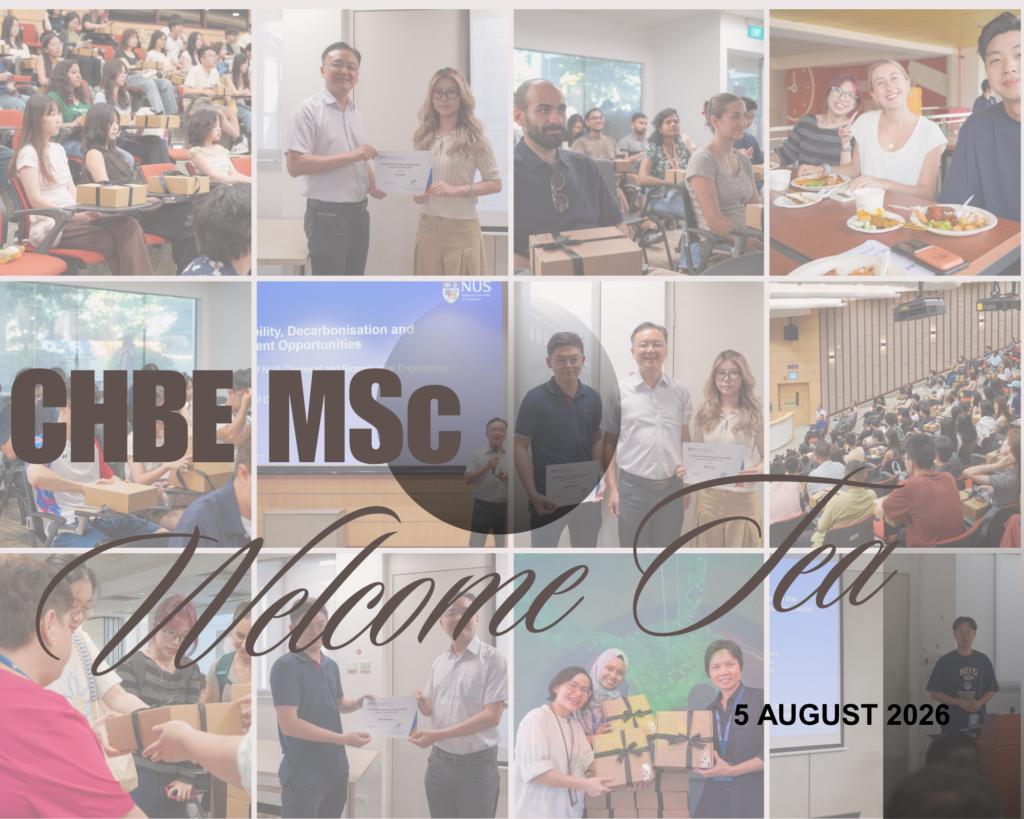
A total of 315 new MSc students from various nationalities joined the Department of Chemical and Biomolecular Engineering (ChBE) for the August 2026 intake, each bringing distinct educational backgrounds and personal aspirations.
During the Welcome Tea on 5 August 2026, students came together over a buffet lunch and had the opportunity to hear learn more about their journey ahead. Associate Professor Yang Kun-Lin, Deputy Head of ChBE, welcomed and shared with the students on the current competitive job market. He highlighted how the department's industrial attachment opportunities allowed international students to gain practical exposure and build relevant industry experiences in Singapore. He encouraged students to actively seek internship opportunities during their studies in NUS.
Associate Professor Jangam Sachin Vinayak provided an overview of the campus resources and student support systems available throughout their time at NUS, covering study facilities, administrative support, health and wellness services, and recreational activities. He encouraged students to not only do well academically but to also embrace and enjoy their student life at NUS.
The event served as an initial step for the new cohort to connect with teaching staff, meet fellow classmates, and familiarise themselves with the university's communities. Overall, it was a positive event marking a great start for ChBE MSc students of August 2026 intake.

Welcome Tea for MSc Cohorts 2026
7 January 2026, 12pm
E-Cubes Foyer
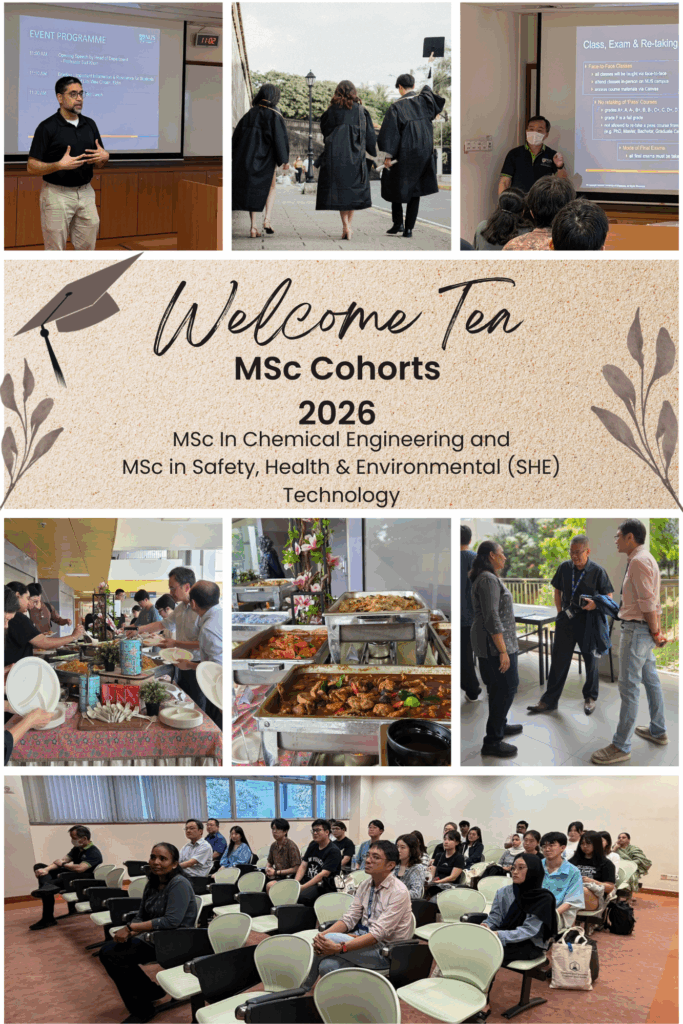
On 7 January 2026, the Department welcomed the new cohorts of the MSc in Chemical Engineering and the Master of Science in Safety, Health and Environmental (SHE) Technology. The session introduced essential academic and student support resources, offered guidance on navigating life at the National University of Singapore, and pointed students to ways to seek assistance.
Students also experienced Singapore’s distinctive Peranakan cuisine through a curated buffet lunch. The Welcome Tea was both informative and engaging, giving students a valuable opportunity to connect with their cohort peers and future lecturers in a welcoming environment.

Combined MSc Student Welfare Event
11-13 November 2025
E-Cubes Foyer
The combined student welfare activity was held at the E‑Cubes foyer from 11–13 November 2025. Melvados cookie hampers were distributed to students from the MSc Chemical Engineering, MSc Energy System, and MSc Safety, Health and Environment Technology programmes to wish them well for the upcoming exam weeks.
At the same time, students completed a survey to share feedback on their academic experience. These inputs will help us identify areas for improvement within each programme.
Thank you to everyone who joined us and contributed your views. Your feedback is invaluable, and we will use it to enhance student support and teaching delivery. We wish all students the very best for your exams.
See you at the future welfare events!

| Department office | Ms. Sharon Lum chelums@nus.edu.sg |
| College of Design & Engineering Postgraduate Coursework Engineering | CDEGradCoursework@nus.edu.sg |