
Solar-driven biohybrid systems could one day use sunlight, semiconductor materials and living cells to produce useful chemicals. But designing them more effectively requires a clearer understanding of what happens at the tiny interface where biological and artificial components meet.
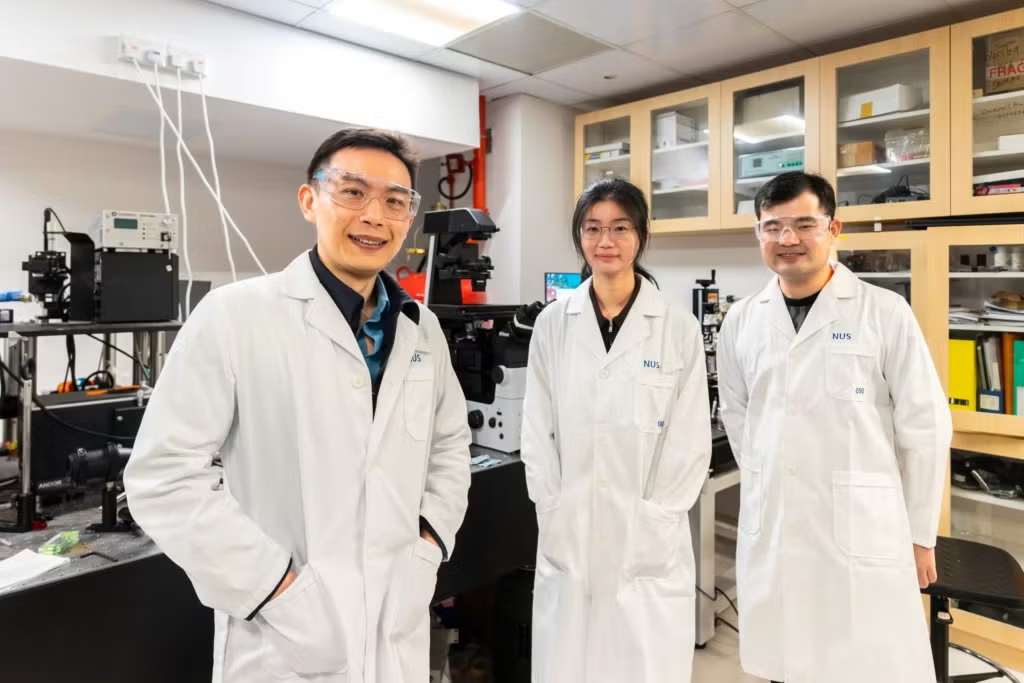
Researchers have developed an imaging platform that can track electron transfer between individual bacterial cells and single semiconductor particles. The study was led by Assistant Professor Mao Xianwen with Professor Liu Bin, alongside Dr Liu Yong, Dr Song Wentao and Dr Zhang Weidong contributing equally as co-first authors.
The team studied how Shewanella oneidensis MR-1, an electroactive bacterium, interacts with particles of haematite, a stable iron-oxide semiconductor. By identifying where each bacterium attached to the particle and measuring the resulting electrical output, the researchers showed that different crystal surfaces, or facets, play different roles in electron transfer.
The study also found that more bacteria are not always better. Electron transfer improved as more cells attached to certain haematite surfaces, but only up to an optimum point. When too many cells accumulated, performance declined, likely because crowding changed how the bacteria organised their electron-transfer machinery.
The findings, published in Nature Catalysis, point towards more rational design of solar biohybrids by showing how crystal facet selection and controlled microbial loading can influence performance. The work could also support research in microbial fuel cells, bioelectronics, bioremediation and other systems where living cells interact with engineered materials.