

As Singapore responds to rising temperatures, growing energy demands and higher expectations for healthy indoor spaces, CDE faculty have played key roles in three new national standards aimed at strengthening the performance and resilience of air-conditioned buildings.
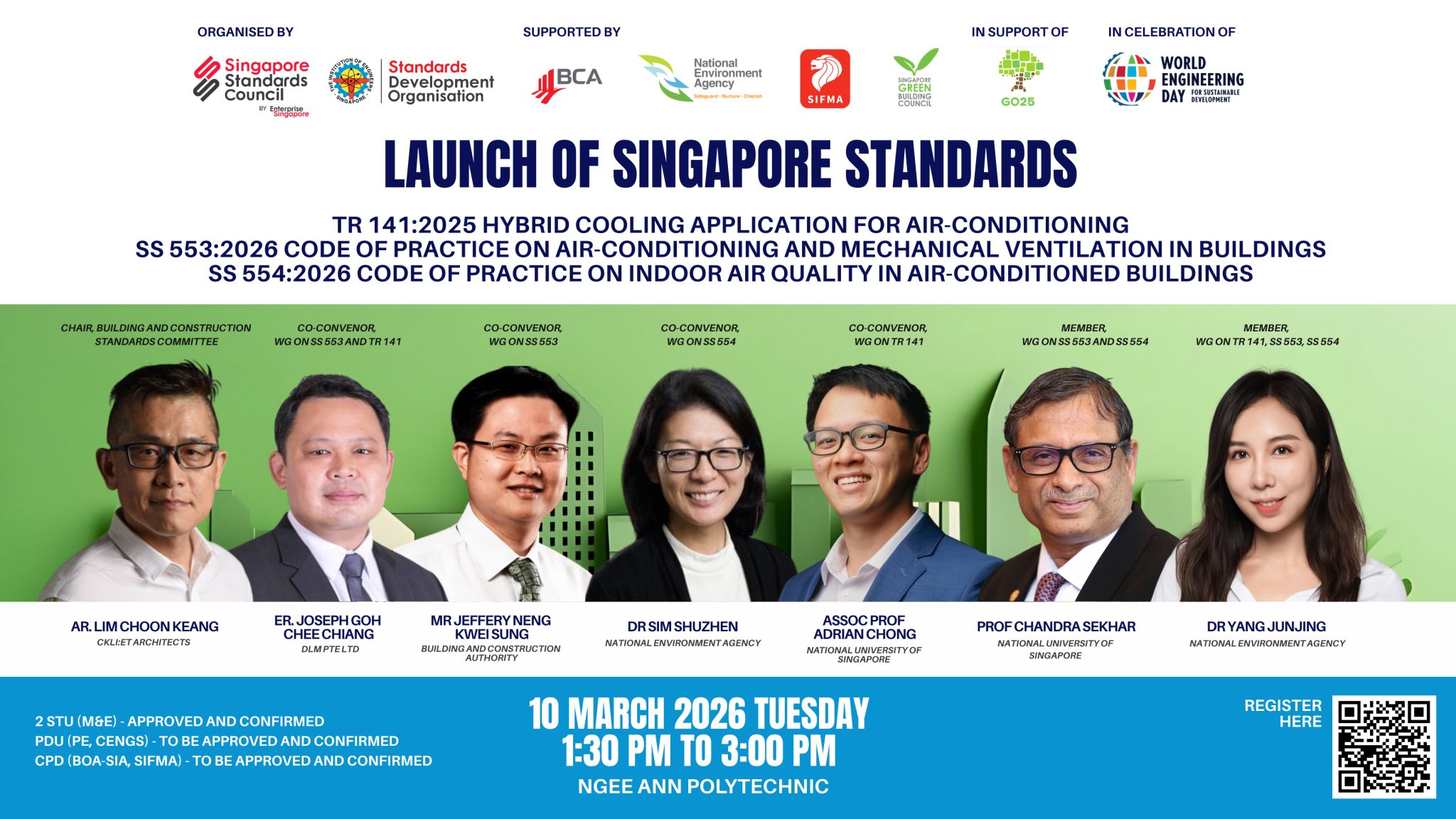
The standards were launched on 10 March at an event marking World Engineering Day, hosted by The Institution of Engineers, Singapore (IES) – Standards Development Organisation (IES-SDO), in collaboration with the Singapore Standards Council.
Prof Chandra Sekhar (NUS Department of the Built Environment), an internationally recognised expert in indoor air quality, ventilation and airborne infection control, served on two working groups that updated Singapore’s codes of practice for air-conditioning and ventilation, and indoor air quality (SS 553:2026 and SS 554:2026). The revised standards strengthen requirements for fresh air supply and filtration, update design conditions based on the latest climate projections, and provide clearer operational guidance for periods of haze or heightened airborne infection risk. Drawing on lessons from the COVID-19 pandemic and aligned with international best practices, they introduce clearer performance targets to support healthier indoor environments while improving energy efficiency.
Assoc Prof Tham Kwok Wai (NUS Department of the Built Environment) was Co-Convenor of SS 554:2026 and a member of the SS 553:2026 working group, while Prof Rajasekhar Balasubramanian (NUS Department of Civil & Environmental Engineering) also served on the SS 554:2026 working group.
Assoc Prof Adrian Chong (NUS Department of the Built Environment), whose research focuses on sustainable and energy-efficient building design and operations, served as Co-Convenor of the working group that developed Singapore’s new Technical Reference on hybrid cooling (TR 141:2025). The guidance promotes a more energy-efficient cooling strategy that combines slightly higher indoor temperatures with increased air movement, such as from ceiling fans, to maintain comfort while reducing energy use.
Mr Bertrand Lasternas, formerly with CDE and Energy Manager of SDE4 and now with University Campus Infrastructure, was also a member of the TR 141:2025 working group.
Together, these standards demonstrate how CDE and NUS expertise translates into real-world impact, shaping the technical benchmarks that influence how Singapore’s buildings are cooled, ventilated and prepared for the future.