
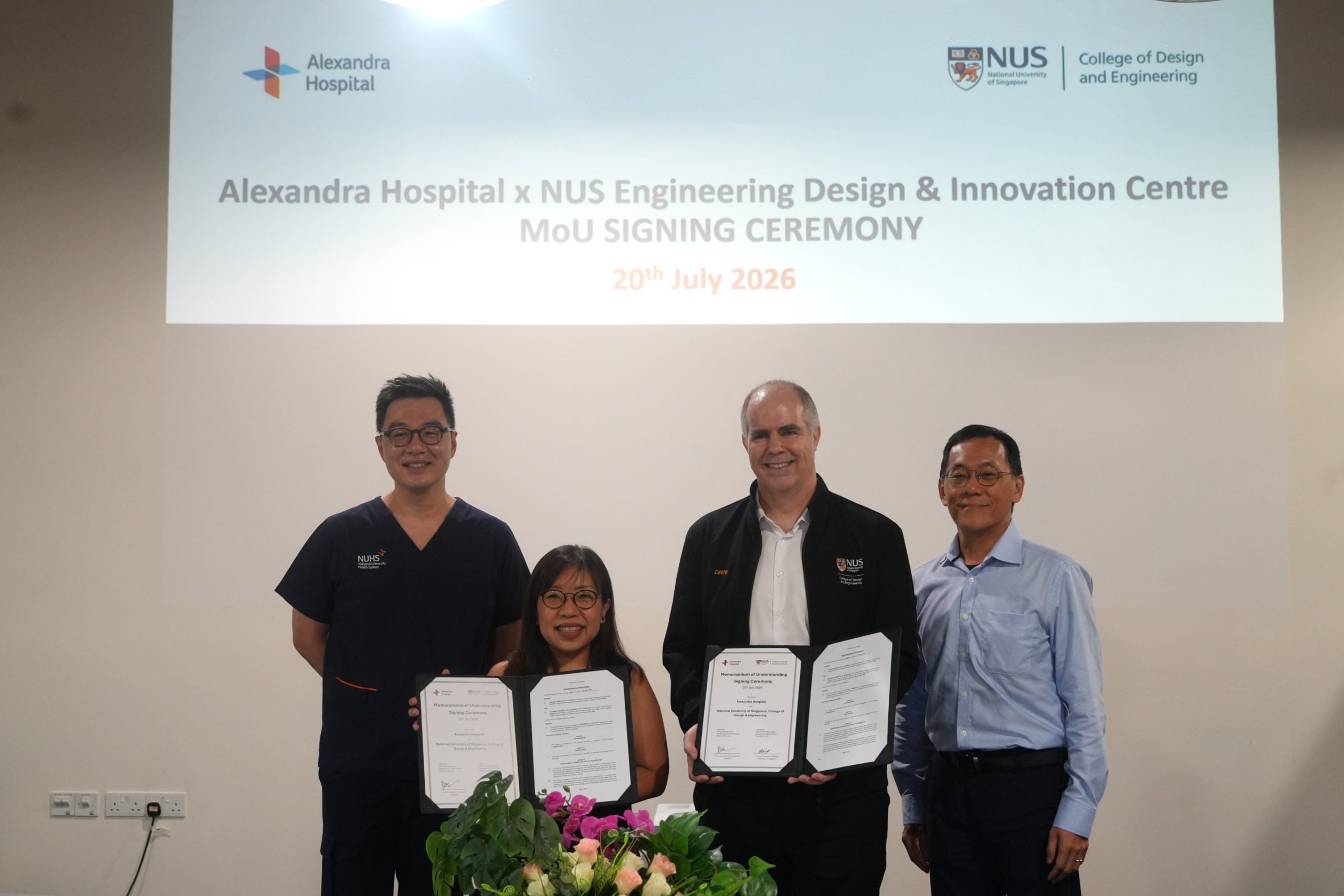
The NUS Engineering Design and Innovation Centre (EDIC) at CDE has signed a Memorandum of Understanding (MOU) with Alexandra Hospital, Singapore to strengthen collaboration in healthcare innovation.
The partnership opens up exciting opportunities for students to work on real-world healthcare challenges, developing a pipeline of innovation projects with the potential to be implemented within Alexandra Hospital and the wider NUHS ecosystem. The three key areas of collaboration are:
Clinical Sandbox – Alexandra Hospital’s Living Lab and Smart Wards will serve as a real-life testing ground for student-developed prototypes.
Virtual Frontier – Students will have opportunities to contribute to the hospital’s Virtual Hospital concept, helping to address complex challenges in remote patient management and digital health engagement.
Future Workforce – Students will also be involved in Healthcare Workforce of the Future initiatives, including the design of AI-enabled tools to improve and redesign staff workflows.
Designing for smart wards, virtual care and future workflows
This builds on ongoing collaborations already underway between CDE students and Alexandra Hospital. Students from Engineering and Architecture are currently exploring solutions such as cuffless blood pressure monitoring, wearable technologies for vital signs monitoring, and vision- and sensor-based patient monitoring for smart wards.
Their projects address pressing clinical and operational needs, including continuous monitoring for patients at risk of sudden blood pressure changes, reducing the manual workload involved in routine vital signs collection, and developing low-cost, scalable and privacy-focused approaches for ward-based patient monitoring.
Many of these innovations also reflect the impact of the Innovation and Design Programme (iDP) — supported by EDIC — which brings students from different disciplines together to tackle real-world challenges through hands-on design, technology and entrepreneurship.
Dr Yen Shih-Cheng, Director (Engineering Design and Innovation Centre), said, “One of the most valuable aspects of this collaboration is the opportunity to bring education and practice closer together. When students are exposed to real constraints, real users and real systems, they develop a much sharper sense of what it takes to create solutions that are relevant and usable.”