

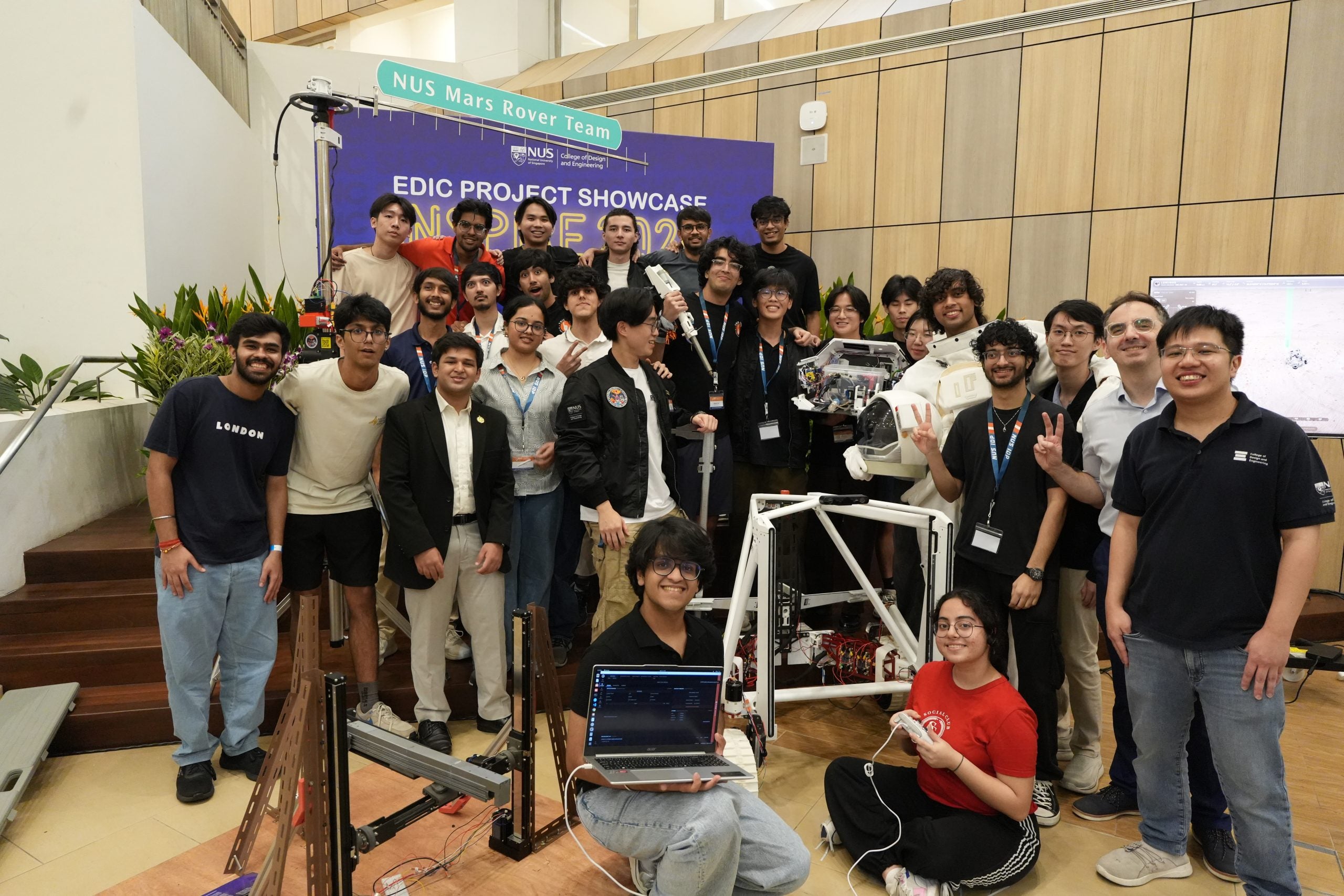
From a home-use device designed to make treatment for a chronic medical condition more accessible to an innovative rental solution, four student projects were recognised for their outstanding work at EDIC INSPIRE 2026, held at the NUS College of Design and Engineering (CDE) on 13 November.
Smart Rental Box, an automated self-service tennis training system, received the Best Concept Award; Exoskeleton in Home SCI Care, a prototype designed to help people with lower-limb paralysis put on an exoskeleton and stand with greater independence, took home the Best Prototype Award; Before It Was Blue, an interactive experience exploring traditional porcelain craftsmanship through touch and simulated warmth, was named Most Innovative Project; while FreeStryde, a device being developed to support lymphedema treatment, received the Most Impactful Project Award.
The four winning projects were among 50 student innovations showcased at the event, spanning healthcare, sustainability, human-centred AI and interactive technologies.
Organised by the Engineering Design and Innovation Centre (EDIC), the showcase featured projects developed through three courses: CDE3301 Ideas to Proof-of-Concept, CDE5311 Designing UX/UI for Human-Centred AI, and CDE5312 Beyond the Surface: Exploring Interactive Wearables.
The event gave visitors an opportunity to explore working prototypes, meet the student teams behind them and discover how ideas had been developed and refined through one or two semesters of experimentation.
“The breadth and quality of projects on display this year are particularly impressive, reflecting the creativity of our students and their ability to apply what they have learned to real-world challenges,” said Dr Yen Shih-Cheng, Director of the Engineering Design and Innovation Centre.

Spotlight on student innovations
For students taking CDE3301 Ideas to Proof-of-Concept, innovation involves understanding users' needs, testing assumptions and adapting when initial solutions fall short.
The five Biomedical Engineering students behind FreeStryde initially developed a smart compression device to help people manage lymphedema, a chronic condition that causes swelling. But patient interviews revealed that the stigma associated with wearing compression devices remained a significant barrier.
The team changed direction, developing a home-use device based on Manual Lymphatic Drainage, a specialised massage therapy that promotes lymphatic drainage. Early testing has shown promising results, and the project has also received recognition at three innovation competitions.
"We learnt not to fall in love with our solutions, but with the problems we are trying to solve," said Sarah Tan, a Biomedical Engineering student.

FridgeMind, developed by students from three different disciplines, is a web app helping households reduce food waste through grocery tracking, expiry reminders and recipe suggestions.
User feedback prompted improvements including a Chinese-language option and personalised progress reports. But attracting users proved challenging, leading the team to launch a Bingo challenge and targeted publicity that increased its user base by 60%.
"We realised that building a useful app wasn't enough of a push factor. We also had to understand what would motivate people to sign up and make it part of their everyday routines," said John Xu, an Electrical Engineering student.

Meanwhile, five Mechanical Engineering students known as The Beach Boys are developing an electric rover to collect litter from wet and dry sand.
Their solution uses a rotating drum to separate sand from debris, overcoming the clogging problems of conventional sieving mechanisms. But development has involved setbacks, including a first full test that revealed six separate problems.
"Seeing so many things go wrong in our first full test was frustrating, but each problem gave us something specific to improve," said Jeon Wonje, a Mechanical Engineering student.
The project was also a finalist in the EUREKA track at CDE Innovation Day 2026.

Designing AI around human needs
Projects from CDE5311 Designing UX/UI for Human-Centred AI explored how artificial intelligence can be designed around the needs and experiences of the people using it.
Temmie is an AI-assisted menstrual health tracking tool designed to help women better understand how their symptoms relate to everyday habits, including sleep, nutrition and exercise.
Developed by a team of three students, the app allows users to document their experiences and uses AI to identify potential patterns, generating accessible summaries that could also help them communicate their concerns during healthcare consultations.
"During our research, we discovered that many women struggled to find a suitable way to record their experiences," said Jia Xuan Ler. "The most rewarding moment was during user testing, when participants asked us to launch Temmie so they could use it themselves."


Wild Whispers, created by Yunzhu Pu, is a nature-themed mystery game that transforms the NUS campus into an interactive adventure. Guided by a mobile web app, players follow the journal of a missing naturalist, solving puzzles and discovering local plants and wildlife along the way.
AI-powered image recognition allows players to photograph and identify species to unlock clues, encouraging them to explore their surroundings rather than simply follow instructions on a screen.
"The biggest challenge was making the game engaging without keeping players glued to their screens," said Yunzhu Pu, a Master of Science in Engineering Design & Innovation student. "Developing it became an exploration for me too. I discovered fascinating ecological stories and noticed details around campus that I had previously overlooked."

Exploring new possibilities for interactive wearables
Students taking CDE5312 Beyond the Surface: Exploring Interactive Wearables explored how technology can create new ways for people to interact with their surroundings and experience the world.
Dragon Claw Challenge is an interactive museum exhibit that brings the dragons depicted on traditional Chinese blue-and-white porcelain to life through hand gestures.
Inspired by artefacts at ArCH Square Museum, the project allows visitors to explore the symbolism of dragons and their claws, before using gestures to summon animated clouds, rain and thunder. A camera tracks their hand movements, while sound and haptic feedback bring the experience to life.
"We wanted visitors to discover the stories behind these artefacts through play, rather than simply looking at them," said Hsu Hsin-Wei. "Our biggest challenge was making the gestures work reliably for different people, so everyone could enjoy the experience."

OceanFeel is a multisensory experience designed to make marine-life discoveries more accessible to people with visual impairments.
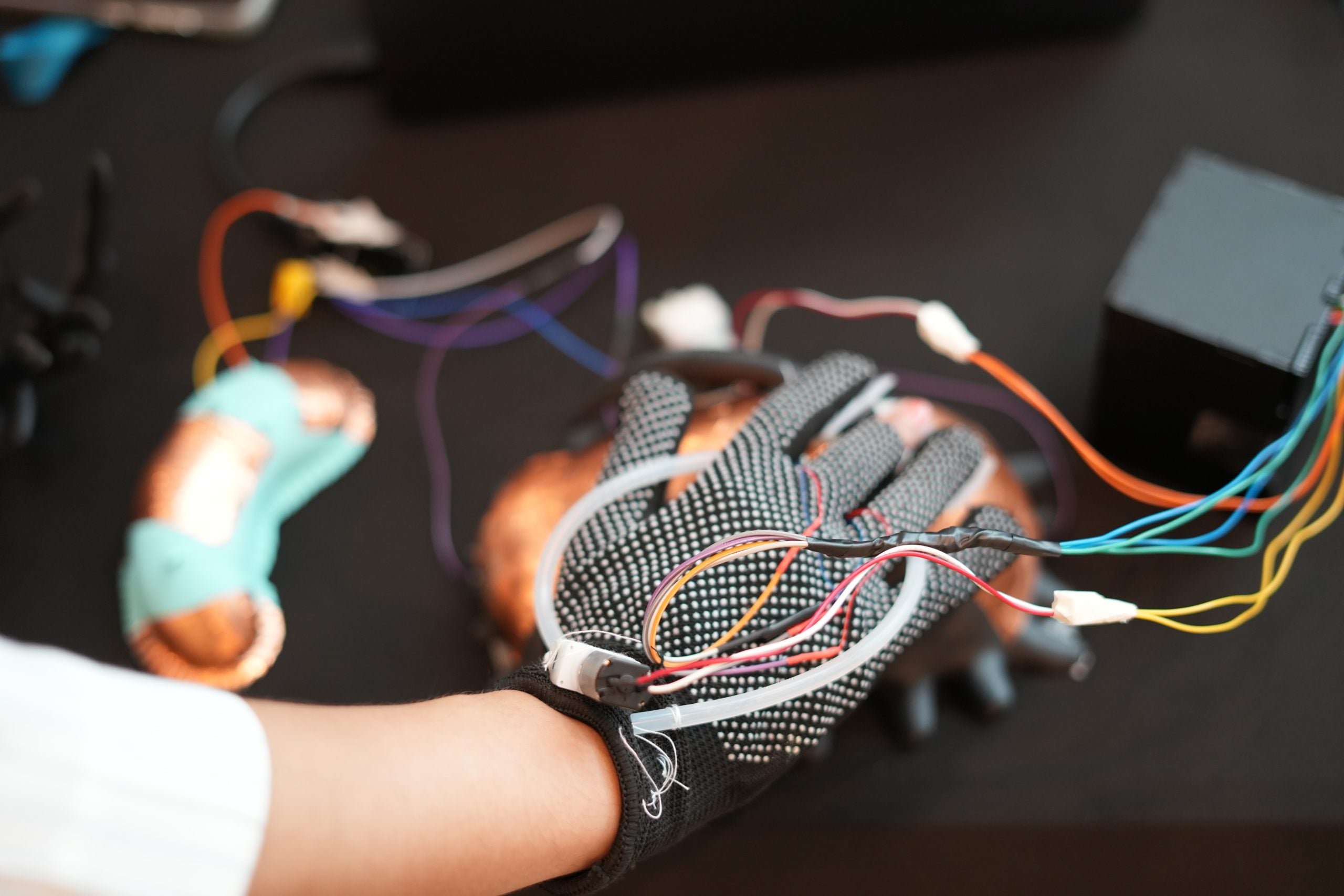
Inspired by a visit to an OceanX exhibition, the team developed an interactive sea cucumber model and a wearable glove that uses vibrations and inflatable airbags to simulate different textures and movements. Touching parts of the model also triggers audio descriptions, allowing users to explore marine life through sound and touch.
"We realised that being together at an exhibition doesn't necessarily mean everyone can share the same experience," said Ziwen Li, speaking on behalf of the team. "We wanted to explore how touch and sound could help make these discoveries accessible to more people."
Beyond showcasing the final prototypes, EDIC INSPIRE 2026 highlighted the learning and experimentation behind each project. From understanding users’ needs to overcoming technical challenges and refining initial ideas, the students’ experiences demonstrated how engineering and design education extends beyond the classroom, equipping them to approach real-world problems with creativity, adaptability and a willingness to learn from setbacks.